
Pet Food Packaging Specifications: What to Include in a Supplier RFQ
A useful pet food packaging RFQ should define more than bag size, artwork and order quantity. Buyers should specify the product and fill weight, pouch construction, dimensions, material requirements, closures and handling features, artwork quantities, performance expectations, compliance documentation, testing requirements and commercial terms.
The objective is not simply to get a price. It is to make sure different suppliers are quoting a comparable package.
Two quotations can show very different unit prices because the suppliers have made different assumptions about film structure, thickness, zipper type, testing, packing method or compliance documentation. Unless these differences are identified before sampling, the lower quotation may not represent the same packaging specification.
If you’d like a closer look at the pouch formats, materials, printing options and features available for pet food projects, see our custom pet food packaging options.
1. Start With the Product and Fill Weight, Not Just the Bag Dimensions
A specification such as “3.5 kg pet food bag, 260 × 530 × 120 mm” is more useful than dimensions alone because it connects the package to its intended load. But even that is only a starting point.
The RFQ should identify the product type, nominal fill weight, target dimensions, product density or filled volume if known, filling method, required headspace, storage conditions, distribution conditions, target shelf life and destination market.
Weight and volume are not interchangeable. Two pet foods weighing 1.5 kg can occupy different volumes because kibble size, shape and density differ. The package also needs sufficient usable space for filling, the zipper, gussets and final heat seal.

Need more help working out the right pouch size for your product? See our pouch size guide for a closer look at the factors that affect bag dimensions and capacity.
When an existing bag is available
Send the supplier a physical sample or a dimensioned drawing whenever possible. The drawing should identify finished width and height, gusset dimensions, filling opening, zipper position, handle position, seal areas, tear notch and bottom construction where applicable.
A photograph can help communicate the general package concept, but it should not be used to guess material structure, thickness or exact finished dimensions.
2. Define the Bag Construction and Functional Features Precisely
“Pet food bag with zipper” leaves too much room for interpretation. A useful RFQ should identify the intended pouch construction and the functional features that matter during filling, retail use and distribution.
Depending on the project, these may include a stand-up pouch, flat-bottom pouch, side-gusset or quad-seal construction, bottom gusset, pocket or resealable zipper, carrying handle, tear notch, top filling arrangement, surface finish or anti-slip requirement.
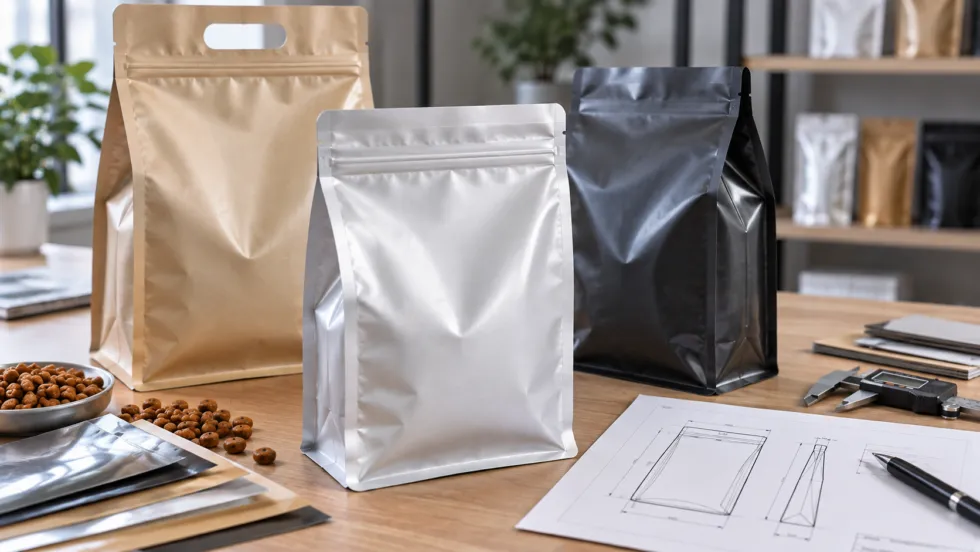
For example, a flat-bottom pouch and a stand-up pouch can both work for pet food, but neither format is universally better. The choice depends on fill weight, product volume, filling equipment, handling requirements, retail presentation and distribution conditions.
If you’d like to compare the two formats in more detail, take a look at our flat-bottom pouches and stand-up pouches before deciding which construction to specify.
A bag name is not a manufacturing drawing
Terms such as “flat bottom,” “quad seal” or “stand-up pouch” are useful for defining the general concept, but they do not fully define the finished package. An approved dimensioned drawing is still important, particularly for larger pet food packs where gusset geometry, sealing areas, zipper position and handles affect filling and handling.
3. Treat the Material Structure as a Specification, Not Just a Material Name
Pet food packaging may use structures such as PET/PE, PET/VMPET/PE, PET/AL/PE, PET/NY/PE or other laminated and application-specific structures. These examples are starting points, not universal recommendations.
A flexible laminate performs as a system. Different layers may contribute to printing, mechanical strength, barrier performance and heat sealing.

Material selection therefore needs to consider moisture sensitivity, oxygen sensitivity, oil or fat content, aroma retention, light sensitivity, kibble shape and puncture risk, fill weight, filling and sealing conditions, storage, distribution and target shelf life.
A dry biscuit product, an oily meat treat and a large bag of hard-edged kibble may create very different packaging requirements even when all three are described as pet food.
Want a more detailed look at how pouch materials, printing and functional features come together in a custom packaging project? See our custom flexible pouch guide.
Be careful with “equivalent” material substitutions
If a supplier proposes an alternative structure, ask what is changing, why the change is being recommended and which required performance characteristics are expected to remain equivalent.
Also clarify whether the alternative requires new testing or sample approval. The decision should be based on application performance rather than the word “equivalent” alone.
4. Do Not Use Thickness Alone to Judge Pet Food Bag Performance
A thicker bag is not automatically a better bag. Performance depends on the complete laminate structure, the function of each layer, finished dimensions, filled weight, seal design, zipper or handle construction, product shape and the stresses created during handling and distribution.
For example, “120 micron bag” is incomplete as a technical description if the laminate structure and intended application are not defined.
Likewise, reducing thickness to lower unit cost can create problems if the revised structure is not validated against the actual product and distribution conditions.
When the structure and thickness are already known, state both in the RFQ. Then define the required performance separately rather than assuming thickness alone guarantees it.
5. Define Barrier and Performance Requirements Before Requesting Test Data
OTR and WVTR data can be useful when oxygen or moisture barrier performance matters, but a number without test context can be misleading.
OTR describes oxygen transmission through a material under defined test conditions. WVTR describes water-vapor transmission under defined conditions. The important phrase is under defined conditions.

When barrier performance matters, confirm the tested material structure, test method, test conditions, units and whether the report or sample identification corresponds to the structure being quoted. Do not assume a numerical value from a generic description such as “high barrier.”
Other performance requirements may include seal strength, lamination or bond performance, leakage resistance, puncture resistance, drop performance, handle strength, zipper function and filled-package stability.
The appropriate list depends on the failure modes that could create a commercial problem for the specific project.
If you’d like to see what supporting documentation may be available during supplier evaluation, visit our certificates and test reports page. For your RFQ, still confirm that the specific report, material structure and test scope apply to your project.
6. Build the Compliance Document List Around the Destination Market
“Food grade” is not a complete regulatory specification. Required documentation depends on the destination market, food-contact material, intended use and the buyer’s own qualification procedures.
For an EU-market project, for example, buyers may need to consider the general food-contact framework under Regulation (EC) No 1935/2004, applicable good manufacturing practice requirements and the rules that apply to plastic food-contact materials under Regulation (EU) No 10/2011.
Migration and compliance documentation may therefore form part of supplier qualification rather than being requested only after the order is placed.
| Document or Requirement | What the Buyer Should Confirm |
|---|---|
| Food-contact documentation | Which material, intended use and destination market are covered |
| Migration report | Tested material, method and scope |
| Material TDS | Whether the documented structure or material applies to the quoted package |
| Ink documentation | Applicable ink system and intended use |
| Restricted-substance declaration | Exact substances and declaration scope |
| Supplier certificate | Legal entity, manufacturing scope and validity |
| Barrier report | Structure, test method and test conditions |
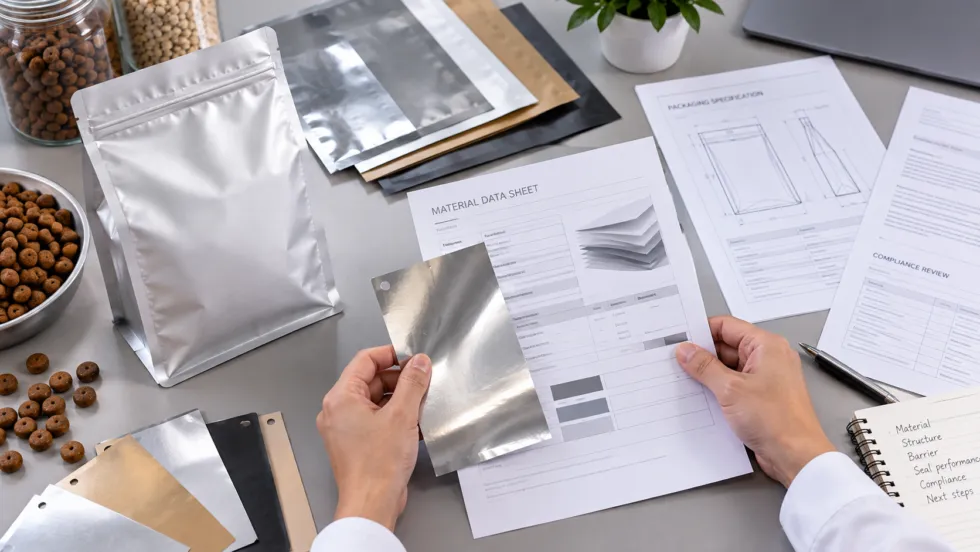
Project-specific requirements may also address substances or topics such as PFAS, mineral oils or REACH-related restrictions where relevant to the buyer, product and destination market.
The key purchasing rule is that one certificate should not be assumed to cover every material structure, every application or every destination market.
Need more detail on the certificates and testing information available from Honghai? Visit our certificates and test reports page, then confirm the documents required for your specific material, application and destination market.
7. Specify Artwork and Quantity by SKU
Total order quantity is not enough when several product variants use the same bag size.
For example, an RFQ that says “80,000 bags total” leaves an important question unanswered. A more useful breakdown would be:
| Bag Size | Artwork / SKU | Required Quantity |
|---|---|---|
| Size A | Chicken | 20,000 pcs |
| Size A | Lamb | 20,000 pcs |
| Size A | Salmon | 20,000 pcs |
| Size A | Puppy | 20,000 pcs |

This matters because artwork count affects printing and production planning even when the physical pouch dimensions are identical.
State the number of artworks, required quantity for each artwork, total project quantity, whether variants involve only minor text or color changes or substantially different graphics, and the expected repeat-order pattern if known.
Honghai supports both digital and rotogravure printing. For custom premade pouches, the standard MOQ starts from 1,000 pcs. For projects involving several designs or SKUs, provide the required quantity for each design so the production arrangement can be confirmed for the actual project.
8. Make Commercial Quotations Comparable
Once the technical specification is aligned, the commercial quotation should also follow a consistent structure.
Ask suppliers to state the quotation quantity tier, quantity per SKU, unit price, Incoterm, FOB port, CIF destination where required, tooling or cylinder charges if applicable, sample options and costs, payment terms, production timing, packing details and quotation validity.
Do not compare an FOB quotation directly with a CIF or landed-cost quotation without separating the logistics assumptions.
Likewise, two unit prices are not directly comparable if one supplier has quoted a different material structure, zipper, printing method, testing scope or packing method.
Unit price is only one part of packaging cost
A lower quoted unit price may not produce a lower total project cost if it creates excess inventory, forces too much quantity into individual SKUs, requires rework, causes filling problems, contributes to leakage or shipping damage, delays a product launch or creates repeated specification corrections.
A well-structured RFQ reduces these ambiguities before price negotiation begins.
9. Use Pre-Production Samples to Validate the Filled Package
An empty sample can confirm dimensions, appearance and some functional details. It cannot validate everything that happens after the bag is filled.
Filling test
Confirm that the opening, gussets and usable internal volume work with the product and filling process.
Sealing test
Check the actual sealing area and process rather than assuming the specified laminate will seal correctly under every filling condition.
Zipper and closure test
Confirm that the closure remains practical after filling and that the zipper position does not interfere with the filling or final sealing process.
Drop and handling test
Evaluate the filled package under handling conditions relevant to its weight and distribution route.
Carton and palletisation evaluation
Check how filled bags fit into cartons, stack and behave during palletisation and transport.
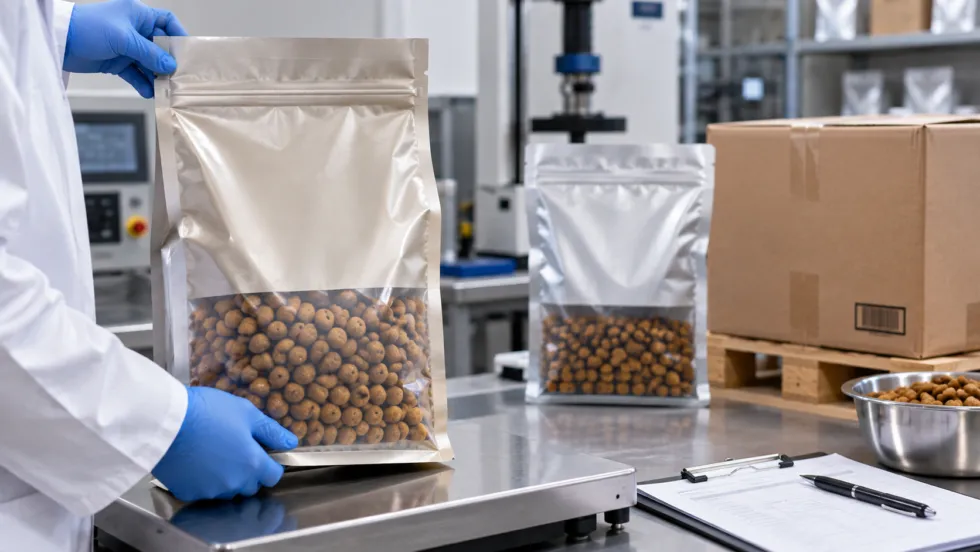
An empty pouch that looks correct is not automatically validated for filling and distribution. That distinction is especially important for heavy pet food bags.
10. Control Specification Changes Before Mass Production
Any approved change should be visible and documented rather than treated as a silent “equivalent” substitution.
Change control may need to cover finished dimensions, gusset dimensions, material structure, thickness, printing, ink system where relevant, zipper, handle, sealing area, surface finish and artwork revision.
A practical approval sequence is:
Approved specification → Approved drawing → Approved sample → Production confirmation.
If the material changes, barrier and sealing performance may need to be reviewed again. If the zipper position changes, filling should be checked again. If a handle changes on a heavy bag, filled-package handling may need to be reassessed.
The purpose is to prevent the approved sample and the mass-production package from gradually becoming different specifications.
Pet Food Packaging RFQ Checklist
- Product: Define the pet food or treat type and relevant product characteristics.
- Fill weight: State the nominal weight for each bag size.
- Bag format: Identify the required pouch construction.
- Dimensions: Provide finished width, height, gussets and other critical dimensions.
- Material: State the required laminate structure when already specified.
- Thickness: Define known thickness requirements without treating thickness as the only performance criterion.
- Barrier requirements: State oxygen, moisture, light or aroma protection needs where relevant.
- Features: Define zipper, handle, tear notch, surface finish, anti-slip or other functional details.
- Printing: Provide artwork information, print expectations and finish requirements.
- SKUs: State the number of artworks and required quantity for each.
- Performance: Define relevant seal, leakage, puncture, drop or handling requirements.
- Compliance: Identify the destination market and required documentation.
- Validation: Define sample, filling, sealing and filled-package approval requirements.
- Commercial terms: Request consistent Incoterms, packing, payment, tooling and production information.
- Change control: Require written approval for specification changes before mass production.
The more clearly these points are defined before quotation, the easier it becomes to compare suppliers on the same technical and commercial basis.
What Should You Send a Pet Food Packaging Supplier for a Quote?
An initial quotation does not require every laboratory requirement to be finalized, but the supplier should receive enough information to avoid guessing the basic package.
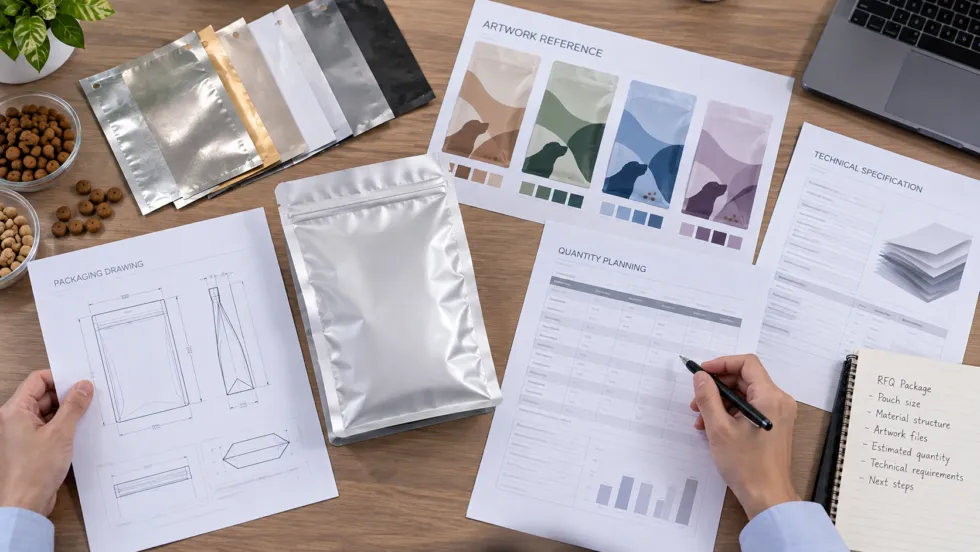
At minimum, send the product type, nominal fill weight, preferred bag format, target dimensions, material structure if already specified, required zipper or handle features, artwork or reference image, number of SKUs, quantity per SKU, destination country, required Incoterm and any mandatory testing or compliance requirements already known.
If the final material or dimensions are not yet confirmed, identify them as technical review items rather than filling the RFQ with guessed specifications.
If you’d like to review available pouch formats, materials, printing methods and functional features before sending your RFQ, see our custom pet food packaging options.
Frequently Asked Questions
What information does a pet food packaging manufacturer need for a quotation?
A useful quotation request should include the product, fill weight, bag format, dimensions, material requirements, functional features, artwork count, quantity per SKU, destination market, required testing or compliance documents and commercial terms. The more variables that remain undefined, the more assumptions the supplier must make.
Should pet food bag MOQ be quoted per size or per artwork?
Ask the supplier to explain how MOQ applies to the actual project and provide both the total quantity and the required quantity for each artwork or SKU. Honghai’s standard MOQ for custom premade pouches starts from 1,000 pcs. For multi-SKU projects, the production arrangement should be confirmed based on the quantity required for each design.
What tests should I request before ordering pet food bags?
There is no universal test list for every pet food package. Depending on the product and risk, buyers may need to review barrier data, seal performance, filled-package behavior, zipper function, leakage, drop performance, handling or palletisation. Testing should be selected according to the package’s actual failure risks.
Do I need OTR and WVTR data for pet food packaging?
That depends on the product’s sensitivity and the barrier requirement. If OTR or WVTR is important to the project, define the test method, conditions, units and tested material structure so the data can be interpreted correctly.
Why should I approve a dimensioned drawing before production?
A dimensioned drawing helps confirm finished size, gussets, zipper position, handle position, sealing areas, opening and other construction details that a bag-format name or photograph may not define precisely.
From RFQ to a Production-Ready Pet Food Bag
A pet food packaging RFQ establishes a common technical baseline for quotation, sampling, validation and production.
A practical sequence is:
Define the product → Define the package → Define performance → Define documentation → Compare quotations → Validate samples → Control the approved specification.
This process reduces the risk of selecting the lowest quoted price only to discover later that suppliers were pricing different packages.
Honghai manufactures custom flexible packaging for pet food and pet treats, including custom pouch formats, sizes, material structures, printing and functional features. Digital and rotogravure printing are available, and the standard MOQ for custom premade pouches starts from 1,000 pcs.
Ready to discuss your project? Visit our custom pet food packaging page to learn more about the available options, then send us your product type, fill weight, preferred bag format, dimensions, material requirements, number of designs and quantity for each design.