
Best Packaging for Dried Fruit: Materials, Pouch Types & Features
Quick Answer
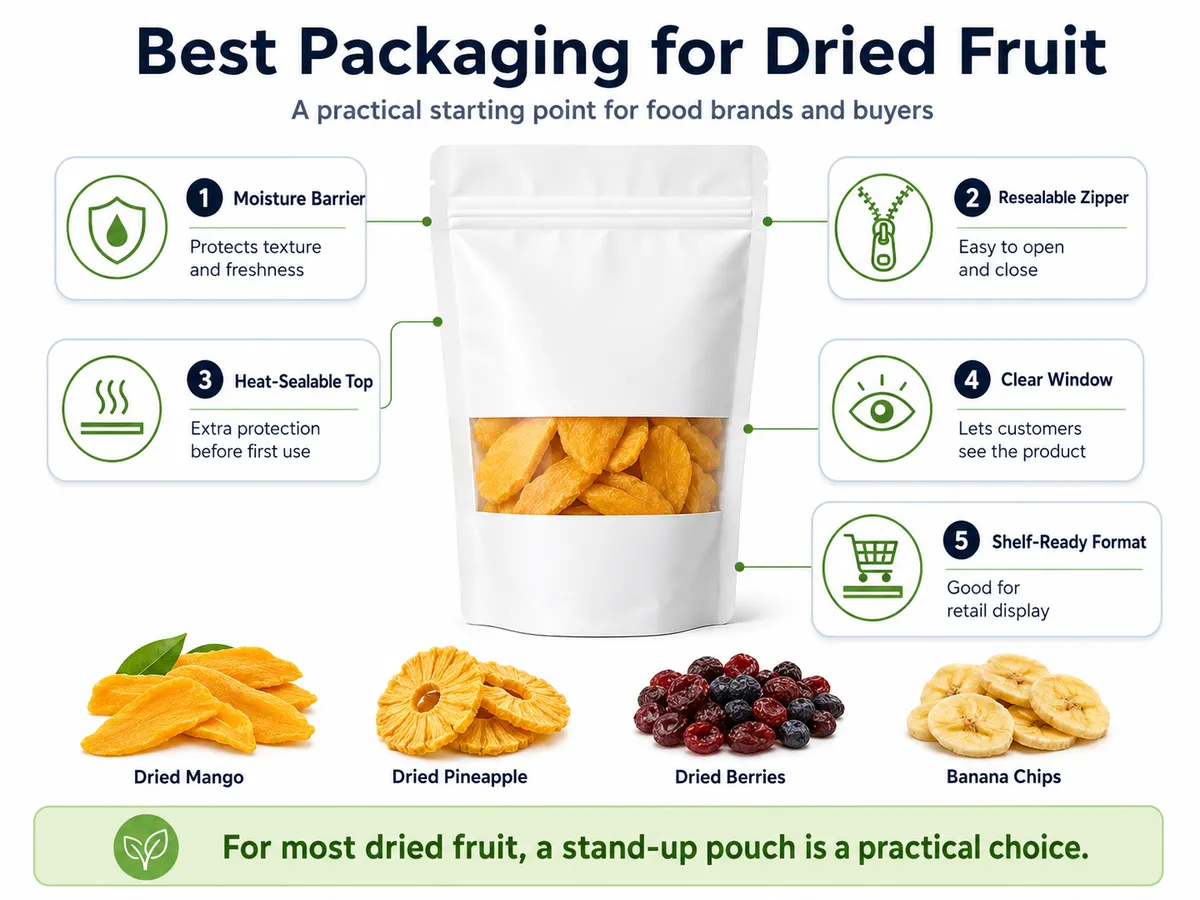
For most dried fruit products, a stand-up pouch with a resealable zipper, heat-sealable top and good moisture barrier is a practical choice.
The best material depends on how much protection the product needs from moisture, oxygen and light.
| Buyer Need | Good Starting Option |
|---|---|
| General dried fruit | PET/PE pouch |
| Better moisture and light barrier | PET/VMPET/PE |
| High barrier protection | PET/AL/PE |
| Natural appearance | Kraft laminated pouch |
| Product visibility | Clear window pouch |
| Repeated opening | Resealable zipper |
| Retail shelf display | Stand-up pouch |
| Premium presentation | Flat-bottom pouch |
There is no single best pouch for every dried fruit.
The right packaging depends on the product, filling weight, shelf life, order quantity and target market.
What Is the Best Pouch Type for Dried Fruit?
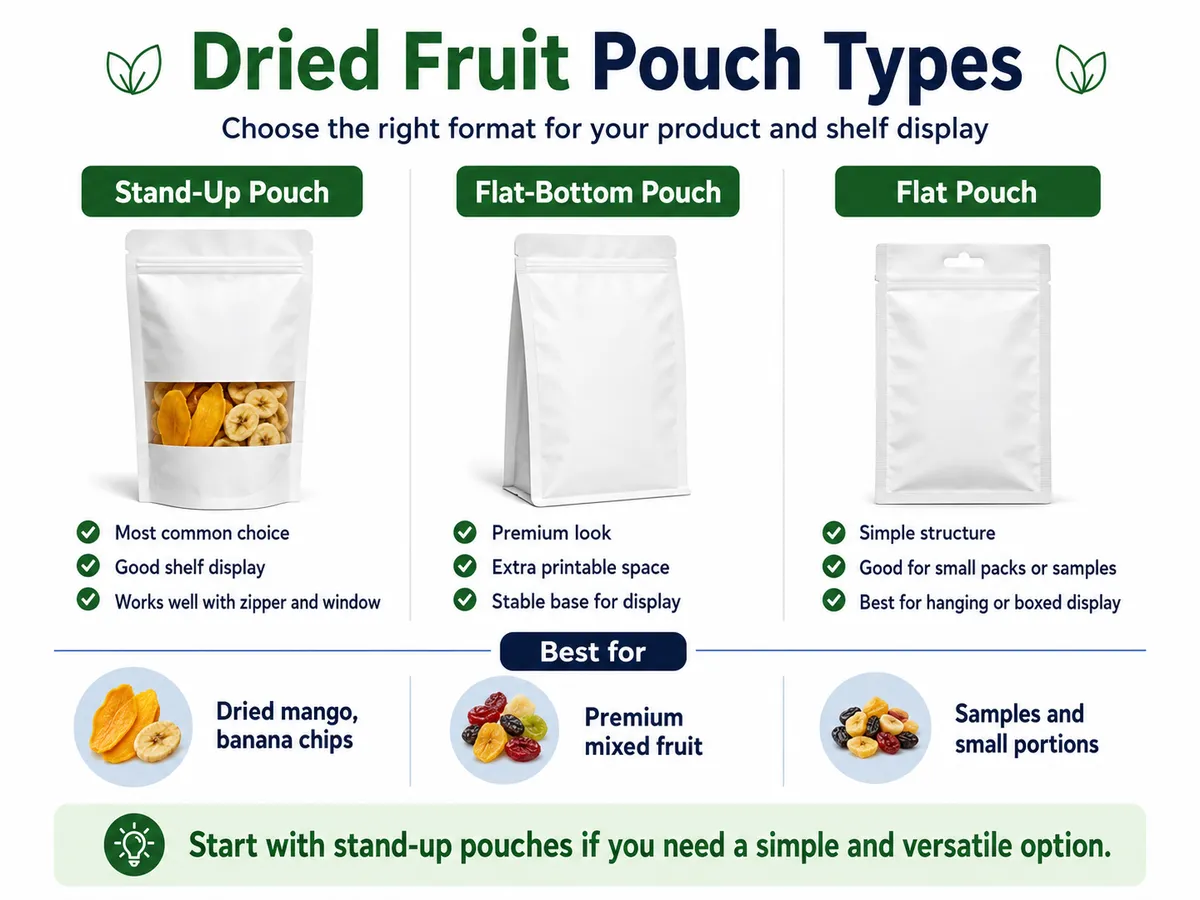
For most retail products, stand-up pouches are the easiest option to start with.
They can include:
- zipper,
- tear notch,
- clear window,
- hang hole,
- matte finish,
- kraft finish,
- or custom printing.
They work well for products such as:
- dried mango,
- dried pineapple,
- banana chips,
- dried berries,
- mixed fruit,
- and fruit snacks.
For a more premium shelf look, flat-bottom pouches are also a good option.
Flat pouches are better suited to small portions, samples or hanging displays.
Why Moisture Barrier Matters
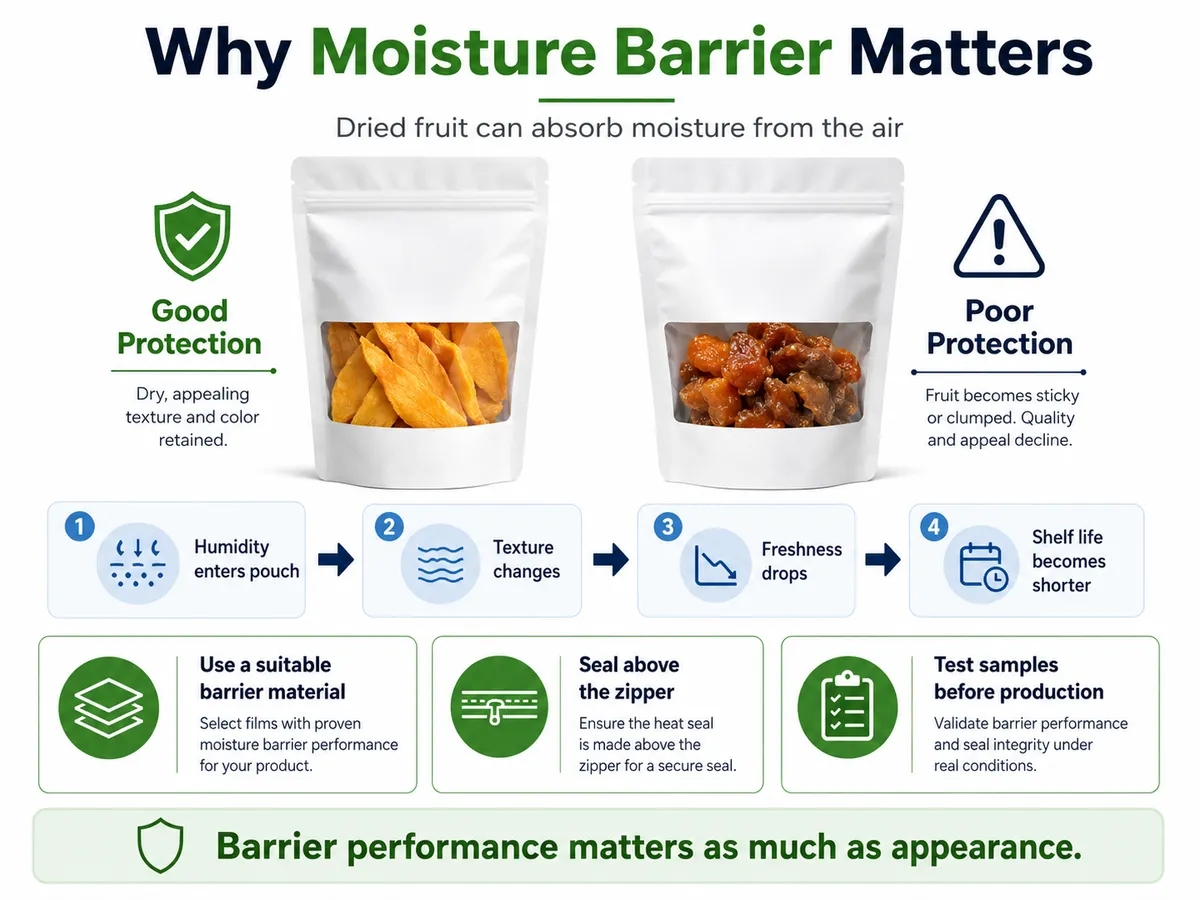
Dried fruit can absorb moisture from the air.
If the packaging does not provide enough protection, the product may:
- become soft,
- become sticky,
- lose texture,
- lose freshness,
- or have a shorter shelf life.
This is especially important for products stored in humid climates or shipped internationally.
That is why buyers should not choose a pouch only by appearance or price.
The material structure matters.
Which Material Should You Choose?
PET / PE
A practical option for many general dried-food applications.
It offers good strength and heat sealing, but may not provide the highest barrier against light or oxygen.
PET / VMPET / PE
A stronger barrier option.
The metallized layer can improve protection from:
- moisture,
- oxygen,
- and light.
It is commonly used for dried fruit, snacks, coffee, tea and powders.
PET / AL / PE
Aluminum foil laminate provides very strong protection from moisture, oxygen and light.
It is useful for products with higher barrier requirements or longer shelf-life targets.
The main limitation is that the pouch is opaque.
Kraft Laminate
Kraft-style pouches are popular with natural and organic food brands.
However, the outer kraft layer is only part of the structure.
The pouch still needs inner layers for sealing, barrier protection and food contact.
Material Comparison
| Material | Moisture Barrier | Light Barrier | Product Visible? |
|---|---|---|---|
| PET / PE | Moderate | Limited | Possible |
| PET / VMPET / PE | High | High | No |
| PET / AL / PE | Very high | Very high | No |
| Kraft laminate | Depends on inner layers | Depends | Optional |
| Clear laminate | Depends on structure | Limited | Yes |
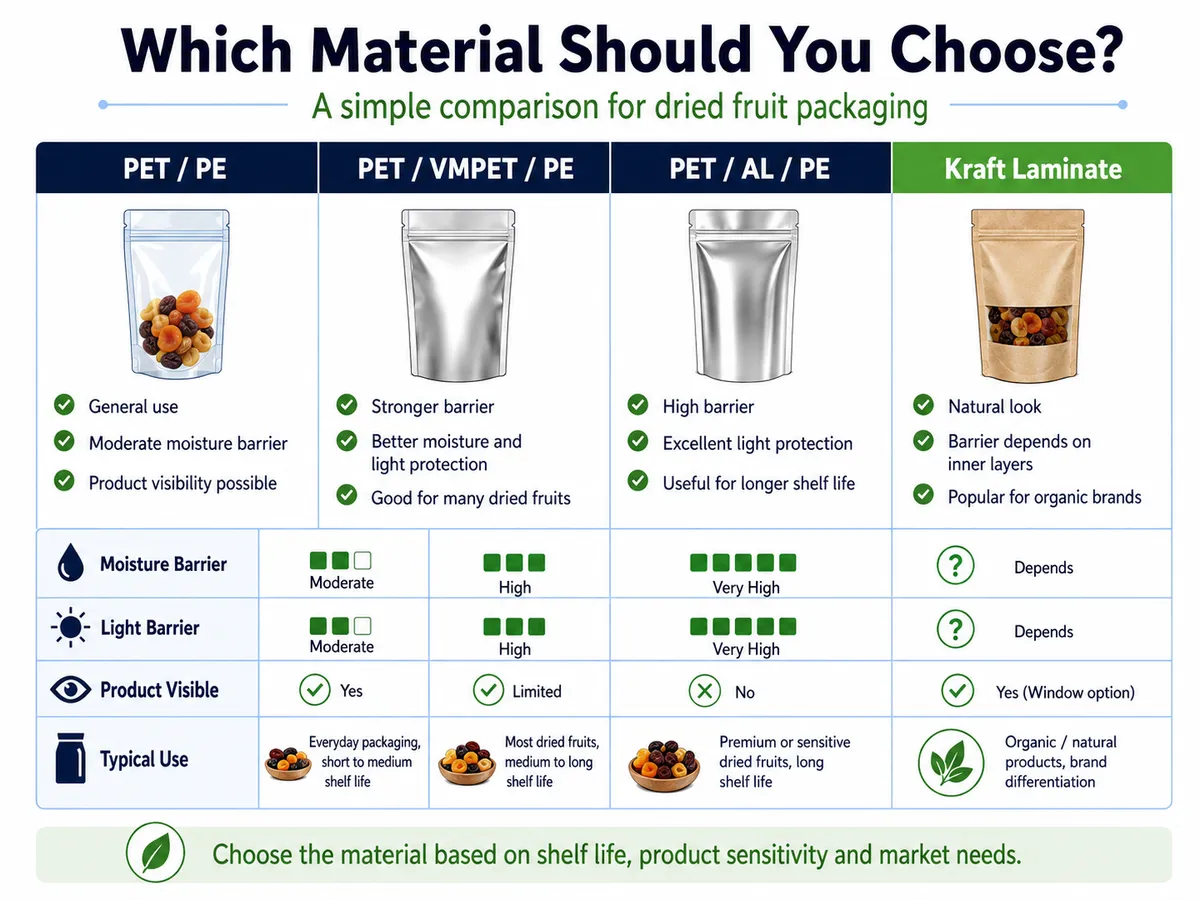
Actual barrier performance depends on the complete laminate structure and thickness.
If shelf life is critical, ask your supplier for the exact material specification.
Should Dried Fruit Pouches Have a Zipper?
For most retail packs, yes.
Customers often open dried fruit several times before finishing it.
A zipper allows the pouch to be closed again after opening.
For better protection before first use, the pouch can also be heat sealed above the zipper.
The two features serve different purposes:
Heat seal: keeps the pouch securely closed before sale.
Zipper: allows the customer to reseal it after opening.
For many dried fruit brands, using both is the better choice.
Is a Clear Window a Good Idea?
A clear window can help customers see the color and quality of the fruit.
This works well for products such as:
- dried mango,
- pineapple,
- berries,
- banana chips,
- and mixed fruit.
However, a transparent window provides less light protection than a fully metallized or foil pouch.
If the product is highly sensitive to light, a fully opaque pouch may be better.
If visibility matters, a small clear window can provide a good balance.
What Size Pouch Do You Need?
Do not choose pouch size by weight alone.
For example:
500g dried mango needs much more space than 500g fruit powder.
The correct dimensions depend on:
- product density,
- fruit piece size,
- filling weight,
- bottom gusset,
- zipper position,
- and filling method.
For a new product, the safest process is:
Choose sample sizes → Fill with the actual product → Check the fit → Confirm final dimensions
This is more reliable than choosing a size from a generic chart.
For more detail, see our 250g, 500g and 1kg Food Pouch Size Guide to learn how product density, gusset size and filling tests affect the final pouch dimensions.
Plain Pouches or Custom Printed Pouches?
Plain Pouches + Labels
A good option if you:
- have several SKUs,
- are testing the market,
- need smaller quantities,
- or change product information often.
Using the same pouch with different labels can reduce packaging inventory.
Custom Printed Pouches
Better suited to:
- established products,
- larger repeat orders,
- stronger branding,
- and retail shelf presentation.
The best choice depends on your order volume and number of designs.
What About MOQ?
MOQ can change depending on:
- pouch size,
- material,
- printing method,
- number of designs,
- and total quantity.
Do not only ask:
“What is your MOQ?”
Ask:
“Is the MOQ per size, per design or for the total order?”
This is especially important if you have several dried fruit flavors or different pack sizes.
Digital printing is often more flexible for multiple SKUs and smaller runs.
Gravure printing is usually better suited to larger and more stable orders.
What Should You Ask a Supplier?
Before placing an order, ask for:
- pouch dimensions,
- material structure,
- thickness,
- barrier level,
- zipper options,
- clear window options,
- MOQ,
- price at different quantities,
- sample availability,
- production lead time,
- shipping cost,
- and food-contact documentation.
A useful quotation should explain what specification you are buying, not just give you a price per pouch.
What Information Should You Send for a Quote?
To get an accurate quotation, send:
- Product: dried mango, pineapple, berries, etc.
- Filling weight: 100g, 250g, 500g, 1kg
- Estimated quantity
- Number of designs or SKUs
- Preferred pouch type
- Plain or custom printed
- Zipper requirement
- Window requirement
- Preferred material or finish
- Destination country
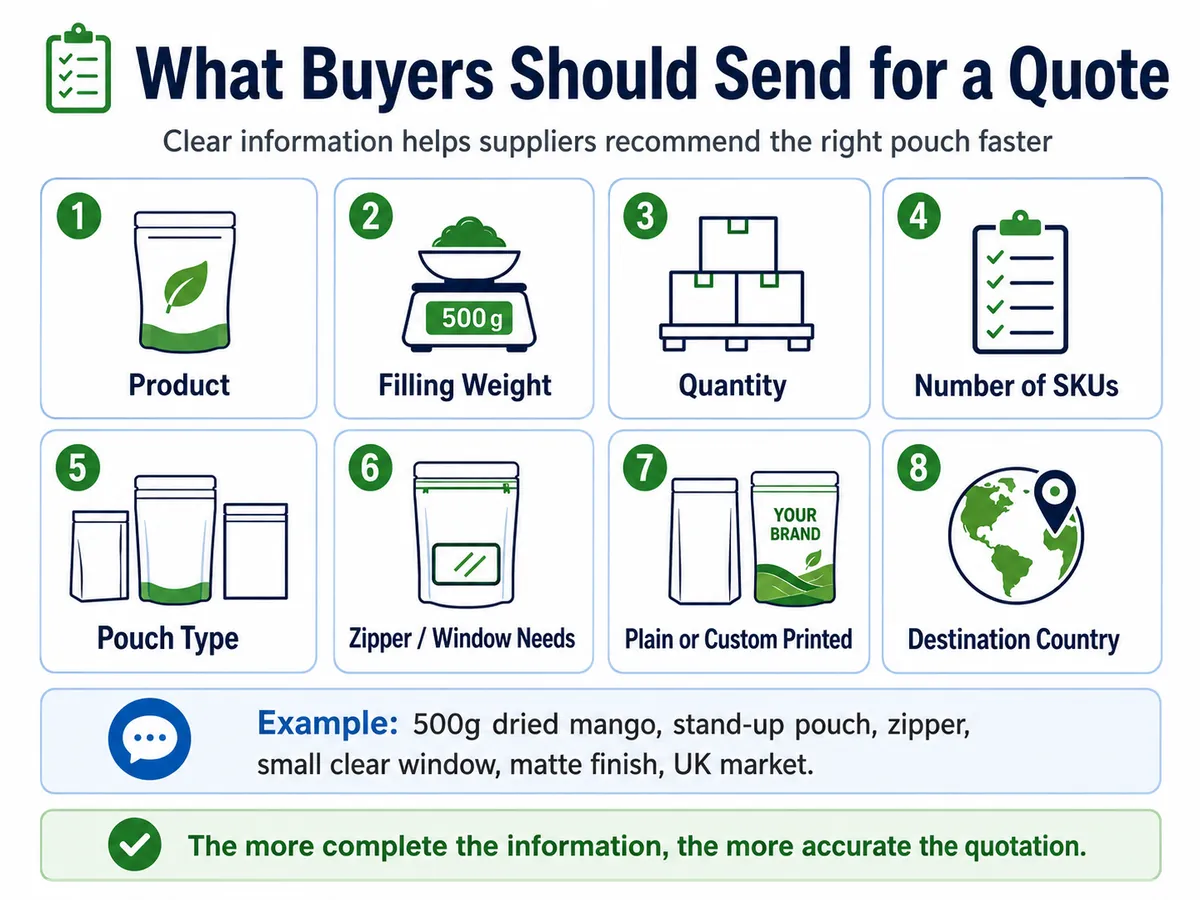
If you already have packaging, send a photo, dimensions or artwork.
A simple inquiry can look like this:
We are packing 500g of dried mango. We need a matte stand-up pouch with a zipper, heat-sealable top and small clear window. Please recommend a suitable size, material and MOQ.
That is enough for a supplier to start.
Common Buying Mistakes
Choosing by price only
A cheaper pouch may not provide enough barrier protection.
Choosing size by weight only
The same weight can require very different pouch volumes.
Using a large clear window without checking light sensitivity
Visibility is useful, but product protection comes first.
Printing before testing the pouch size
Confirm dimensions first, then finalize artwork.
Not asking whether MOQ applies per design
This can create problems when you have multiple SKUs.
Frequently Asked Questions
What is the best packaging for dried fruit?
For many dried fruit products, a resealable stand-up pouch with a heat-sealable top and good moisture barrier is a practical starting point.
What material is best for dried fruit packaging?
PET/PE works for many general applications. PET/VMPET/PE or aluminum foil laminates are better options when stronger moisture, oxygen or light protection is needed.
Do dried fruit bags need a zipper?
For retail packs that may be opened several times, a zipper is usually useful.
Are clear-window pouches suitable for dried fruit?
Yes, but the window reduces light protection. A small window is often a good compromise.
What size pouch do I need for 500g of dried fruit?
There is no standard 500g size. The correct dimensions depend on the fruit type, density and piece size.
What is the MOQ for custom dried fruit pouches?
MOQ depends on the pouch size, material, printing method and number of designs. Ask whether MOQ applies per size or per design.
Final Recommendation
When choosing dried fruit packaging, focus on five things:
Product → Barrier → Size → Features → Order Quantity
For most projects, start with:
- a suitable stand-up pouch,
- enough moisture protection,
- a resealable zipper,
- the correct pouch size,
- and a material that matches the required shelf life.
If you are not sure which structure is suitable, send your supplier the product, filling weight, quantity, number of SKUs and destination country.
That is usually enough to recommend the right pouch options and prepare a useful quotation.
Need Packaging for Dried Fruit?
If you are sourcing pouches for dried mango, pineapple, banana chips, berries or other dried fruit, send us your:
- product,
- filling weight,
- quantity,
- preferred pouch style,
- number of designs,
- and destination country.
We can help you compare suitable pouch sizes, materials, barrier options and MOQ before production.