
How to Choose 250g, 500g and 1kg Pouch Sizes for Food Products
Quick Answer
There is no single standard pouch size for 250g, 500g or 1kg of food.
The right size depends mainly on what you are packing and how much space the product takes up.
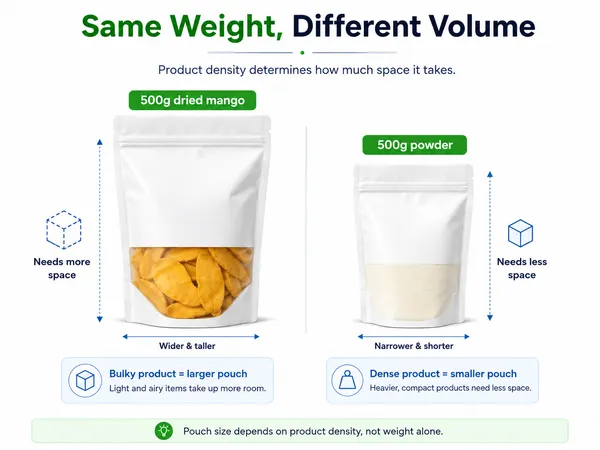
For example, 500g of dried mango needs much more space than 500g of powder.
As a general starting point for stand-up pouches:
| Filling Weight | Common Starting Size Range |
|---|---|
| 250g | 130–180 mm wide × 200–260 mm high |
| 500g | 160–220 mm wide × 240–320 mm high |
| 1kg | 200–280 mm wide × 300–400 mm high |
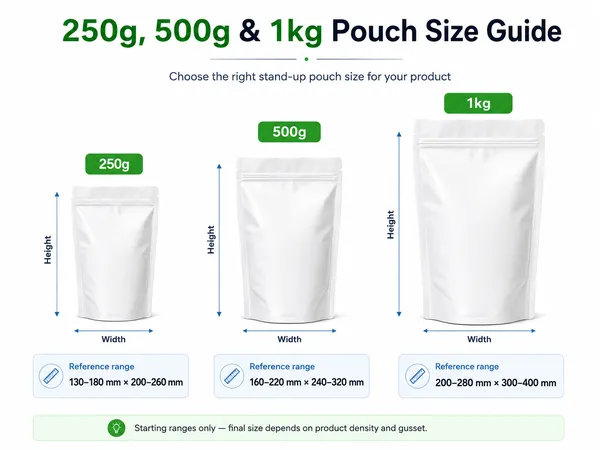
These are reference ranges only. Product density, bottom gusset, zipper position and filling method can all change the final size.
For a new product, the safest approach is simple:
Choose a trial size → Fill it with your actual product → Check the fit → Confirm the final pouch size.
Why Weight Alone Is Not Enough
One of the most common questions we receive is:
“What size pouch do I need for 500g?”
Before recommending a size, we need to know what is going inside.
The same 500g weight can look very different depending on the product.
For example:
- 500g of fruit powder is relatively compact.
- 500g of dried mango is much bulkier.
- 500g of dehydrated vegetables may need even more space.
This is because every product has a different bulk density.
So instead of starting with:
“I need a 500g pouch.”
Start with:
“I need a pouch for 500g of dried mango.”
That gives the manufacturer much more useful information.
250g, 500g or 1kg: What Should You Check?
250g Pouches
250g is common for:
- dried fruit,
- nuts,
- tea,
- coffee,
- spices,
- powders,
- and snacks.
Small powders may fit into a compact pouch, while dried fruit or loose-leaf products usually need more volume.
If the product is bulky, choose a wider pouch rather than forcing it into a very small bag.
500g Pouches
At 500g, product density becomes even more important.
A pouch that works well for 500g of powder may be too small for 500g of dried fruit.
Also check the opening width.
Larger food pieces need enough room for easy filling.
For B2B buyers, filling efficiency matters just as much as whether the product technically fits inside the pouch.
1kg Pouches
For 1kg packs, you should check more than capacity.
The pouch also needs enough strength to handle the weight.
Pay attention to:
- bottom-gusset stability,
- seal strength,
- zipper strength,
- material thickness,
- and shipping durability.
A 1kg pouch should be tested when filled, not judged only when empty.
The Bottom Gusset Matters
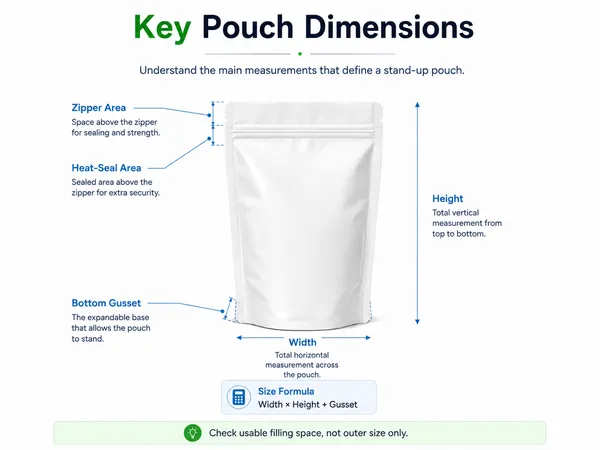
For stand-up pouches, capacity is affected by three main dimensions:
Width × Height × Bottom Gusset
Two pouches can have the same width and height but very different internal capacity because their bottom gussets are different.
For example, a specification may be written as:
160 mm × 240 mm + 80 mm
This usually means:
Width × Height + Bottom Gusset
When comparing quotations from different suppliers, always check how the gusset is measured.
Remember the Zipper and Heat-Seal Area
The full pouch height is not usable filling space.
The top area may contain:
- a zipper,
- tear notches,
- heat-seal area,
- or hang hole.
The product should stay below this area.
If the pouch is filled too high, the product may interfere with the zipper or contaminate the seal area.
This can cause sealing problems, especially with powders.
A slightly larger pouch is often better than a pouch that is filled too tightly.
Do Not Oversize the Pouch Either
A pouch can also be too large.
Too much empty space can:
- make the pack look underfilled,
- use more packaging material,
- take up more carton space,
- increase shipping volume,
- and reduce shelf efficiency.
The goal is not to choose the largest pouch that fits.
The goal is to find a size that looks right, fills efficiently and seals reliably.
The Best Way to Confirm Pouch Size
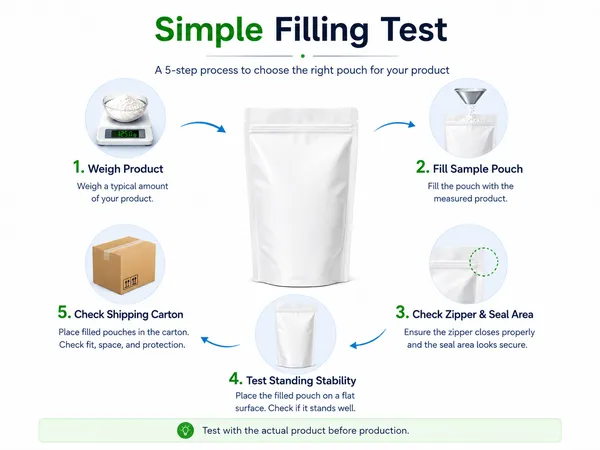
For a new packaging project, we recommend a simple filling test.
1. Prepare the actual product
Use the food you plan to sell.
2. Weigh the exact filling amount
For example:
250g, 500g or 1kg.
3. Fill the sample pouch
Use a process similar to your real production method.
4. Check the top area
Make sure there is enough clean space for the zipper and heat seal.
5. Check how the pouch stands
The bottom gusset should open properly and the pouch should remain stable.
6. Check the appearance
The pouch should not look too empty or too tight.
7. Test it inside your shipping carton
This is especially important for larger B2B orders.
A well-sized pouch should also use carton space efficiently.
Manual Filling vs Automatic Filling
How you fill the pouch can also affect the size.
Manual Filling
A wider pouch opening often makes hand filling easier and faster.
Automatic Filling
If you use filling equipment, check:
- pouch width,
- opening size,
- zipper position,
- material stiffness,
- and machine tolerance.
Tell your packaging supplier about your filling equipment before ordering custom pouches.
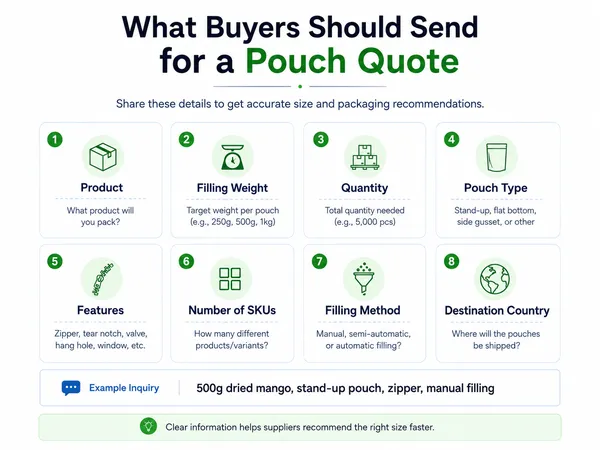
What Should You Send a Manufacturer for a Size Recommendation?
You do not need a complete technical specification.
For most projects, send:
- Product: What are you packing?
- Filling weight: 250g, 500g, 1kg or another weight
- Order quantity: How many pouches per size?
- Pouch type: Stand-up, flat-bottom, flat pouch, etc.
- Required features: Zipper, window, hang hole, tear notch, etc.
- Filling method: Manual or automatic
- Number of SKUs: How many products or designs?
- Destination country
- Reference pouch or photo: If available
For example:
We are packing 500g of dried mango slices. We need a stand-up pouch with a resealable zipper and heat-sealable top. The pouches will be filled manually. Please recommend suitable dimensions and sample sizes for testing.
This gives a supplier enough information to make a useful recommendation.
Does Pouch Size Affect MOQ and Price?
Yes.
Different pouch sizes may be treated as separate production specifications.
If you need:
- 250g,
- 500g,
- and 1kg pouches,
ask whether the MOQ applies to each size or to the total order.
If you also have several printed designs, ask whether the MOQ applies separately to each design.
This is especially important for brands with multiple SKUs.
Larger pouches also use more material, so size can affect the unit price.
Common Pouch Sizing Mistakes
Avoid these common problems:
Choosing by weight only
250g or 500g does not tell you the actual volume.
Copying another brand’s pouch size
Their product density may be completely different.
Ignoring the bottom gusset
Width and height alone do not determine capacity.
Filling too close to the zipper
This can cause zipper and sealing problems.
Ordering printed pouches before testing the size
Confirm the pouch dimensions first, then finalize the artwork.
Ignoring shipping cartons
Pouch size also affects storage and freight efficiency.
Frequently Asked Questions
What size pouch do I need for 250g of food?
A common stand-up pouch starting range may be around 130–180 mm wide × 200–260 mm high, but the correct size depends on the product.
A 250g powder pouch can be much smaller than a 250g dried-fruit pouch.
What size pouch do I need for 500g?
A general starting range may be around 160–220 mm wide × 240–320 mm high.
However, product density and bottom-gusset depth can change the required dimensions significantly.
Always test your actual product.
What size pouch do I need for 1kg?
A common starting range may be approximately 200–280 mm wide × 300–400 mm high.
For 1kg packs, also check pouch strength, bottom stability and seal performance.
Can I use the same pouch size for different products?
Sometimes.
Products with similar volume and shape may share one pouch size.
This can help reduce packaging inventory and MOQ pressure.
However, each product should still be tested before production.
Final Recommendation
When choosing a food pouch size, do not start with weight alone.
Start with:
Product → Filling Weight → Product Volume → Trial Size → Filling Test → Final Size
For B2B buyers, the right pouch should:
- fit the product properly,
- fill efficiently,
- seal reliably,
- look good on the shelf,
- work with your filling process,
- and pack efficiently for shipping.
If you are not sure which 250g, 500g or 1kg pouch size is suitable, send us your product, filling weight, quantity and required pouch features.
We can recommend suitable pouch sizes and provide samples for filling tests before you confirm production.