
How to Choose Small Snack Packaging Pouches for 5g, 10g and 20g Packs
A 5g, 10g or 20g fill weight is not enough to specify a food pouch. Products with the same net weight can require different pouch dimensions because density, particle shape, headspace, filling method and pouch geometry all affect the space needed.
This matters for small portions of dried fruit, nuts, confectionery, puffed snacks and other dry foods. A pouch that looks suitable on a drawing may become awkward to fill, difficult to seal or visually unbalanced once the actual product is inside.
A useful specification sequence is:
product and fill weight → actual filled volume → consumption pattern → pouch format → pouch dimensions → material requirements → functional features → printing and SKU plan → MOQ and quotation
Starting in that order reduces the risk of choosing a pouch from a generic size chart and redesigning it after filling trials.
Can You Choose a 5g, 10g or 20g Pouch by Weight Alone?
No. Net weight is a starting input, not a finished pouch specification.
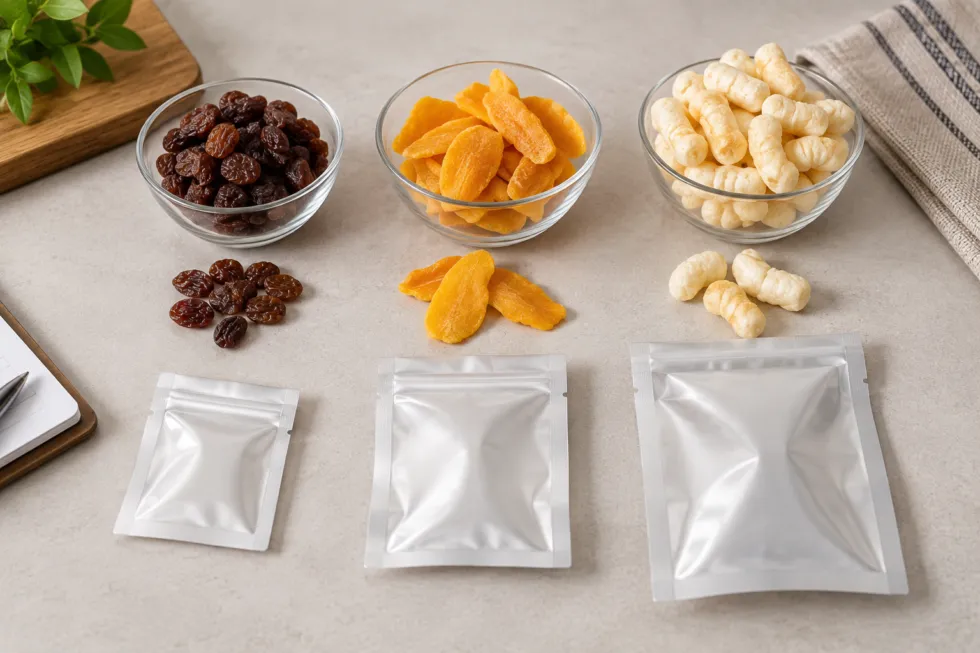
Five grams of raisins, dried mango pieces and a light expanded snack can occupy very different volumes. Product shape also affects how the contents settle and how much usable space remains around them.
Product density and shape change the required volume
A supplier needs more than the target weight.
Useful sizing inputs include:
- the actual food product;
- target fill weight;
- approximate particle size and shape;
- whether pieces are rigid, irregular, soft or fragile;
- whether the product packs tightly or leaves substantial air space;
- the intended pouch format.
Irregular dried fruit pieces, for example, will not necessarily occupy the same volume as a dense confectionery product at the same weight.
A request that says only “10g pouch required” leaves the supplier to make assumptions that should instead be checked against the real product.
Headspace and sealing area still matter in a small pack
The contents cannot occupy the entire pouch.
Enough space must remain for filling and sealing. If food particles sit too close to the sealing zone, filling becomes harder and contamination of the seal area becomes more likely.
This issue is especially noticeable in small snack packaging because seals and other functional areas take up a larger share of the total pouch.
A pouch can therefore hold the target weight and still be impractical to fill or close.
Why a real fill test is safer than copying a size chart
A size chart can provide a starting range. It should not replace a fill test.
Select a preliminary size, fill it with the actual product, close it as intended and check:
- product fit;
- headspace;
- opening width;
- sealing area;
- filled appearance;
- usable artwork area;
- handling.
This matters even more when launching several pack sizes together. A 5g, 10g and 20g range should look related, but the dimensions do not need to scale in a simple mathematical ratio.
Decision rule: use fill weight to begin the sizing process, not to finish it.
Which Pouch Format Works Best for Small Snack Portions?
There is no single best format for every small snack pack. Choose the pouch according to how the product will be filled, opened, displayed and consumed.
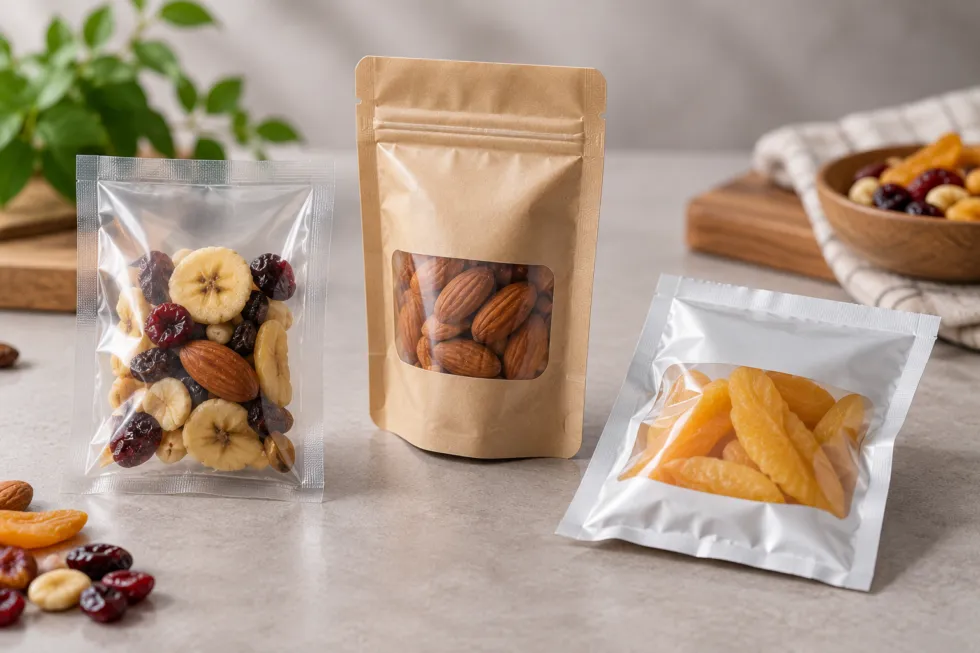
For compact single portions, a three-side-seal pouch is often worth evaluating. A small stand-up pouch becomes more relevant when upright shelf presentation or additional front-panel presence justifies the extra structure.
Three-side-seal pouches for compact single portions
A three-side-seal pouch has a straightforward flat construction and can suit small portions where compactness matters more than standing upright.
It can be considered for:
- sample-size food packs;
- single-serve dried fruit;
- confectionery portions;
- small snack servings;
- packs displayed inside a larger carton or retail unit.
Because the format does not rely on a bottom gusset, more of a small package may remain available for the product and graphics.
That does not make it automatically cheaper or better. Final cost and manufacturability still depend on dimensions, material, printing, quantity and project configuration.
When a small stand-up pouch adds retail value
A stand-up pouch can make sense when the individual package needs to sit upright on a shelf or when the brand wants a more structured retail presentation.
The trade-off is additional pouch geometry. On a very small single-use pack, that geometry may add complexity without solving a meaningful retail or consumer-use problem.
Before specifying a stand-up format for a 5g or 10g product, ask:
Does this pack need to stand independently?
If not, a simpler format may deserve comparison.
A 20g pack may offer more room for a stand-up structure, depending on product volume and presentation requirements, but net weight alone still does not determine the format.
When rollstock may become relevant for automated packing
Premade pouches and rollstock support different packing processes.
A business filling smaller volumes manually or using equipment designed for premade pouches may prefer finished bags. A project built around form-fill-seal equipment may require rollstock instead.
In that case, the packaging machine becomes part of the specification. Finished pack dimensions, film width, repeat length and available machine information may need to be reviewed with the packaging supplier and equipment team.
For Honghai custom premade pouches, the standard MOQ starts from 1,000 pieces, excluding rollstock. Rollstock MOQ is project-specific and is not defined by a fixed number of meters.
That distinction should be clear before quotations are compared.
Does a 5g or 10g Snack Pouch Need a Zipper?
Not necessarily. Decide first whether the package is intended for single use or repeated opening.
A zipper has a clear function when the consumer is expected to remove part of the contents and store the remainder. It may add little value when the entire portion is normally consumed at once.
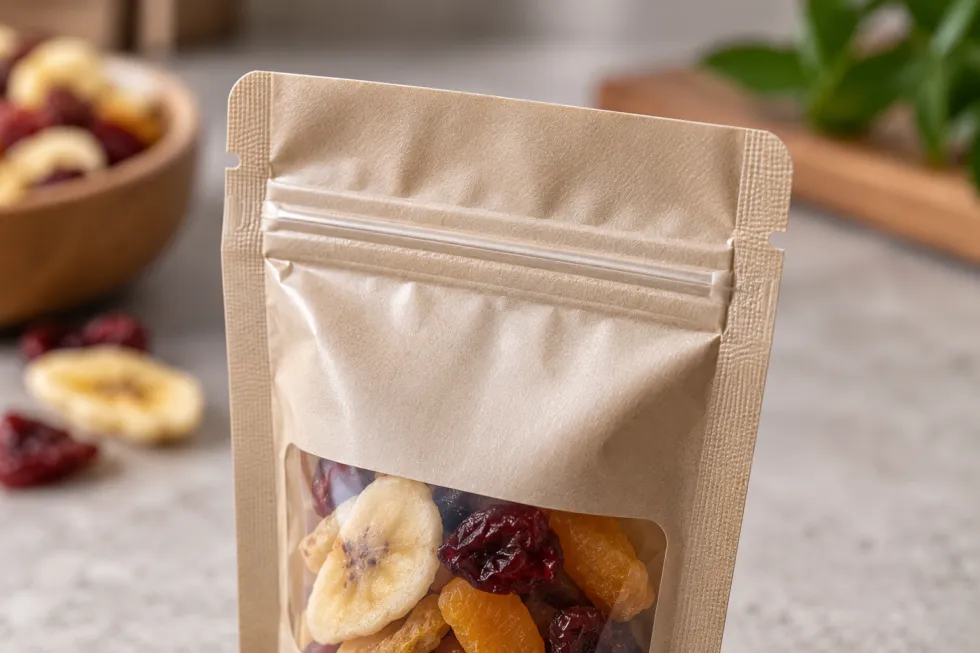
Single-use packs have different closure priorities
For a small single-serve pack, the priorities may instead be:
- seal integrity;
- easy opening;
- sufficient product space;
- clear branding;
- convenient handling.
In that situation, a tear notch may address a more relevant consumer need than a zipper.
For a larger multi-use pack, resealability may become more important.
The decision should follow the intended use rather than a general rule that all snack pouches need zippers.
Zippers, tear notches and hang holes compete for space
Every feature uses physical area.
On a larger pouch, a zipper, hang hole and clear window may fit without causing layout problems. On a small pouch, the same combination can leave limited space for the product, graphics and required information.
This is why small food pouches should not simply be treated as scaled-down versions of larger stand-up bags.
Before final artwork is prepared, identify the functional zones:
- top seal;
- tear notch;
- zipper, if required;
- hang hole, if required;
- clear window;
- bottom seal or gusset;
- usable print area.
The space remaining after those areas are defined is the real branding panel.
Keep functional features proportional to the package
A common specification mistake is to add every available feature because each sounds useful on its own.
A better question is:
What problem does this feature solve for this exact pack?
If the entire portion is likely to be consumed after opening, a resealable closure may not justify the space and production complexity it adds. If the contents are intended for repeated use, the decision may be different.
What Material Direction Makes Sense for Dried Fruit and Small Snacks?
Material selection should follow the protection needs of the food, not the package weight.
Dried fruit and dry snacks can differ in moisture sensitivity, oxygen sensitivity, oil content, aroma and sensitivity to light. Storage and distribution conditions also affect which material direction should be evaluated.
Moisture sensitivity matters for dried fruit and crispy snacks
A moist dried fruit and a crisp expanded snack do not necessarily need the same packaging structure.
A crispy product may require strong moisture protection to maintain texture. A dried fruit product may have different moisture, oxygen or aroma considerations depending on the product and intended storage conditions.
This is why food-contact suitability and barrier performance should be treated as separate questions.
The first concerns whether the material is suitable for the intended food-contact use and target market. The second concerns whether the structure provides the protection needed for the product under defined storage and distribution conditions.
Transparent vs metallized or foil-based structures
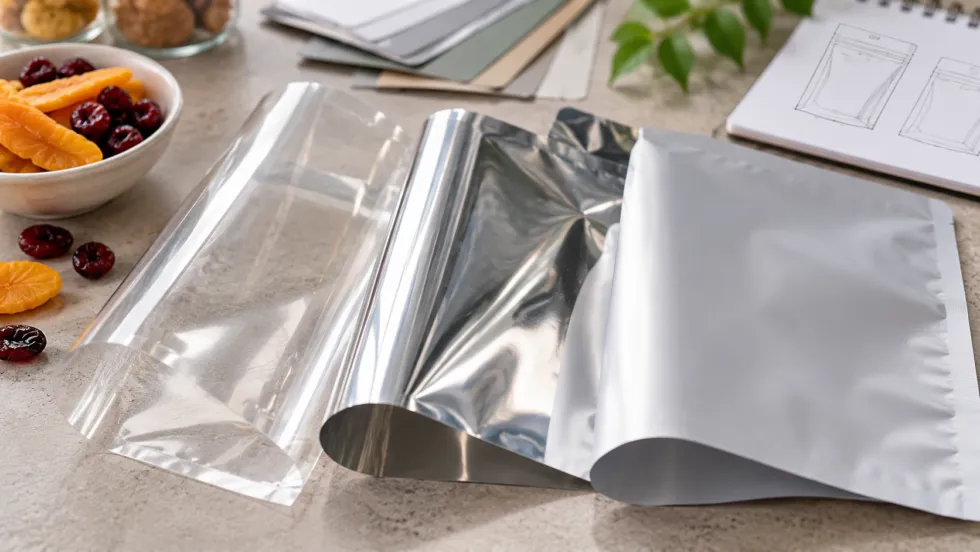
A transparent laminate can support product visibility. Metallized or foil-based structures may be considered when greater protection from light, moisture or oxygen is required.
Candidate flexible-packaging structures available for discussion include PET/PE, PET/VMPET/PE and PET/AL/PE.
These are material directions, not automatic specifications for a 5g, 10g or 20g dried fruit pouch.
The final structure should be reviewed after the supplier understands:
- the food product;
- desired product visibility;
- storage conditions;
- distribution environment;
- shelf-life objective;
- filling and sealing process;
- destination-market requirements.
If objective barrier data are required, they should come from the applicable material specification or test documentation. Generic material names should not be used to invent OTR, WVTR or shelf-life performance.
Why thickness should not be specified before the structure
A total thickness figure does not explain the function of each layer in a laminate.
Different structures can allocate layers differently for printing, mechanical performance, barrier and heat sealing. The material structure and functional requirements should therefore be defined before final thickness is confirmed.
Choosing a thickness simply because it appears stronger can lead to over-specification without addressing the actual packaging risk.
What Does “Food Grade” Need to Mean for an Export Snack Pouch?
“Food grade” is not a complete export packaging specification. Buyers should confirm both the intended food-contact use and the requirements that apply in the destination market.
A broad statement about food-grade material does not by itself establish that a specific document, test or certification applies to every product or country.
Direct food contact and barrier performance are different questions
A material can be considered for direct food contact while still requiring a different structure to meet the product’s barrier needs.
Likewise, selecting a high-barrier structure does not automatically establish compliance for a particular market.
The RFQ should separate:
- food-contact requirements, and
- product-protection requirements.
That gives procurement, QA and the packaging supplier a clearer basis for reviewing the project.
Confirm the destination market before asking for compliance documents
Instead of asking only:
“Is this food grade?”
provide the destination market and ask which current documents apply to the proposed material and intended food-contact use.
This is more useful than requesting a general list of certificates without checking whether the document covers the correct material, entity, application or market.
Current documentation and scope should be verified before an export order is approved.
Children’s snacks do not automatically define the packaging requirement
The phrase “children’s snack” does not determine one universal flexible-packaging structure, closure or certification.
Requirements may vary according to the product and market, so the specification should begin with:
- the actual food product;
- intended retail format;
- destination market;
- applicable food-contact and labeling requirements.
Do not assume that a children’s snack automatically needs a particular zipper, film structure or certification.
How Should Printing Be Planned Across 5g, 10g and 20g SKUs?
Plan printing around the number of pouch sizes, artworks and quantities per artwork. Do not choose a printing method from appearance alone.
Digital printing and rotogravure printing are available for custom pouch projects, with printing capability of up to 10 colors. The production route still needs to be selected according to the actual order.
Record quantity per size and per artwork
Consider a range with:
- 5g mango;
- 5g raisins;
- 10g mango;
- 10g raisins;
- 20g mango.
From a purchasing perspective, this is not simply “three sizes.” It may involve five artwork versions across three pouch dimensions.
A useful RFQ table is:
| Size | Product / Flavor | Artwork | Required Quantity |
|---|---|---|---|
| 5g | Mango | Design A | To confirm |
| 5g | Raisin | Design B | To confirm |
| 10g | Mango | Design C | To confirm |
| 10g | Raisin | Design D | To confirm |
| 20g | Mango | Design E | To confirm |
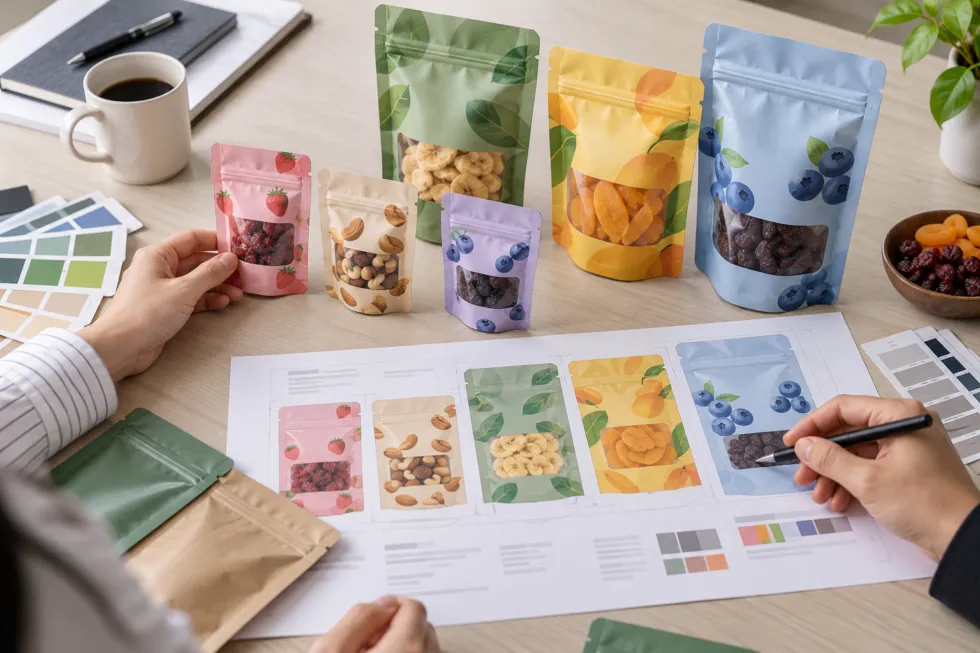
This prevents a common quotation problem: the buyer provides only the total order quantity while the supplier needs to know how that quantity is divided between pouch specifications and print designs.
Digital printing for flexibility vs gravure for stable repeat production
Digital printing can be worth discussing for projects with several designs, smaller initial runs or artwork that may change.
Rotogravure may be worth evaluating for larger or more stable repeat programs.
The choice should be reviewed against:
- quantity;
- number of designs;
- pouch size;
- material;
- finish;
- expected repeat demand.
Do not choose between the two by applying an old or generic MOQ rule.
Confirm the dieline before final artwork
Small packages leave limited room for layout errors.
Before artwork is finalized, confirm the actual pouch dieline and identify:
- seal zones;
- gussets;
- zipper area;
- tear notch;
- hang hole;
- clear window;
- safe print area.
A design that looks balanced on a flat rectangle can change once the pouch is sealed and filled.
How Does MOQ Work When You Have Several Small Pouch Sizes?
For Honghai custom premade pouches, the standard MOQ starts from 1,000 pieces, excluding rollstock. Buyers should not assume that different pouch sizes or artworks can automatically be combined in any particular way to meet that MOQ.
Multi-SKU production arrangements need to be confirmed from the actual project.
Total quantity and quantity per size are different variables
A request such as “I need 3,000 bags in 5g, 10g and 20g sizes” is incomplete.
The supplier still needs to know whether the project means:
- 1,000 pieces of each size;
- different quantities for each size;
- several artworks within one size;
- the same artwork adapted across several sizes.
Those configurations are not commercially identical.
Multiple designs need separate quantity planning
For each SKU, state:
- pouch size;
- product or flavor;
- artwork;
- required quantity.
Also provide the total project quantity.
Do not assume that the standard MOQ automatically applies per artwork or can always be divided across a whole order. The production arrangement should be confirmed for the specific combination of sizes and designs.
Rollstock follows a different MOQ logic
The premade-pouch MOQ does not apply to rollstock.
Rollstock MOQ is project-specific and depends on actual packaging requirements rather than a fixed number of meters.
A rollstock RFQ should include the product, finished pack size, material and printing requirements, number of designs, expected packaging quantity and available packaging-machine information.
What Should You Send a Supplier Before Asking for a Factory Price?
Send enough information for the supplier to quote the package you actually intend to buy.
“Factory price for a 10g snack bag” is not a complete RFQ because cost can change with pouch format, dimensions, material structure, printing, finishes, number of designs and quantity.
A useful RFQ should include:
- product name and type;
- target fill weight;
- actual product form or a sample where practical;
- preferred pouch format, or a request for a recommendation;
- proposed dimensions, if already tested;
- barrier or material requirements;
- zipper, tear notch, window or hang hole requirements;
- number of artworks;
- quantity per artwork;
- total quantity;
- destination market;
- filling method;
- shipping destination if freight is to be discussed.
Why destination matters before shipping is quoted
Packaging price and freight are different parts of the purchasing decision.
For an export project, the destination is needed before shipping options can be evaluated. Freight cost, transit time and Incoterm arrangements are project-specific and should be confirmed during quotation.
Do not compare a packaging-only quotation with another quotation based on different freight or delivery assumptions.
What still needs supplier confirmation
Some commercial and technical items should remain open until the specification is clear, including:
- final pouch dimensions;
- final laminate;
- final thickness;
- sample arrangement;
- any applicable sample or cylinder charges;
- production schedule;
- shipping method;
- freight cost;
- applicable food-contact or technical documentation.
Leaving these items for project confirmation is safer than filling gaps with assumptions.
How Should Buyers Compare Quotations for Small Snack Packaging?
Compare specifications before comparing unit prices.
A lower unit price does not necessarily represent a lower-cost packaging solution if suppliers have quoted different pouch formats, materials, finishes, quantities or printing scopes.
Use a normalization table first:
| Quote Item | Supplier A | Supplier B | Supplier C |
|---|---|---|---|
| Pouch format | |||
| Finished dimensions | |||
| Material structure | |||
| Printing method | |||
| Surface finish | |||
| Zipper / tear notch / window | |||
| Number of designs | |||
| Quantity per SKU | |||
| Sample basis | |||
| Packaging basis | |||
| Shipping basis |
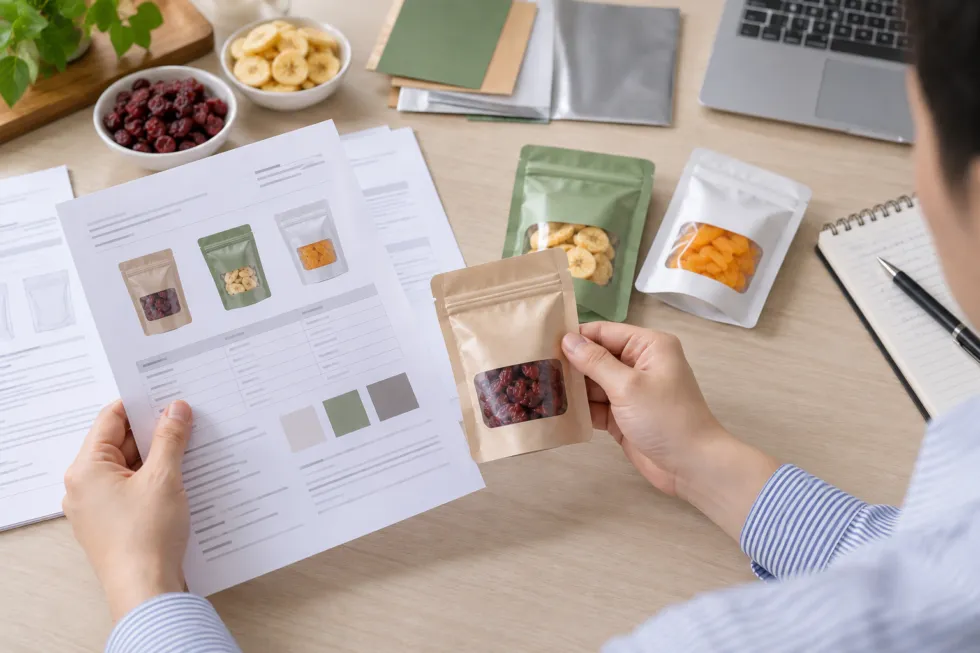
If one quotation says only “10g printed food pouch” while another identifies the format, dimensions, material, features and quantities, the offers are not yet comparable.
Normalize pouch construction and dimensions
Check that each supplier is quoting the same:
- pouch style;
- finished width and height;
- gusset, if applicable;
- closure features;
- window configuration.
Even a small structural change can alter the commercial basis of the quotation.
Normalize printing and artwork count
A quotation for one design is not directly comparable with one covering several designs unless both scopes are clear.
This matters when launching several flavors or fill weights at the same time.
Separate packaging price from shipping assumptions
For international orders, identify what each quotation includes.
Packaging cost, export packing, freight and import-side expenses should not be combined without a clear commercial basis.
If the objective is to compare manufacturing cost, normalize the pouch specification first and then compare logistics separately on equivalent terms.
What Should You Validate Before Ordering Three Small Snack Sizes?
Validate the filled package, not only the artwork file.
A flat design proof can confirm graphics, but it cannot show how the real product occupies the pouch or whether the opening, headspace and sealing zones work as intended.
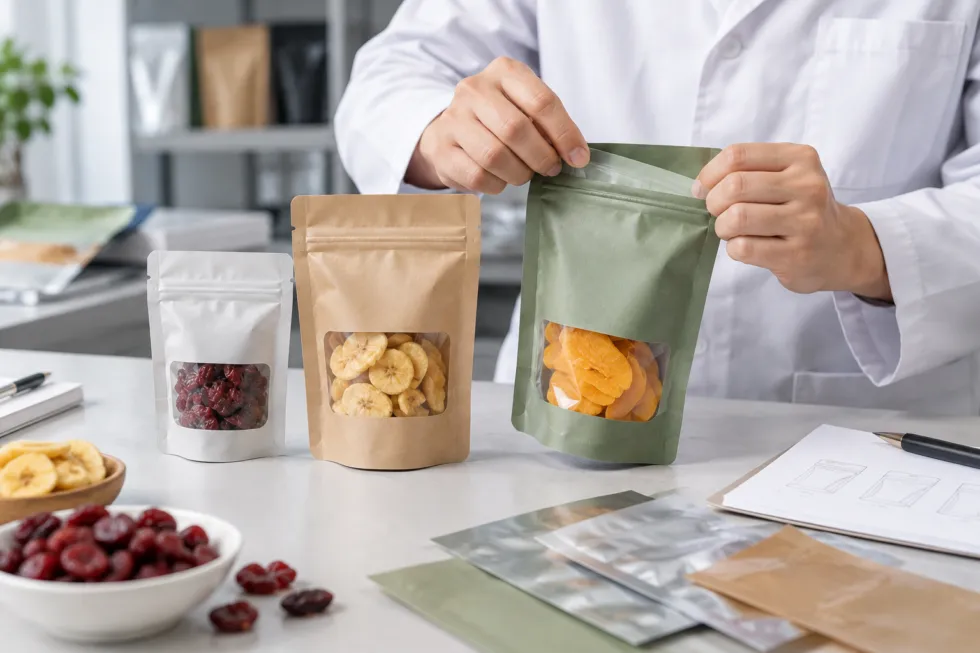
Fill the actual product
For each planned size, check:
- whether the target weight fits naturally;
- whether there is enough room for filling;
- whether the product settles as expected;
- whether the pouch appears underfilled or overfilled;
- whether the filled geometry matches the intended retail appearance.
If different products have different densities or particle shapes, test them separately rather than assuming one result will apply to all SKUs.
Check sealing and opening
Inspect the top area after filling.
Confirm that:
- product does not interfere with the seal area;
- tear-open features are accessible;
- zipper operation is practical if a zipper is included;
- the opening suits the intended filling method.
On a small pack, limited functional space can affect both filling and consumer use, so these checks should happen before bulk production.
Review all three sizes side by side
A multi-size range should work technically and visually.
Place the filled 5g, 10g and 20g packs together and review:
- relative proportions;
- logo position;
- product naming;
- flavor differentiation;
- window size;
- space for required product information;
- consistency across the range.
The objective is not to force identical proportions. Each size needs to function first, while still belonging to the same product family.
Confirm each artwork separately
Do not approve a multi-SKU order because one design looks correct.
Match every artwork to the correct:
- pouch size;
- dieline;
- product;
- print file;
- quantity.
That check reduces the risk of discovering an artwork-to-size mismatch after production has started.
A Practical RFQ Checklist for Small Snack Packaging Pouches
Before requesting a final quotation, prepare:
- Product: dried fruit, nuts, candy, puffed snack or another food
- Fill weight: 5g, 10g, 20g or another target
- Product form: size, shape and approximate filled volume
- Pouch format: three-side-seal, stand-up pouch or another format
- Dimensions: confirmed size or request for sizing support
- Material requirements: transparent, light-blocking or other protection needs
- Features: tear notch, zipper, window, hang hole or none
- Printing: number of artworks and required finish
- Quantity: quantity per size and per artwork
- Filling method: manual or machine filling
- Destination market: for food-contact and export requirements
- Shipping destination: if freight is required in the quotation
For Honghai custom premade pouch projects, the standard MOQ starts from 1,000 pieces, excluding rollstock. If the project includes several sizes or designs, provide the quantity required for each so the production arrangement can be reviewed correctly.
If the final material, pouch size or printing route has not yet been selected, state the product conditions and identify those items as open for recommendation.
That gives the supplier enough information to compare practical options, validate the specification and prepare a quotation based on the same purchasing scope.