
Moisture-Barrier Food Packaging: How to Choose the Right Pouch
Quick Answer
Moisture-barrier food packaging helps protect products from humidity, water vapor and moisture damage.
For dry foods such as:
- dried fruit,
- coffee,
- tea,
- snacks,
- nuts,
- spices,
- and powders,
the right pouch material can help maintain:
- texture,
- freshness,
- flavor,
- and shelf life.
Common moisture-barrier pouch options include:
| Material Structure | Barrier Level | Typical Applications |
|---|---|---|
| PET/PE | Standard | General dry foods |
| PET/VMPET/PE | High | Dried fruit, snacks, coffee, powders |
| PET/AL/PE | Very High | Sensitive products requiring maximum protection |
| Kraft laminate | Depends on inner layers | Natural and organic food brands |
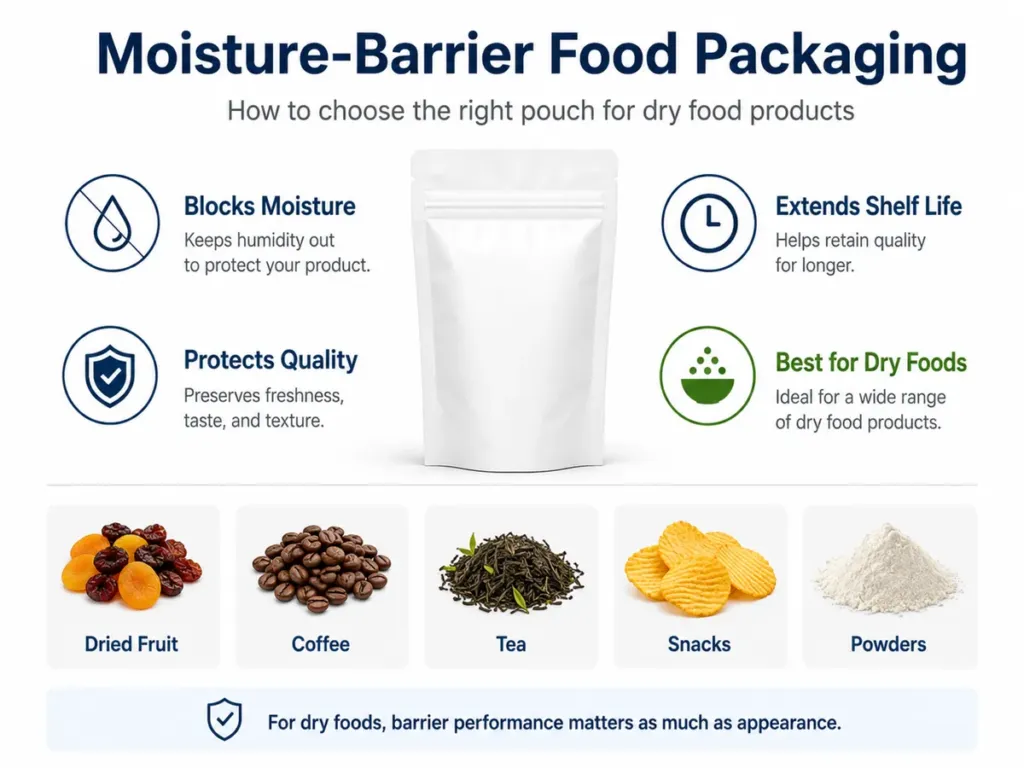
The best choice depends on your product sensitivity, shelf life target, storage conditions and market requirements.
What Is Moisture-Barrier Food Packaging?
Moisture-barrier packaging is designed to reduce the amount of water vapor that enters or leaves the package.
For dry foods, controlling moisture is one of the most important packaging functions.
A good moisture barrier helps prevent problems such as:
- softening,
- loss of crispness,
- clumping,
- texture changes,
- and reduced shelf life.
The pouch is not just a container.
It is a protective layer between the product and the environment.
Why Dry Foods Need Moisture Protection
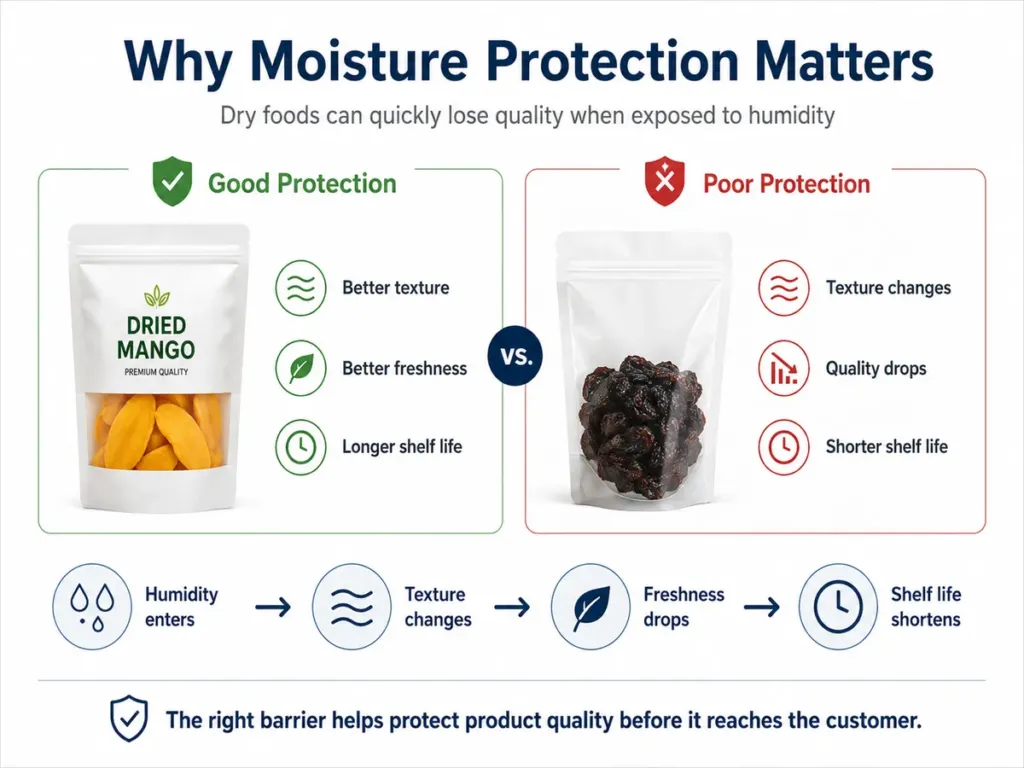
Many foods look stable because they have already been dried.
However, dried products can easily absorb moisture from the surrounding air.
For example:
Dried Fruit
Excess moisture can make fruit:
- sticky,
- soft,
- or less enjoyable to eat.
Powders
Moisture can cause:
- clumping,
- poor flow,
- and difficulty during use.
Snacks
Humidity can reduce:
- crispness,
- texture,
- and customer experience.
This is why choosing the correct packaging structure is important before production.
How Does Moisture Enter Food Packaging?
Moisture can enter packaging through:
- the packaging material itself,
- seals,
- closures,
- or damaged areas.
The biggest factor is usually the barrier performance of the film structure.
Flexible food pouches are normally made from multiple layers.
Each layer has a different function:
- one layer provides strength,
- one layer provides barrier protection,
- one layer provides heat sealing.
A pouch that looks attractive outside may not always provide the protection your product needs.
What Is WVTR and Why Does It Matter?
When comparing moisture protection, buyers may see the term:
WVTR (Water Vapor Transmission Rate)
It measures how much water vapor passes through a packaging material over time.
Generally:
Lower WVTR = Better moisture protection
For products that are highly sensitive to humidity, a lower moisture transmission rate is usually preferred.
However, the correct barrier level depends on:
- product type,
- expected shelf life,
- storage environment,
- shipping conditions,
- and cost requirements.
A higher barrier is not always necessary for every product.
Which Packaging Materials Provide Better Moisture Protection?
PET / PE
PET/PE is a common structure for general food packaging.
Advantages:
- good strength,
- reliable sealing,
- practical cost,
- suitable for many dry products.
It may work well when extremely high moisture protection is not required.
Common applications:
- snacks,
- dry foods,
- simple retail packaging.
PET / VMPET / PE
PET/VMPET/PE adds a metallized layer.
This improves protection against:
- moisture,
- oxygen,
- and light.
It is widely considered for products that need stronger barrier performance.
Common applications:
- dried fruit,
- coffee,
- tea,
- nuts,
- powders,
- premium snacks.
For many dried food brands, this is a practical balance between protection and cost.
PET / AL / PE
Aluminum foil laminate provides very strong barrier performance.
Advantages:
- excellent moisture protection,
- strong oxygen barrier,
- excellent light protection.
It is often considered for:
- sensitive products,
- longer shelf-life requirements,
- products requiring maximum protection.
The limitation:
The pouch is usually opaque, so customers cannot see the product.
Kraft Laminated Pouches
Kraft packaging is popular for brands that want a natural appearance.
It is commonly used for:
- organic foods,
- natural snacks,
- premium products.
However, the kraft paper itself is not the main barrier layer.
The inner structure still determines:
- moisture protection,
- sealing performance,
- and food-contact suitability.
Always ask about the complete laminate structure.
Moisture Barrier Material Comparison
| Material | Moisture Protection | Light Protection | Suitable For |
|---|---|---|---|
| PET/PE | Moderate | Limited | General dry foods |
| PET/VMPET/PE | High | High | Most dried foods |
| PET/AL/PE | Very High | Very High | Sensitive products |
| Kraft laminate | Depends | Depends | Natural brand packaging |
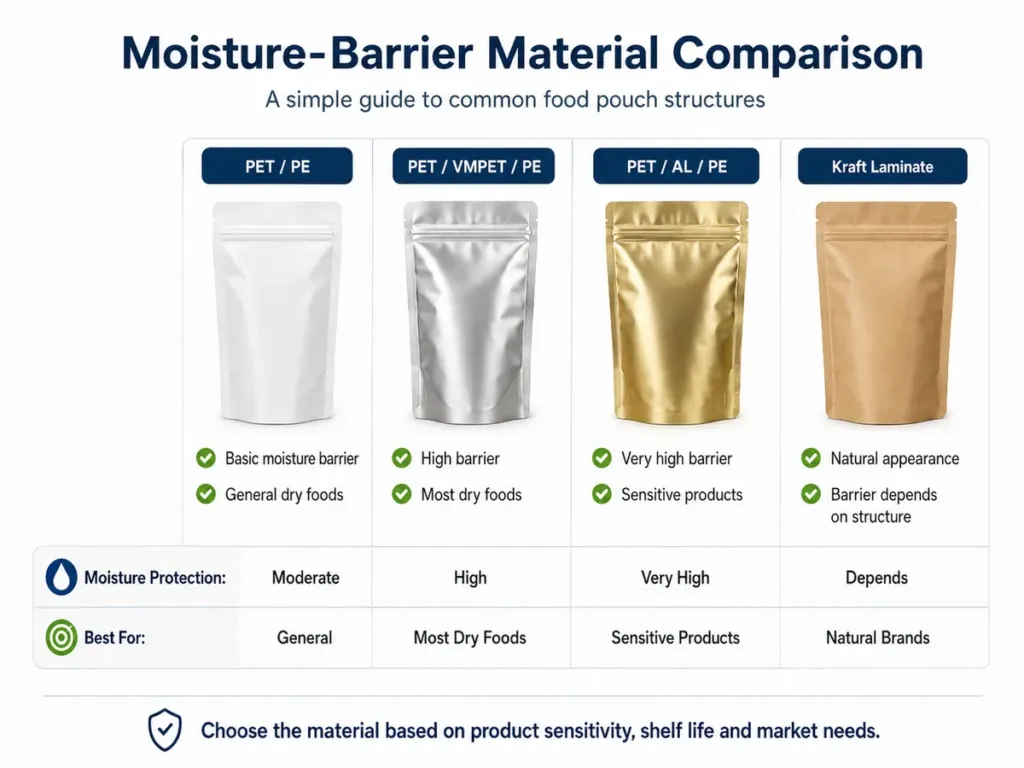
The best material is not always the one with the highest barrier.
The right choice balances:
Product Protection + Cost + Brand Positioning
Do You Need High-Barrier Packaging?
Not every food product needs the highest barrier material.
Ask these questions:
1. Is the product sensitive to moisture?
Examples:
- dried fruit,
- crispy snacks,
- powders.
2. How long is the expected shelf life?
Longer shelf life usually requires stronger protection.
3. Will the product be shipped internationally?
Long-distance shipping exposes products to:
- humidity changes,
- temperature changes,
- and longer storage periods.
4. Does the product need light protection?
Some foods are affected by light exposure.
Examples:
- coffee,
- tea,
- certain powders.
Moisture Barrier vs Oxygen Barrier
Moisture protection and oxygen protection are related but different.
A pouch can perform well against moisture but have different oxygen barrier performance.
Depending on the product, you may need protection from:
- water vapor,
- oxygen,
- light,
- or all three.
For example:
Dried Fruit
Usually requires strong moisture protection.
Coffee
Often requires moisture and oxygen protection.
Powders
May require moisture protection to prevent clumping.
The packaging structure should match the product requirements.
Does a Zipper Affect Moisture Protection?
A zipper improves convenience, but it is not usually the main moisture barrier.
The zipper allows customers to reopen and reseal the pouch after use.
For stronger protection:
- the pouch should be heat sealed before first opening,
- the zipper should provide good resealing performance,
- and customers should close it properly after use.
For many retail food products:
Heat seal + zipper
is a practical combination.
Can a Clear Window Reduce Barrier Protection?
Yes, depending on the design.
A clear window allows customers to see the product.
This can be useful for:
- dried fruit,
- snacks,
- natural foods.
However, transparent areas usually provide less light protection than metallized or foil structures.
The decision depends on your priority:
Product visibility or maximum protection?
For many brands, a small window provides a good balance.
How to Choose the Right Moisture Barrier Pouch?
A simple decision process:
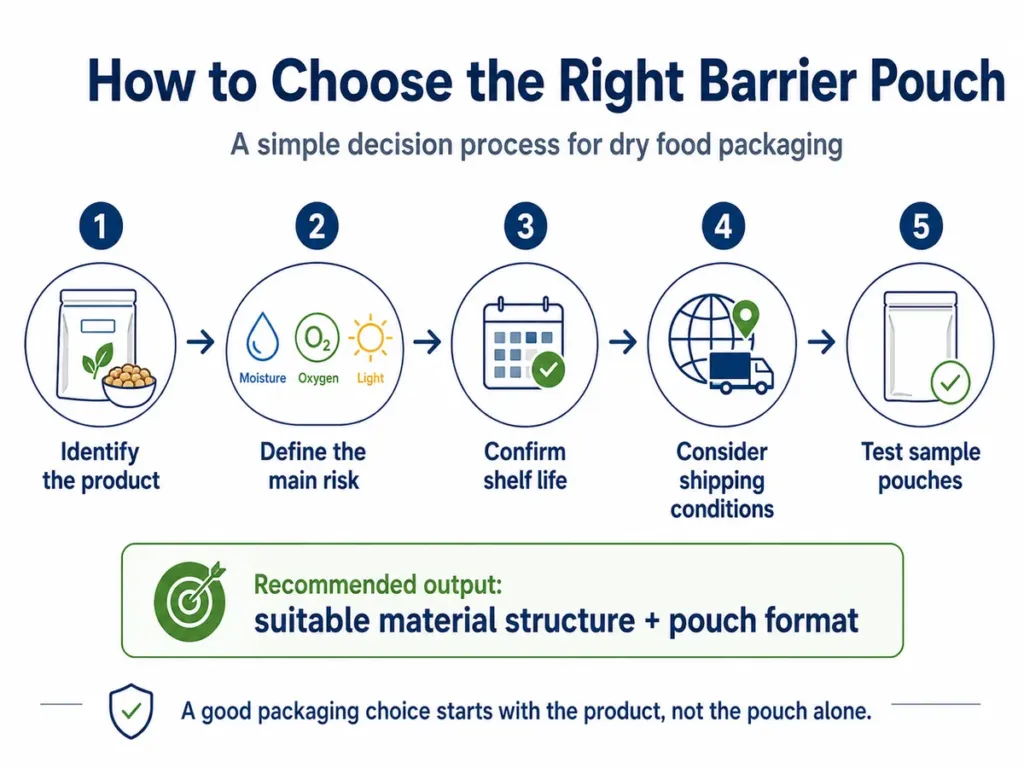
Step 1: Identify the Product
Example:
- dried mango,
- fruit powder,
- tea,
- coffee,
- nuts.
Step 2: Understand the Main Risk
Is the main concern:
- moisture,
- oxygen,
- light,
- or all three?
Step 3: Define Shelf Life
Longer shelf life usually requires stronger protection.
Step 4: Consider Shipping Conditions
International shipping may require stronger protection than local sales.
Step 5: Test Samples
Before mass production:
- fill the pouch,
- store samples,
- check product condition,
- confirm sealing performance.
What Information Should You Give a Packaging Supplier?
For a correct moisture-barrier recommendation, provide:
- product type,
- filling weight,
- expected shelf life,
- storage conditions,
- destination market,
- pouch size,
- required features,
- and estimated quantity.
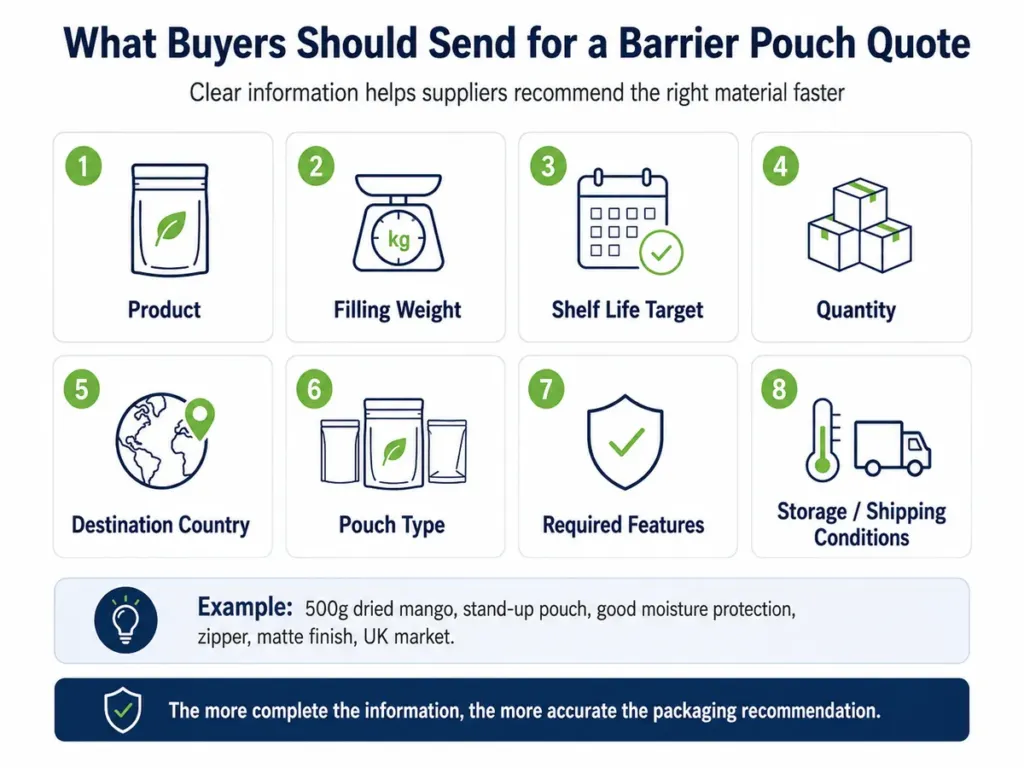
Example:
We need a 500g stand-up pouch for dried mango. The product will be shipped internationally and needs good moisture protection, zipper closure and a matte finish. Please recommend a suitable material structure.
This gives the supplier enough information to recommend the right pouch.
Common Mistakes When Choosing Moisture Barrier Packaging
Choosing the Cheapest Material
Lower cost does not always mean suitable protection.
A poor barrier can affect product quality and customer satisfaction.
Choosing Based Only on Appearance
A beautiful pouch is not useful if it cannot protect the product.
Assuming All Laminated Pouches Are the Same
Different structures provide different barrier performance.
Always confirm the material layers.
Ignoring Shipping Conditions
A product shipped internationally may need different protection than a locally sold product.
Skipping Sample Testing
Small sample tests can prevent large production mistakes.
Frequently Asked Questions
What is moisture-barrier food packaging?
Moisture-barrier food packaging is designed to reduce moisture transfer and protect food products from humidity damage.
It is commonly used for dried foods, snacks, powders, coffee and tea.
What is the best material for moisture barrier packaging?
There is no single best material.
PET/VMPET/PE is commonly used for many dried foods, while PET/AL/PE provides higher protection for more sensitive products.
Do dried fruit pouches need moisture protection?
Yes.
Dried fruit can absorb moisture, which may affect texture, freshness and shelf life.
Is aluminum foil packaging better than VMPET?
Aluminum foil generally provides stronger barrier protection.
However, VMPET can provide a good balance between protection, cost and appearance for many applications.
Does a zipper make a pouch moisture proof?
No.
The main barrier comes from the pouch material structure.
The zipper mainly improves resealing convenience after opening.
How do I choose the right food pouch material?
Consider:
- product sensitivity,
- shelf life,
- shipping conditions,
- required barrier level,
- and budget.
A packaging supplier can recommend suitable structures based on these factors.
Final Recommendation
Choosing moisture-barrier packaging is not about selecting the strongest material.
It is about finding the right balance between:
Product Protection → Shelf Life → Cost → Customer Experience
For most dry food brands, the selection process should start with:
Product → Barrier Requirement → Material Structure → Sample Testing → Production
A suitable pouch should protect the product during:
- storage,
- transportation,
- retail display,
- and customer use.
Need Help Choosing Moisture-Barrier Packaging?
If you are sourcing packaging for dried fruit, coffee, tea, snacks or powders, send us:
- your product,
- filling weight,
- target shelf life,
- quantity,
- destination country,
- and required pouch features.
We can help you compare suitable materials, barrier levels and pouch structures before production.