
The right pouch structure depends on what can make the snack unacceptable during storage,
the target shelf life, filling conditions and the final package validation.
For products such as roasted nuts, crackers, chips and mixed savory snacks, packaging usually needs to manage several risks at the same time:
oxygen exposure, moisture absorption, light exposure, sealing performance and handling conditions.
A practical selection process is:
Product risk → Storage target → Barrier requirement → Laminate structure → Sealing process → Filled-pack validation → Final specification
What Does High-Barrier Packaging Need to Protect in a Snack Pouch?
Before selecting a laminate, buyers should identify what quality change will determine the end of shelf life.
Different snacks fail in different ways.
- Fat-containing snacks may develop oxidation-related flavor changes.
- Crispy snacks may lose texture when moisture enters the package.
- Light-sensitive products may require additional protection from light exposure.
- Packages may fail if seals do not maintain protection after filling.
A “high barrier” structure is therefore a solution to a specific product requirement, not a universal material category.
Oxygen Protection: When Does It Matter?
Oxygen can affect snacks that contain oils or ingredients sensitive to oxidation.
When selecting packaging, the key question is not:
“Is this film high barrier?”
The more useful question is:
“What oxygen protection does this product need during its expected storage period?”
The answer depends on:
- product ingredients
- fat content
- target shelf life
- storage temperature
- distribution conditions
If an existing OTR requirement or product testing data is available, it should be used during material selection.
If not, buyers should provide product information and shelf-life expectations instead of choosing a barrier value only from another snack application.
Moisture Protection and Snack Texture
For many dry snacks, moisture absorption is one of the main quality risks.
A product may remain safe but lose its expected texture, such as crispness or crunch.
Moisture protection requirements depend on:
- the original moisture level of the product
- desired texture during storage
- climate conditions during distribution
- storage duration
For example, a roasted nut product and a crispy snack mixture may require different packaging considerations even if both are sold in similar pouch formats.
Decision rule:
Define the quality change you need to prevent before choosing the packaging structure.
Light Protection and Product Appearance
Some snacks require protection from light because exposure may affect product quality or appearance.
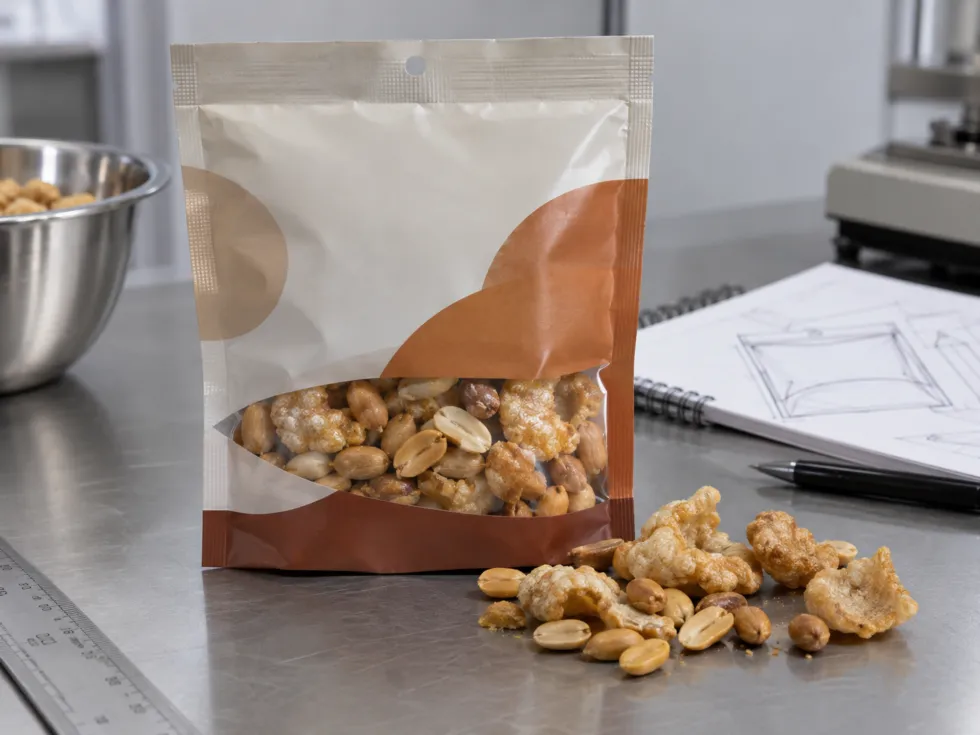
A clear window can improve product visibility, but it also changes the protection characteristics of the package.
Buyers should evaluate the balance between shelf appearance and protection requirements before approving the final design.
Why Fill Weight Alone Cannot Define Snack Pouch Size
A common purchasing mistake is selecting pouch dimensions only from fill weight.
An 80g or 250g snack pouch does not have one fixed size because products with the same weight can occupy different volumes.
Pouch dimensions are affected by:
- product density
- piece size and shape
- product volume
- headspace requirement
- filling method
- sealing area
- pouch style
Product Volume Is More Important Than Weight Alone
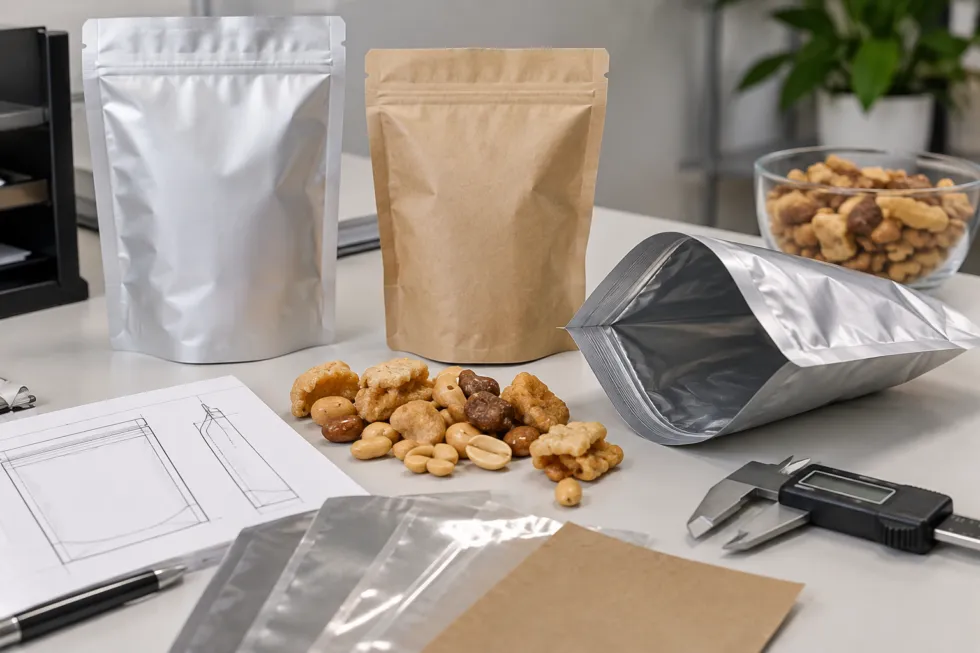
Two products with the same net weight can require different pouch dimensions.
For example:
- Dense nuts may need less space for the same weight.
- Lightweight irregular snacks may require more volume.
- Products with fragile pieces may require additional space to reduce crushing.
Before confirming pouch size, suppliers usually need:
- product description
- fill weight
- estimated product volume if available
- desired pouch style
- filling method
- existing pouch sample or reference size
Filling and Sealing Conditions Affect the Final Size
The usable space inside a pouch is not only the product volume.
The package also needs enough area for filling and reliable sealing.
A pouch designed for manual filling may require different considerations from a pouch used on automated packaging equipment.
If a current pouch is already working well, providing the existing sample, dimensions and product information can reduce communication time during development.
How Should Buyers Choose a High-Barrier Laminate Structure?
The laminate should be selected after defining the product risks and packaging requirements.
Common flexible packaging structures may include:
- PET/PE
- PET/VMPET/PE
- PET/AL/PE
- Other multilayer structures designed for specific applications
The correct structure depends on:
- oxygen protection requirements
- moisture protection requirements
- light protection needs
- sealing performance
- filling process
- storage and distribution conditions
A stronger barrier layer does not automatically mean the package is suitable for every snack product.
Compare Laminate Structure by Function, Not by Name
When reviewing packaging quotations, buyers should compare the actual laminate structure rather than only the description such as “premium barrier film” or “high-performance material”.
| Material Direction | Main Consideration | Buyer Should Confirm |
|---|---|---|
| Clear laminated structure | Product visibility and general packaging performance | Required oxygen, moisture and light protection |
| Metallized laminate | Barrier improvement and light protection direction | Exact structure, application and required performance |
| Foil-containing laminate | Higher barrier direction and opacity | Final pouch performance, sealing and product compatibility |
OTR and WVTR: Useful Data, Not Complete Specifications
OTR (Oxygen Transmission Rate) and WVTR (Water Vapor Transmission Rate) are commonly used when comparing packaging materials.
However, a single number does not define whether a pouch will protect a snack product successfully.
Buyers should confirm:
- the tested material structure
- test method
- test conditions
- measurement units
- whether the data applies to the final quoted laminate
A barrier value from another material or another snack application should not automatically become the specification for a new pouch project.
Why Heat-Seal Integrity Is Part of Snack Packaging Performance
A high-barrier laminate can still fail if the pouch seal does not perform properly.
The package protects the snack only when the entire system works together:
- film structure
- sealant layer
- heat-sealing process
- equipment settings
- production handling
The Sealant Layer Affects Package Reliability
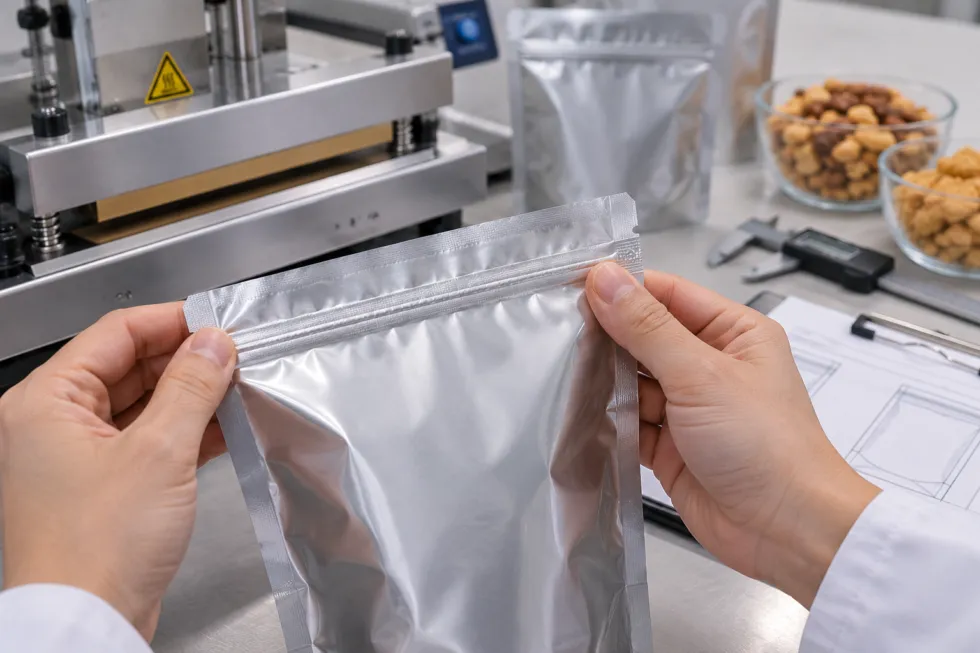
The inner sealant layer must match the pouch application and sealing process.
A material specification should not only describe the outside layer and barrier layer.
It should also consider the sealing layer because the seal creates the final protection boundary.
Important questions include:
- What sealing equipment will be used?
- What product conditions exist during filling?
- Could crumbs, powder or oil affect the seal area?
- How will seal quality be checked?
Sealing Temperature, Pressure and Time Need Validation
There is no universal heat-sealing setting that works for every snack pouch.
Seal performance depends on:
- film structure
- sealant material
- equipment condition
- temperature
- pressure
- sealing time
The correct sealing conditions should be established using the actual laminate and production equipment.
Seal Strength Does Not Equal Leak Protection
A seal can have sufficient mechanical strength but still contain a leak path.
For this reason, buyers should consider both:
- seal strength
- package leak tightness
Decision rule:
Evaluate the packaging material and sealing process as one system.
What Does Long Ambient Shelf Life Mean for Snack Packaging?
“Long shelf life” is not a material specification by itself.
A shelf-life target should define:
- storage conditions
- target period
- acceptable quality limits
- validation method
Define What Product Failure Means
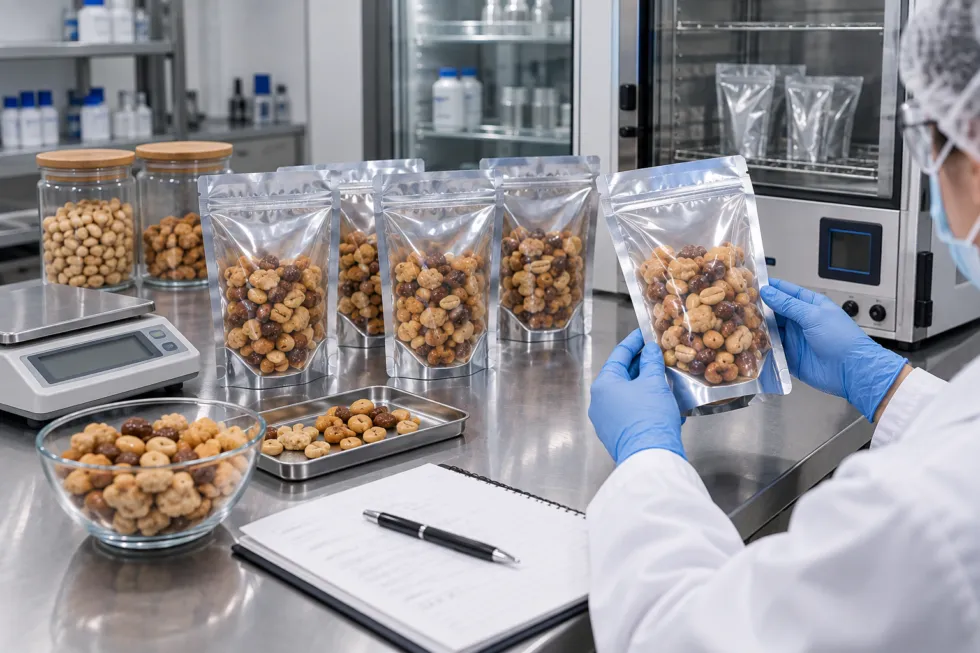
Different snack products have different shelf-life limits.
Possible quality limits may include:
- loss of crispness
- unacceptable flavor changes
- oxidation-related quality changes
- aroma loss
- package leakage
The acceptable limit should come from the brand owner’s product and quality requirements.
Material Data Is Not the Same as Finished Package Performance
A laminate may have measured barrier properties, but the final pouch includes additional factors:
- seals
- gussets
- zippers or other features
- conversion quality
- filling conditions
The finished pouch needs to be evaluated as the product that reaches the customer.
Validate the Filled Package
The important question is not only:
“What barrier film is used?”
It is:
“Does the finished package maintain the required product quality during the target storage period?”
Does a Snack Pouch Need Nitrogen Flushing?
Nitrogen flushing may be used for some snack applications, but it is not automatically required for every product.
Barrier film reduces gas and moisture transfer through the package.
It does not remove oxygen already inside the pouch when it is sealed.
The decision depends on:
- product sensitivity to oxidation
- current filling process
- headspace volume
- residual oxygen requirements
- shelf-life target
Questions to Confirm Before Adding Gas Flushing
- Is the current product already gas flushed?
- What filling equipment is being used?
- How much headspace remains after filling?
- Is residual oxygen measured?
- What quality issue is the process intended to solve?
Trade-off:
A stronger barrier material does not replace proper headspace management.
What Information Should You Send for a High-Barrier Snack Pouch Quote?
A good quotation starts with clear product and packaging information.
Providing the right details helps suppliers recommend a suitable pouch structure and reduces repeated communication.
Before requesting a quote, prepare the following information:
Product Information
- Product type
- Main ingredients or product characteristics
- Fill weight
- Approximate product volume if available
- Expected shelf life
- Storage and distribution conditions
Pouch Requirements
- Pouch style
- Finished pouch dimensions if available
- Reference pouch sample or photos
- Zipper requirement
- Tear notch requirement
- Window requirement
- Special shape or design features
Material and Performance Requirements
- Oxygen protection requirements
- Moisture protection requirements
- Light protection requirements
- Existing material structure if available
- Existing OTR or WVTR requirements if available
Production Information
- Filling method
- Heat-sealing equipment
- Gas flushing process if used
- Number of designs or SKUs
- Quantity required for each design
- Total order quantity
Market and Compliance Information
- Destination market
- Food-contact documentation requirements
- Special regulatory requirements if applicable
If some information is not available, buyers can provide the product details they already know.
The packaging structure can then be discussed based on the actual application.
How Should Buyers Compare High-Barrier Snack Pouch Quotations?
The lowest unit price does not always represent the lowest project cost.
Two quotations should be compared based on the complete specification:
| Comparison Item | Why It Matters |
|---|---|
| Finished pouch size | Confirms both suppliers are quoting the same package format. |
| Exact laminate structure | Different structures may provide different protection and sealing performance. |
| Pouch features | Zippers, windows, valves and special functions affect the final package. |
| Printing method | Digital and gravure printing may suit different quantities and project requirements. |
| Quality documentation | Helps buyers understand what information supports the specification. |
| Production arrangement | Important for launch timing and repeat orders. |
Common Mistakes When Buying High-Barrier Snack Packaging
Choosing Material Before Understanding the Product
A common mistake is selecting packaging only because another snack brand uses the same material.
The better approach is to start with:
- product characteristics
- shelf-life target
- storage conditions
- filling process
Using Fill Weight as the Only Size Reference
Weight does not determine pouch dimensions by itself.
Density, product shape and filling requirements also affect the final size.
Assuming a Strong Barrier Film Solves Every Problem
Packaging performance depends on the complete system.
Material, sealing, filling and handling all influence the final result.
Comparing Price Without Comparing Specifications
A lower quotation may represent a different laminate, different features or different production assumptions.
Always compare the same specification before comparing prices.
High-Barrier Snack Pouch RFQ Checklist
Use this checklist when contacting a flexible packaging supplier:
- Product name and description
- Fill weight
- Product volume or reference package size
- Target shelf life
- Storage conditions
- Required pouch style
- Pouch dimensions
- Material preference if available
- Barrier requirements if available
- Printing requirements
- Artwork availability
- Number of designs
- Quantity per design
- Total quantity
- Filling method
- Sealing process
- Gas flushing requirements if applicable
- Destination market
High-Barrier Snack Packaging FAQ
What is the best material for snack packaging?
There is no single best material for every snack product.
The suitable structure depends on product sensitivity, barrier requirements, filling process and storage conditions.
Does a thicker pouch always provide better protection?
Not necessarily.
Packaging performance depends on the complete laminate structure, barrier layer, sealing performance and application requirements.
Can an 80g or 250g snack pouch use a standard size?
Fill weight alone does not determine pouch size.
Product density, shape and filling requirements should also be considered.
Does every snack pouch need aluminum foil?
No.
Some products may require foil-containing structures, while others may use different laminated structures depending on protection requirements.
Is nitrogen flushing required for high-barrier snack packaging?
Not always.
Nitrogen flushing is a process decision based on product sensitivity, shelf-life requirements and packaging conditions.
What information should I prepare before requesting a quotation?
Prepare product details, fill weight, pouch style, quantity, artwork information, storage conditions and any known packaging requirements.
Work With a Flexible Packaging Supplier Based on Your Product Requirements
Choosing high-barrier snack packaging is not only a material selection decision.
The final pouch needs to match the product, filling process, storage conditions and quality expectations.
Beijing Honghai Packaging provides customized flexible packaging solutions including food pouches, stand-up pouches, flat bottom bags, rollstock film and other pouch formats.
For custom snack packaging projects, buyers can share:
- product information
- required pouch format
- target quantity
- design requirements
- application details
The packaging structure and production arrangement can then be reviewed according to the project requirements.
Request a packaging consultation for your snack pouch project.