
How to Choose Edible Ice Cube Packaging Bags for Retail Use
A bag for edible ice has a different job from a typical dry-food pouch. It comes into direct contact with food, stays frozen, carries a relatively heavy product, and is repeatedly pressed from the inside by hard, irregular cubes. If the pack also needs a flat bottom, large clear window, matte graphics and a carrying handle, those features become part of the packaging specification—not just the artwork.
For a 1 kg retail ice pack, do not start with a single film thickness or assume that PE/NY/PE is automatically the best structure. A more useful specification sequence is:
product and handling conditions → pouch geometry → functional features → candidate material structure → thickness → filled-pouch validation
This sequence helps avoid solving one problem, such as puncture resistance, while overlooking another at the seal, handle or window.
What Does an Edible Ice Cube Bag Actually Need to Do?
An edible ice bag needs to maintain its integrity under freezer conditions while managing direct food contact, localized pressure from frozen cubes, sealing and handling loads. For a 1 kg retail pouch, mechanical performance deserves specific attention alongside any barrier requirements.
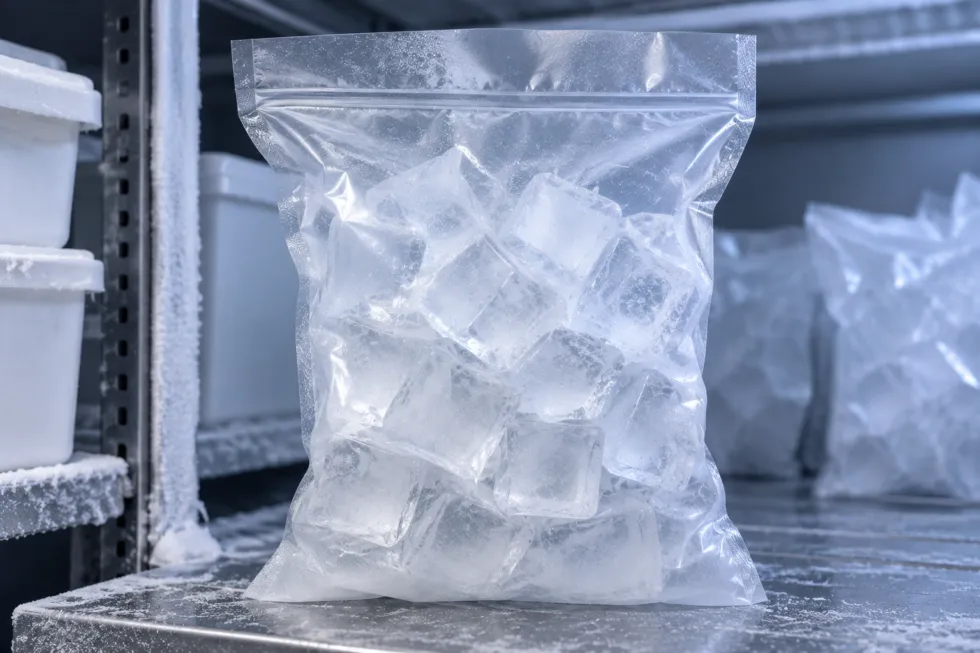
Freezer conditions change the mechanical requirement
Room-temperature performance should not be treated as proof of frozen performance.
Low-temperature food packaging can face pinhole, flex and puncture problems. Published technical work on a specific polyamide-based film for frozen-food packaging addresses pinhole and puncture resistance under low-temperature conditions, supporting the broader point that freezer performance should be evaluated rather than assumed. (patents.google.com)
This does not mean every nylon-containing laminate will perform adequately for ice. The exact construction and finished pouch still need to be evaluated for the intended application.
The buyer should therefore define more than “freezer bag.” Useful project conditions include the expected storage environment, distribution method, carton configuration and how the bags will be handled after freezing.
Ice cubes create localized puncture pressure
The contents themselves can become a source of mechanical stress. Cube edges and corners may press against small areas of the pouch during filling, freezing, carton packing, transport and consumer handling.
The risk can also change with cube geometry. Large angular cubes and smaller rounded pieces do not necessarily load the film in the same way.
Instead of asking only for a “strong material,” ask:
Can the proposed finished pouch tolerate the actual ice cubes, fill weight and handling conditions without unacceptable pinholes, punctures or seal damage?
That question shifts the discussion from material labels to finished-package performance.
Direct food contact needs to be treated as a defined use
Because edible ice directly contacts the inside of the pouch, food-contact suitability needs to be considered for the actual material structure and destination market.
For U.S. applications, the FDA lists frozen storage without thermal treatment in the container as a specific food-contact condition of use. FDA guidance also evaluates food-contact substances according to their intended conditions of use rather than through a generic “food-grade” designation alone. (fda.gov)
The buyer should therefore identify the destination market and required food-contact documentation before approving the final structure.
A retail pouch adds structural demands
A basic commodity ice bag may primarily need to contain and transport ice. A custom retail pouch may also need to stand on shelf, carry printed branding, display the product through a window and support its weight through a die-cut handle.
Those requirements interact. A large window reduces printable area. A handle creates a concentrated load zone. A flat bottom changes the pouch geometry. A matte surface affects the visual specification. The top of the pouch also needs enough usable space for sealing, the handle and artwork.
The finished pouch should therefore be evaluated as one package rather than as a list of independent features.
PE, NY/PE or a Multilayer Laminate: Which Material Direction Makes Sense?
There is no single laminate code that is best for every edible ice pouch. PE-family structures may suit some applications, while a nylon-containing laminate is worth evaluating when puncture, flexing and mechanical stress are more demanding.
For a 1 kg flat-bottom retail pouch with a carrying handle, choose the material together with the pouch construction rather than in isolation.
| Material direction | Why a buyer might consider it | What still needs confirmation |
|---|---|---|
| PE-family structure | Heat-sealing function and potentially simpler ice-bag applications | Freezer behavior, puncture resistance, required thickness, print construction and finished-bag performance |
| Nylon-containing structure | Worth evaluating where puncture, flexing and mechanical stress are concerns | Exact layer construction, thickness, sealing behavior and freezer validation |
| PET/Nylon/PE | A candidate direction where printability, mechanical performance and a PE sealing layer need to work together | Suitability for the actual ice cubes, pouch size, handle, filling and distribution |
| Other multilayer laminate | Projects requiring a different combination of print surface, mechanical properties, sealing or other functions | Purpose of each layer, food-contact suitability, manufacturing compatibility and validation |

When does a PE-based direction make sense?
PE is relevant to flexible packaging as a heat-sealing layer and can contribute useful flexibility. A PE-oriented construction may be worth discussing when the application is relatively straightforward and the proposed structure can meet the required mechanical conditions.
But “PE bag” is not a complete specification.
Bags described with the same general material name can still differ in construction, thickness, sealing behavior and finished performance. When comparing quotations, ask suppliers to state the proposed structure rather than comparing only the headline material name.
Why consider nylon for ice packaging?
Nylon, or polyamide, is worth evaluating when puncture and mechanical abuse are important concerns.
Technical work on specific polyamide-based films for frozen-food packaging has examined pinhole and puncture resistance under low-temperature conditions. (patents.google.com) That provides a technical basis for considering nylon-containing structures in a frozen application, but it does not establish the performance of every NY laminate.
The distinction is important:
A candidate material direction is not a proven final specification.
PET/Nylon/PE can be considered for a strength-oriented flexible packaging project, but the laminate name alone does not establish that the finished 1 kg ice pouch will meet the required puncture, handle or freezer performance.
When does a multilayer structure make sense?
Use additional layers when each layer performs a defined job.
In a laminated pouch, different layers may contribute printability, mechanical properties and heat sealing. More layers do not automatically mean a better package.
For the proposed ice pouch, ask:
- What is the outer layer intended to do?
- Which part of the structure addresses mechanical demands?
- Which layer provides the food-contact sealing surface?
- Why is each layer needed for this pack?
A more complicated laminate only adds value when its construction addresses a defined packaging requirement.
Why Shouldn’t Thickness Be Chosen Before the Structure?
Thickness should not be selected before the material structure because the same total thickness can represent different layer combinations and different package behavior. Pouch dimensions, cube geometry, laminate composition, handle design and distribution conditions all affect the decision.
A request for a specific micron value may sound precise while leaving the more important packaging variables unresolved.

Cube size and shape matter
Hard, angular cubes can concentrate force against a small area of film. Cube dimensions should therefore be part of the specification when puncture resistance is a priority.
If possible, use representative cube dimensions or the actual product during validation.
Finished pouch dimensions and headspace matter
One kilogram defines the mass of ice, not the required pouch width, height or gusset.
The required volume depends on cube size, packing arrangement, pouch geometry and headspace. An overfilled pouch can also increase pressure against the walls and seals.
Total thickness does not describe layer composition
A multilayer laminate has to be considered by structure, not only by total thickness. Adding thickness without understanding where the mechanical or sealing risk lies may add material without addressing the weak point.
The better question is not:
“What is the thickest option?”
It is:
“What structure and thickness combination suits the actual mechanical and sealing conditions?”
The handle changes the load
Once the pouch is carried by a die-cut handle, the package is dealing with more than pressure from the contents. The filled weight is transferred through the handle region and nearby material.
Thickness therefore needs to be considered together with handle geometry and pouch construction.
Use filled samples to replace guessing
Do not approve a thickness simply because it sounds heavy-duty. Compare candidate constructions using the intended fill weight and representative ice under the expected freezer and handling conditions.
That evaluates the package buyers will actually use rather than a micron number in isolation.
Is a Flat-Bottom / Eight-Side-Seal Pouch Suitable for 1 kg of Ice?
A flat-bottom pouch is a viable starting format for a 1 kg branded ice pack when shelf presentation, printable panels and a structured retail format are priorities. Final suitability still depends on dimensions, bottom construction, material, top seal, handle and filled-pouch behavior.
Flat-bottom pouches can be produced with an integrated top-handle configuration, so the format is compatible in principle with the proposed retail concept.

Do not determine pouch size from 1 kg alone
Net weight is not enough to determine the final pouch size.
The supplier also needs the physical volume of the packed cubes, approximate cube dimensions, intended fill level, headspace and how the cubes settle inside the pouch.
If an existing ice pack fits the product well, its finished dimensions can provide a useful reference. Otherwise, sample filling is more reliable than selecting dimensions from weight alone.
Check the bottom after filling and freezing
A flat base can improve retail presentation, but the finished pouch should be checked with the product inside it.
Questions include:
- Does the base open and fill as intended?
- Does the frozen pack remain acceptably stable?
- Do cubes concentrate pressure at bottom or corner areas?
- Does the pouch fit and behave properly inside the shipping carton?
An empty pouch cannot answer these questions.
Define the top seal around the filling process
“Strong heat-sealed top” describes the desired outcome, not a complete specification.
Seal performance can depend on the sealant layer, sealing parameters, seal geometry and conditions in the seal area. The buyer should also state whether filling and sealing will be manual or equipment-based because that can affect the final pouch design.
How Should a Large Clear Window and Matte Finish Be Designed?
Treat the clear window and matte appearance as part of the pouch construction and print specification from the beginning. Do not finalize the artwork and then ask the converter to add a window afterward.
A large window affects both product visibility and available branding space.

Specify the window, not just “large”
The RFQ should define:
- approximate window dimensions;
- position on the front panel;
- required clarity;
- distance from seals and structural areas;
- whether the window should expose most of the ice or only part of the product.
The converter can then evaluate the window against the dieline and pouch construction.
Separate the matte and clear visual targets
If the concept calls for a frosted or matte translucent pack with a clear product window, identify those areas separately.
Define which regions need the muted matte appearance and which need unobstructed visibility of the ice. Otherwise, suppliers may interpret the same brief differently.
Protect functional areas before finalizing graphics
Keep important branding, mandatory text and the clear window away from handle, seal and gusset zones unless the design has been reviewed for those locations.
The dieline should establish these functional areas before final artwork approval. This matters particularly when a large window and top carrying handle compete for space on the same pouch.
Digital and rotogravure printing are available for custom pouch projects, with printing of up to 10 colors. The appropriate printing route should be confirmed against order quantity, number of designs, material and required finish.
What Should Be Checked When Adding a Carrying Handle?
Treat the carrying handle as a load-bearing part of the pouch. Its location, surrounding material, relationship to the top seal and behavior with a frozen 1 kg load should be checked before bulk production.
A die-cut handle is not simply a graphic feature.
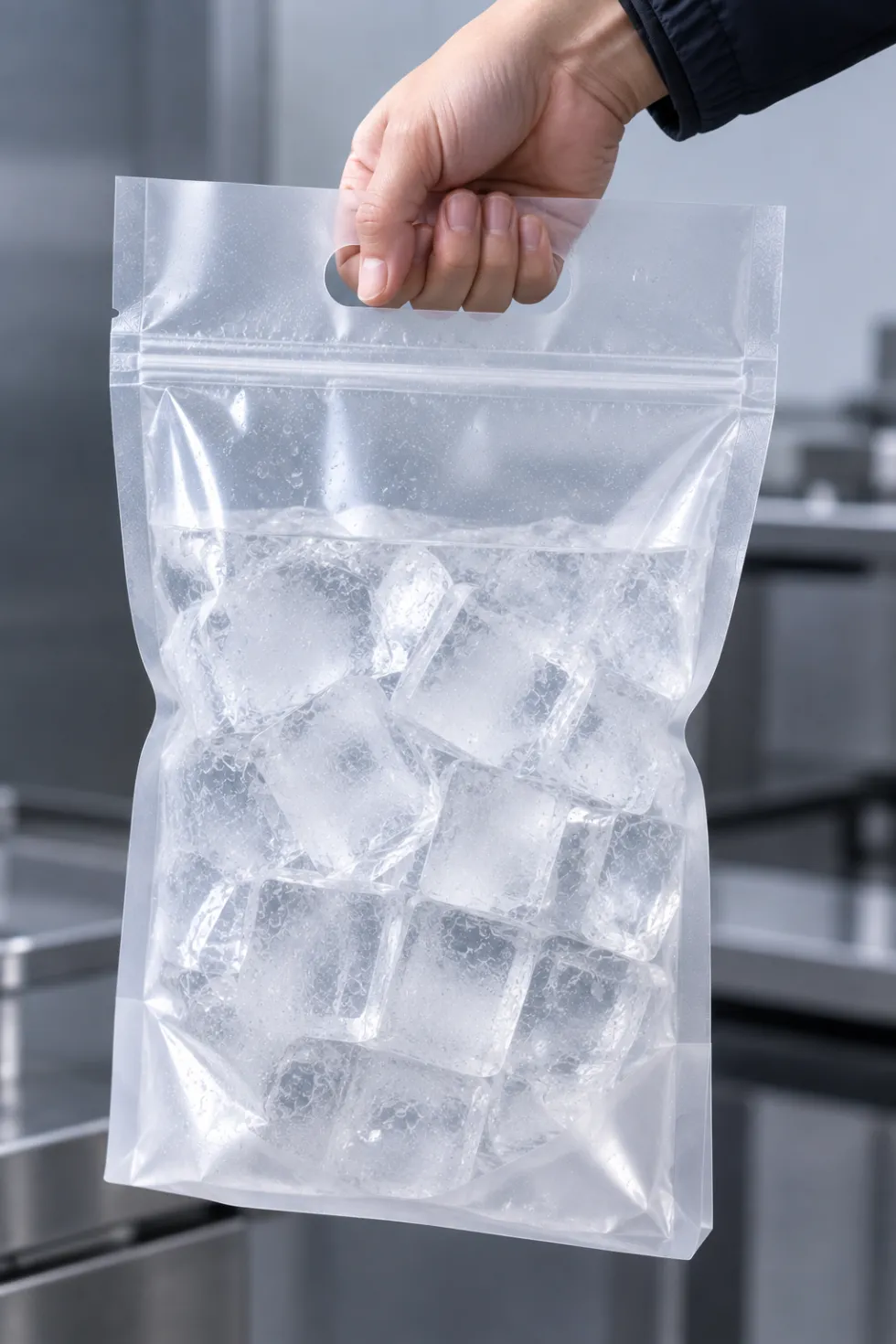
Consider the load path
When the customer lifts the bag, the filled weight is transferred toward the handle area. The material around the cutout therefore experiences concentrated stress.
The design needs enough material around the handle rather than placing the cutout too close to an edge or another weakened area.
Keep the handle and top seal from competing for space
A large handle near the top reduces the space available for sealing, printing and structural support.
Review handle location together with the top seal and overall pouch height instead of approving these features separately.
Define whether the handle is for carrying or hanging
A carrying handle and a retail hanging feature do not necessarily experience the same load pattern.
If the 1 kg pack will only be lifted and carried, state that. If it may hang from the handle during display or storage, include that condition in the project brief.
Test the filled frozen pouch
Handle evaluation should use the intended fill weight.
Fill the pouch with representative ice, freeze it under the intended conditions, handle it as expected in distribution or consumer use, and inspect the handle region, top seal and adjacent laminate.
An empty sample can show the handle position and appearance, but it cannot validate performance under load.
What Does “Food Grade for Edible Ice” Need to Mean?
For edible ice, “food grade” should refer to food-contact materials and documentation appropriate to the intended use and destination market. It should not be treated as a universal certification claim.
Start with where the product will be sold and how the packaging will be used.
For U.S. applications, FDA identifies frozen storage without thermal treatment in the container as a food-contact condition of use. (fda.gov)
For a purchasing or QA team, the RFQ should identify:
- destination country or market;
- direct food-contact application;
- frozen storage conditions;
- required declarations, reports or supporting documents;
- customer- or retailer-specific documentation requirements.
Do not assume that a general factory certificate proves that every material structure satisfies every food-contact requirement in every market. Where regulatory approval matters, check the applicable documentation, its scope and its relevance to the proposed packaging.
What Should You Test Before Ordering Bulk Ice Packaging?
Test the finished pouch under conditions that resemble actual filling, freezing, handling and distribution. A material name or empty sample cannot validate all the failure modes of a 1 kg ice pack.
The purpose is to find specification problems while dimensions, structure, handle or artwork can still be adjusted.
A practical buyer-side validation checklist includes:

- Fill fit: Does 1 kg of the intended cube format fit with appropriate headspace?
- Freezer behavior: Does the pouch remain usable after the intended frozen-storage conditions?
- Puncture observation: Are there pinholes, cuts or concentrated stress marks where cube edges contact the film?
- Top seal: Does the sealed area remain intact after freezing and handling?
- Handle: Can the frozen filled pouch be carried as intended without visible tearing or deformation?
- Bottom and side seals: Are there signs of stress after filling, freezing and carton handling?
- Window: Does it provide the required product visibility?
- Print and matte appearance: Does the finished pack match the approved visual target?
- Carton fit: Does the filled pouch work with the intended secondary-packaging arrangement?
These are buyer-side validation points rather than a fixed factory testing protocol. The final checks should reflect the risks of the actual project.
If the project requires defined puncture performance, OTR, WVTR or other technical values, request applicable material data or test documentation rather than substituting generic industry values.
A stock sample can help evaluate format, appearance or general construction. It does not prove how the final custom pouch will perform with the buyer’s ice.
What Information Does a Supplier Need to Recommend the Final Structure?
A supplier can make a more useful recommendation when the RFQ describes the product, pouch, handling conditions and commercial requirements together. “1 kg ice bag—please recommend material and thickness” leaves too many variables unresolved.
For this project, provide the following information.
Product and filling
- Edible ice cubes
- Net weight: 1 kg
- Approximate cube dimensions and shape
- Filling temperature, if known
- Manual or automatic filling
- Expected fill level and headspace
Pouch construction
- Flat-bottom / eight-side-seal format
- Target finished dimensions, if known
- Integrated die-cut carrying handle
- Heat-sealed top requirement
- Large front clear window
- Any zipper, tear feature or other required function
Storage and distribution
- Expected freezer conditions
- Transport method
- Secondary carton arrangement
- How the consumer is expected to carry the bag
- Destination country or market
Printing and appearance
- ICEENO artwork
- Number of designs or SKUs
- Matte or frosted visual target
- Clear-window dimensions and position
- Number of print colors, if defined
- Artwork status
Commercial and approval information
- Quantity required per design
- Total quantity
- Required food-contact documentation
- Sample or validation requirements
- Target purchasing schedule
For custom premade pouches, the standard MOQ starts from 1,000 pieces, excluding rollstock. If the project contains multiple designs or sizes, provide the required quantity for each design so the production arrangement can be confirmed.
How Should Buyers Compare Quotes for Custom Ice Cube Bags?
Compare quotations only after suppliers are quoting substantially the same specification. A lower unit price is not a meaningful comparison if pouch size, laminate, thickness, handle construction, print process or quantity basis differs.
A normalization table makes those differences visible:
| Quote field | Supplier A | Supplier B | Supplier C |
|---|---|---|---|
| Finished pouch dimensions | |||
| Pouch format | |||
| Material structure | |||
| Total thickness / layer details | |||
| Printing method | |||
| Number of designs | |||
| Matte / frosted finish | |||
| Clear window specification | |||
| Handle construction | |||
| Quantity per design | |||
| Total quantity | |||
| Plate / cylinder charges, if applicable | |||
| Sample arrangement | |||
| Production schedule | |||
| Required food-contact documents |

This table also exposes incomplete quotations. “NY/PE, 1 kg ice bag,” for example, is not enough for a technical comparison if dimensions, construction and thickness are unspecified.
Define the quote basis before comparing unit prices
Unit price depends on the project specification. Size, material structure, thickness, printing, surface finish, window, handle, number of designs and quantity need to be defined before quotations can be compared on the same basis.
Plate or cylinder charges, where applicable, also depend on the selected printing route and artwork arrangement.
Sample costs and arrangements require project-specific confirmation and should not be inferred from the bulk MOQ.
Production timing should likewise be confirmed for the current project. Artwork status, printing route, material, pouch construction, quantity and production scheduling can affect the quotation and schedule.
What Should Be Confirmed Before Requesting a Final Quote?
Before requesting a final quote, define enough of the project for suppliers to quote on the same basis while leaving genuinely technical variables open for recommendation and validation.
For the proposed ICEENO 1 kg edible ice pouch, the brief can be divided into two groups.
Known requirements
- 1 kg edible ice cubes
- Flat-bottom / eight-side-seal pouch
- Frosted or matte appearance
- Large clear front window
- Integrated die-cut carrying handle
- Heat-sealed top
- Direct food contact
- Freezer storage
- High concern about puncture from ice cubes
- Custom printed artwork
Still to be confirmed
- Final pouch dimensions
- Cube dimensions and geometry
- Final laminate structure
- Final material thickness
- Exact handle geometry
- Window dimensions and placement
- Filling and sealing method
- Required freezer and puncture validation
- Destination-market food-contact documentation
- Printing route
- Sample arrangement
- Unit price
- Plate or cylinder cost, where applicable
- Current production schedule
A nylon-containing structure such as PET/Nylon/PE is a reasonable candidate to evaluate because this project places meaningful mechanical demands on the pouch. It should not be approved from the laminate name alone. The final structure and thickness should be assessed using the actual pouch geometry, fill conditions and representative ice under the intended freezer and handling conditions.
For an RFQ, send the 1 kg fill weight, approximate cube dimensions, desired pouch dimensions if known, flat-bottom format, handle and window requirements, freezer and transport conditions, ICEENO artwork, quantity per design, total quantity and destination market. These inputs give the supplier a clearer basis for recommending the structure and preparing a comparable quotation without relying on guessed thicknesses or generic specifications.