
Beef Jerky Packaging With Clear Windows: Materials, Seals and Small Orders
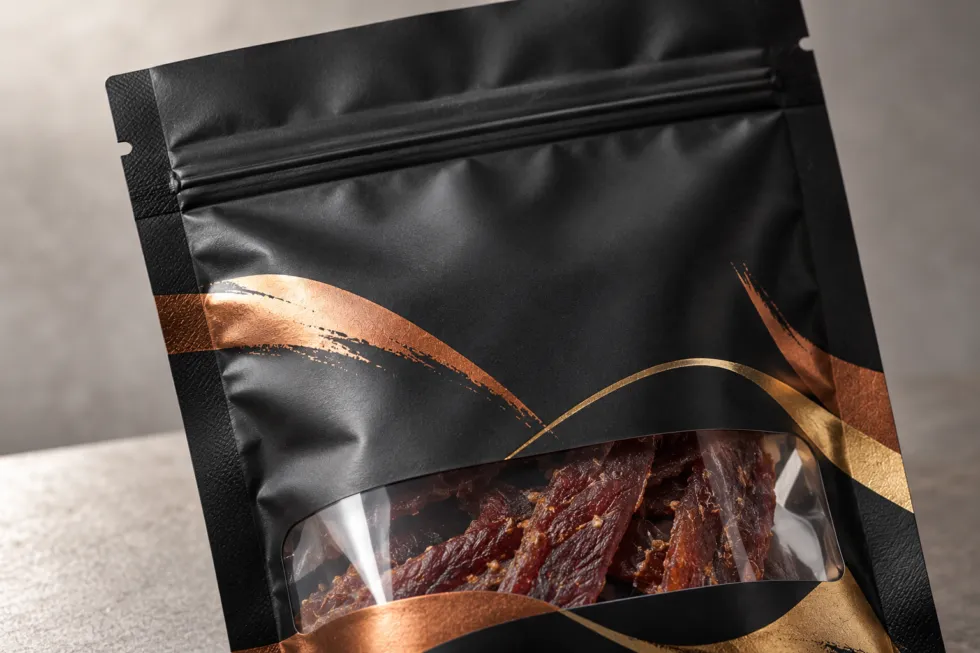
A matte-black beef jerky pouch with a transparent window, metallic accents and a resealable zipper can give a brand a recognizable retail appearance. The window lets shoppers see the meat inside, while the printed panels carry the brand and product information.
But appearance alone does not establish whether the packaging will protect the product during storage and distribution.
Beef jerky packaging with a clear window can be a suitable option when the material construction, oxygen and moisture barriers, sealing method and storage conditions have been properly evaluated. A transparent window does not automatically mean inadequate protection, just as an opaque foil pouch does not automatically guarantee a particular shelf life.
The buying decision involves several connected questions. Can the windowed pouch provide the required barrier performance? Will the proposed dimensions accommodate the actual product? Can the zipper, tear notch and top heat seal work together? Which printing method can achieve the desired finish without unnecessary cost?
For smaller brands, order quantity introduces another consideration. The packaging design may be ready before the business is prepared for a full custom production run.
The sensible starting point is to establish the product’s protection requirements, develop a manufacturable pouch specification and validate the design with samples before approving commercial production.
Can Beef Jerky Packaging Have a Clear Window Without Compromising Protection?
Yes. Beef jerky packaging can include a transparent window if the complete material structure and finished package meet the product’s protection requirements. The window should be evaluated as part of the packaging construction, not treated solely as a decorative feature.
The relevant issue is not simply whether a bag is transparent or opaque. It is whether the selected film, printed and unprinted areas, seals and any window construction provide appropriate protection under the intended conditions.
What a Clear Window Changes in Pouch Design
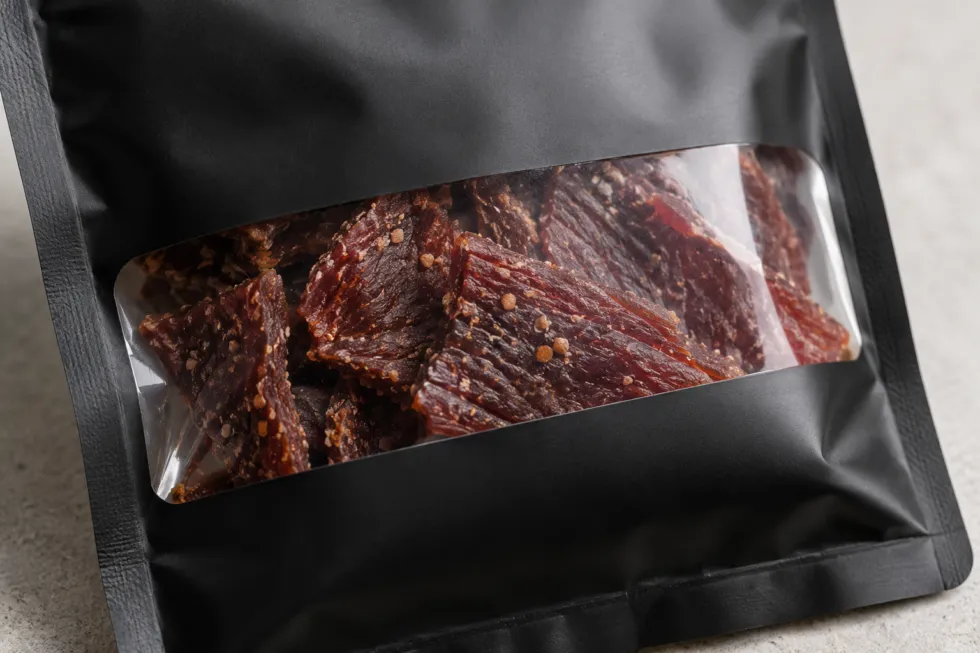
A transparent window gives shoppers a direct view of the jerky’s color, cut size, shape and texture.
This can be useful when product appearance is part of the purchasing decision.
However, there are different ways to create a transparent viewing area.
One approach is to use a suitable transparent laminate and leave a selected area unprinted while printing the surrounding panels. In this configuration, the transparent viewing area may retain the same underlying film structure as the printed areas.
Another approach involves an otherwise opaque construction with a separate transparent window area. Such a design may introduce different materials or additional construction requirements.
These approaches should not be treated as technically equivalent.
The first requires confirmation that the underlying transparent film provides the necessary performance. The second requires the supplier to review the window construction, material compatibility and any additional joining or sealing requirements.
For either approach, confirm:
- What material actually forms the transparent area?
- Does the transparent region have appropriate oxygen and moisture barrier properties?
- Is the window created by the printing layout or by a different material construction?
- Will its position interfere with seals, folds or the bottom gusset?
- Does the material provide the required protection under the intended storage conditions?
The practical rule is to specify the window construction before approving the final artwork.
A visual design showing a clear area does not identify the material behind it.
Clear-Window vs Fully Opaque Beef Jerky Pouches
| Evaluation factor | Clear-window pouch | Fully opaque pouch |
|---|---|---|
| Product visibility | Allows consumers to inspect the visible jerky | Product appearance must be communicated through artwork |
| Light exposure | Depends on transparent material and window dimensions | May provide greater light shielding with suitable opaque materials |
| Oxygen and moisture barrier | Requires evidence for the actual transparent construction | Depends on the selected opaque laminate |
| Artwork | Must preserve a suitable viewing area | Allows more continuous printing |
| Manufacturing | Printing or window-construction details require review | No transparent-window construction is needed |
| Main trade-off | Product visibility versus material and design constraints | Product concealment versus potentially simpler construction |
Neither option is automatically better.
A transparent barrier film may be suitable for a product with a defined protection requirement. Conversely, a fully opaque structure may be preferable when the approved packaging specification places greater emphasis on light shielding or a particular laminate construction.
The comparison should use materials with documented performance rather than rely on visual appearance.
When a Fully Opaque Pouch May Be More Appropriate
An opaque pouch deserves consideration when the product requires protection from light, when the intended window cannot be incorporated into the approved material structure or when simplifying the packaging construction is commercially valuable.
It also provides a useful comparison during development.
Testing an opaque candidate alongside a transparent-window candidate can help determine whether the additional design complexity produces a worthwhile retail benefit.
The goal is not to eliminate windows. It is to retain them when their benefits justify the material, manufacturing and validation requirements.
What Product Information Determines the Barrier Requirements for Beef Jerky?
The correct barrier material depends on the actual jerky formulation, processing controls, water activity, intended storage conditions and packaging method. The term “beef jerky” alone cannot establish a suitable OTR, WVTR, film thickness or shelf life.
Two beef jerky products may have different moisture characteristics, seasoning formulations, fat contents and storage requirements.
A packaging specification should begin with the product rather than a generic high-barrier material recommendation.
Water Activity, Moisture and Storage Conditions
Water activity, commonly expressed as aw, describes the availability of water within a food. It is different from total moisture content.
The US Food and Drug Administration identifies water activity as an important factor affecting microbial growth and food stability.
Source: FDA — Water Activity (aw) in Foods.
For jerky products, processing controls and the final product condition matter alongside packaging.
The US Department of Agriculture also explains that the safe production and storage of jerky depend on appropriate processing and drying practices. Its guidance distinguishes commercial jerky production from uncontrolled home preparation.
Source: USDA FSIS — Jerky and Food Safety.
Before selecting a pouch material, the food producer should establish:
- The actual product formulation and processing conditions.
- Available water activity and moisture information.
- Whether the product is validated for ambient storage or requires refrigeration.
- The intended filling and packaging process.
- The distribution and retail storage environment.
- The required shelf life and supporting validation criteria.
These details determine which performance requirements the packaging must help maintain.
A material supplier cannot establish food safety or shelf life simply by recommending a laminated film.
Oxygen and Moisture Exposure: What Needs to Be Evaluated?
Oxygen and moisture can affect the quality of dried meat products, although the degree and nature of the effects depend on the product.
Oxygen exposure may be relevant to oxidation-related changes in susceptible components, including fats. Moisture transfer may affect product texture and other quality characteristics.
The appropriate packaging response depends on the established product requirements.
Two common material measurements are:
OTR — Oxygen Transmission Rate: Used to evaluate oxygen transmission through a specified material under defined test conditions.
WVTR — Water Vapor Transmission Rate: Used to evaluate water vapor transmission through a specified material under defined test conditions.
A low transmission value under one test condition does not automatically prove that the packaging is suitable for every product or storage environment.
When reviewing technical documents, buyers should confirm the tested material structure, measurement units, test conditions and whether the results apply to the proposed finished packaging.
This is particularly important if the pouch uses different materials in its transparent and opaque sections.
Why Packaging Film Alone Cannot Guarantee Shelf Life
Packaging helps control exposure to the surrounding environment. It does not replace validated food-processing controls.
Shelf-life assessment must account for the product, processing method, material properties, package integrity and intended storage conditions.
Changing from an existing pouch to a windowed design may require reassessment if the materials or packaging system change.
The correct purchasing question is therefore:
Which documented packaging construction meets this jerky product’s established protection and storage requirements?
A supplier can propose candidate films and provide available technical information. The food producer and responsible quality team must determine whether the complete packaging system meets the product’s safety and stability requirements.
How Do You Choose the Right Stand-Up Pouch Size, Gusset and Closure?
Pouch width, height and bottom gusset dimensions must be verified with the actual jerky before they become an approved manufacturing specification. A proposed external size does not guarantee the required filling capacity.
Jerky pieces can vary in length, thickness, shape and packing density. Those variations affect the space occupied inside a bag.
External Dimensions vs Usable Filling Space
A stand-up pouch contains areas that cannot all be used for filling.
These include its side seals, bottom construction, upper heat-seal area and space occupied by the zipper and other accessories.
Two bags with the same stated width and height may have different usable capacities.
For a trial package, check:
- Whether the intended product weight fits without excessive compression.
- Whether the jerky remains below the required sealing area.
- Whether the filled pouch stands and presents the product correctly.
- Whether the product presses excessively against any part of the film.
- Whether there is sufficient room for reliable final sealing.
The actual pieces should be used during testing.
A nominal product weight cannot establish capacity without accounting for the size, shape and arrangement of the contents.
Use a filled physical sample before approving the final pouch dimensions.
How Bottom Gusset Dimensions Affect the Filled Pouch
The bottom gusset allows the package to expand when filled and contributes to the shape of the finished pouch.
Increasing the gusset may increase available space, but it does not automatically improve standing stability or reduce cost.
The result depends on the product quantity, distribution of contents and overall bag dimensions.
There is also a possible communication problem: manufacturers and buyers may use different conventions when describing gusset depth.
Before approving the dieline, confirm exactly how the stated gusset dimension is measured.
A physical sample or a technical drawing showing the folded and opened construction can prevent a dimensional misunderstanding.
Top Heat Seal, Tear Notch and Zipper: How They Work Together
The zipper, tear notch and top heat seal have separate functions.
Top heat seal: Forms the initial sealed closure after the pouch has been filled, using a suitable material and validated sealing process.
Tear notch: Helps the consumer open the sealed upper section at the intended location.
Resealable zipper: Allows the consumer to close the pouch again after opening.
A typical design must provide adequate space for each function.
| Feature | Main purpose | What to verify |
|---|---|---|
| Top heat seal | Initial package closure | Seal position, consistency and integrity |
| Tear notch | Controlled initial opening | Correct location relative to the seal and zipper |
| Zipper | Reclosing after opening | Accessibility and reliable operation |
| Upper pouch area | Space for the closure construction | Adequate allowance above and below the zipper |
The design should allow the consumer to open the package without damaging the zipper.
It must also prevent product pieces from interfering with the final heat-sealing area during filling.
A resealable zipper should not be treated as a substitute for the initial heat seal when the unopened package requires a sealed closure.
Both manufacturing requirements and consumer use should be checked before approving the bag.

Which Material Structures Should Be Considered for Clear-Window Jerky Pouches?
Material structures should be shortlisted according to the product’s required oxygen and moisture protection, transparency, sealing compatibility and handling conditions. No laminate should be approved solely because it is commonly described as suitable for jerky.
The selected material must be evaluated as part of the complete package.
Transparent Laminates and Barrier Requirements
Transparent packaging may use a multilayer laminate designed to combine printability, mechanical properties and heat sealing.
PET/PE is one possible structure for initial discussion, but the designation alone does not establish any particular barrier performance.
Other transparent structures, including certain coated barrier films, may provide different properties.
The important distinction is between transparency and demonstrated barrier performance.
A transparent film can be evaluated for oxygen and moisture resistance without assuming that every transparent construction performs identically.
The supplier should confirm the exact structure and available technical data before recommending it for the intended product.
For a pouch whose window is formed by leaving part of the outer artwork unprinted, the underlying transparent film specification still needs to meet the product requirements.
If the window uses a separate material construction, that difference must also be included in the technical review.
Metallized and Foil-Based Material Directions
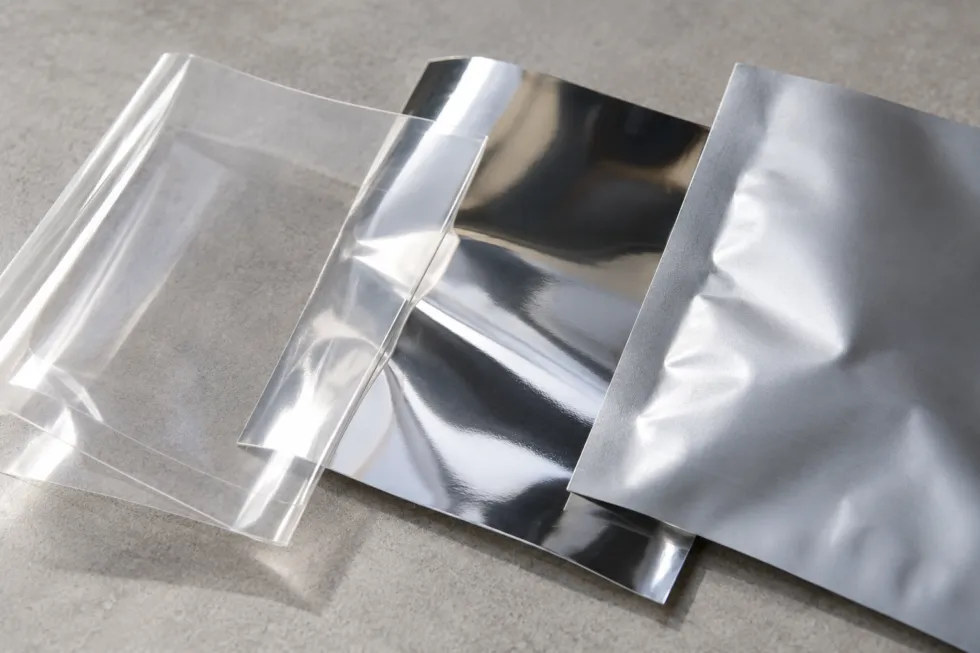
Metallized and aluminum-foil-containing laminates may be appropriate for applications requiring particular barrier or light-protection properties.
Examples of material directions used in flexible packaging include PET/VMPET/PE and PET/AL/PE.
However, these structures are generally opaque in areas containing metallized or aluminum-foil layers.
A transparent window cannot simply be assumed to have the same performance as the opaque area.
| Material direction | Potential reason to evaluate | What needs confirmation |
|---|---|---|
| Transparent PET-based laminate | Transparency, printing and heat-sealing possibilities | Actual barrier data and compatibility |
| Transparent barrier-coated film | Visibility with additional specified barrier requirements | Material-specific test evidence and availability |
| Metallized laminate | Selected barrier properties in opaque packaging | Window feasibility, material performance and sealing |
| Aluminum-foil-containing laminate | Defined high-barrier or light-protection requirements | Suitability, construction, flexibility and cost |
These are material selection directions, not approved specifications or measured performance rankings.
A complex laminate may add cost without a corresponding benefit if the product does not require its particular properties.
Why OTR and WVTR Reports Must Match the Proposed Film
Barrier reports are valuable only when they correspond to the material under consideration.
Relevant recognized test methods include:
These methods provide ways to evaluate the respective transmission properties of packaging films under specified conditions.
A buyer should review:
- The actual tested material structure.
- The test method and stated conditions.
- The reported units and results.
- Whether coatings or other relevant material features are included.
- Whether the report applies to the proposed transparent area.
A report for one laminate should not be presented as evidence for a different laminate simply because the material names appear similar.
Film testing also does not replace evaluation of seals, filled-package integrity or food shelf life.
Where those factors matter, the validation plan should cover them separately.
How Should Matte Black and Copper or Gold Finishes Be Specified?
Matte black, copper and gold should first be defined as visual design requirements, then translated into specific printing and finishing processes. A metallic-looking color does not automatically mean foil stamping is required.
Different processes may produce different appearances and commercial costs.
Matte Finish vs Metallic Printed Effects
A matte surface provides a low-gloss appearance.
Metallic-looking details can be created through suitable printing or finishing processes, depending on the intended effect and material compatibility.
A gold-colored design element may look different when produced as ordinary printing, a metallic effect or foil stamping.
The same applies to a copper-colored detail.
A digital mockup cannot establish how each option will appear on the final pouch.
Before production, determine whether the important requirement is color accuracy, metallic reflectivity, texture or contrast against the matte background.
Gold Stamping, Copper-Look Printing and Cost Trade-offs
Foil stamping and printed metallic effects are different manufacturing processes.
Foil stamping adds a decorative foil effect through a separate application process. Printed metallic effects depend on the printing system, inks and substrate.
A copper-look design may be achievable through an approved printed effect without requiring copper foil.
| Desired appearance | Option to discuss | Main confirmation |
|---|---|---|
| Matte-black background | Suitable matte print and finish | Appearance and surface compatibility |
| Metallic gold detail | Metallic effect or gold stamping | Required reflectivity and production method |
| Copper-colored accent | Suitable printed or decorative finish | Color and appearance approval |
| Transparent window | Unprinted transparent region or reviewed window construction | Manufacturing and material compatibility |
Honghai Packaging has established custom printing capabilities, including digital and rotogravure printing, along with several decorative finishing directions.
The feasibility of a particular combination depends on the artwork, selected materials, production method and quantity.
There is no reliable universal price difference between these options.
Compare costs only after the pouch structure, dimensions and finish requirements have been defined consistently.
Window Placement, Artwork Layout and Print Approval
Window placement should be incorporated into the dieline before artwork approval.
The finished pouch must still display branding, product information and any required labeling clearly after filling.
The design should account for:
- The window’s dimensions and position.
- The bottom gusset and side seals.
- The zipper and tear notch.
- Areas requiring metallic or other special effects.
- Front and back printing.
- Barcode and product-information placement.
- Artwork variations across different products.
For multiple designs, confirm the quantity required for each artwork before determining the production arrangement.
Approve a design that can be manufactured and filled correctly, not only one that looks attractive on a screen.
Can You Order Custom Beef Jerky Packaging Below 1,000 Pieces?
Honghai Packaging’s standard MOQ for custom premade pouches starts from 1,000 pieces, excluding rollstock. Requests for fewer than 1,000 custom printed pouches therefore require separate discussion about samples or other project-specific possibilities. They should not be treated as automatically accepted commercial production orders.
For a small brand, the immediate need may be packaging validation rather than a full printed production run.
Commercial MOQ vs Sample Quantity
MOQ is the minimum quantity associated with the standard commercial production arrangement.
A sample request serves a different purpose.
A brand may want to test the filling capacity, window position, zipper operation or appearance before committing to printed inventory.
Those tests help determine whether the specifications are ready for production.
For multiple pouch sizes or artworks, the buyer should provide the quantity required for each. The production arrangement and applicable MOQ must then be confirmed.
Do not assume that quantities from different designs can automatically be combined into a single MOQ.
Existing Samples, Trial Samples and Custom Printed Production
| Purchasing requirement | Main purpose | What must be confirmed |
|---|---|---|
| Existing pouch sample, if available | Examine general materials, construction or accessories | Availability and relevance |
| Trial sample | Assess product fit, filling and selected functional requirements | Feasible sample structure, cost and timing |
| Custom printed production | Manufacture the approved commercial pouch | MOQ, printing, artwork and quantity arrangement |
An existing sample may help a brand evaluate the feel of a laminate or the operation of a zipper.
It cannot establish that a different custom structure will perform identically.
Likewise, a printed design proof does not replace the physical evaluation of the actual package.
Sample availability, charges and preparation times must be confirmed for the particular project.
What Small Brands Should Confirm Before Paying for Custom Packaging
A business preparing its first packaging order should separate technical validation from commercial purchasing.
First establish:
- The actual fill weight and filled pouch dimensions.
- The product’s required storage and barrier conditions.
- Which design features are mandatory.
- What the first sample needs to demonstrate.
- The realistic future production quantity per size and design.
This may reveal that a sample is needed before the final artwork or commercial order can be approved.
The objective is not simply to purchase the smallest quantity available.
It is to avoid committing funds to a custom specification that has not yet been validated.
What Should Be Tested Before Approving a Custom Beef Jerky Pouch?
A custom jerky pouch should be validated using the actual product and intended packaging process, not approved solely from its artwork or empty-bag appearance. The test plan should cover filling, sealing, functional features, relevant material documentation and the product’s established protection requirements.
The responsible food and quality teams should define the acceptance criteria before testing.
Compare Clear-Window and Opaque Pouch Samples
A direct comparison can help determine whether a clear-window design satisfies the project requirements.
| Evaluation | Clear-window option | Opaque option |
|---|---|---|
| Retail appearance | Check window position and product visibility | Check printed presentation |
| Material documentation | Review transparent-region and complete construction evidence | Review selected opaque laminate evidence |
| Product fit | Fill with actual jerky | Use the same product and fill quantity |
| Sealing | Test the intended heat-sealing process | Use comparable sealing validation |
| Storage suitability | Evaluate against the defined product requirements | Evaluate against the same requirements |
| Commercial cost | Obtain a specification-based quotation | Obtain a comparable quotation |
A successful visual comparison is not sufficient if the product or packaging requirements remain unverified.
Test Filled-Pouch Fit, Seal Integrity and Zipper Function
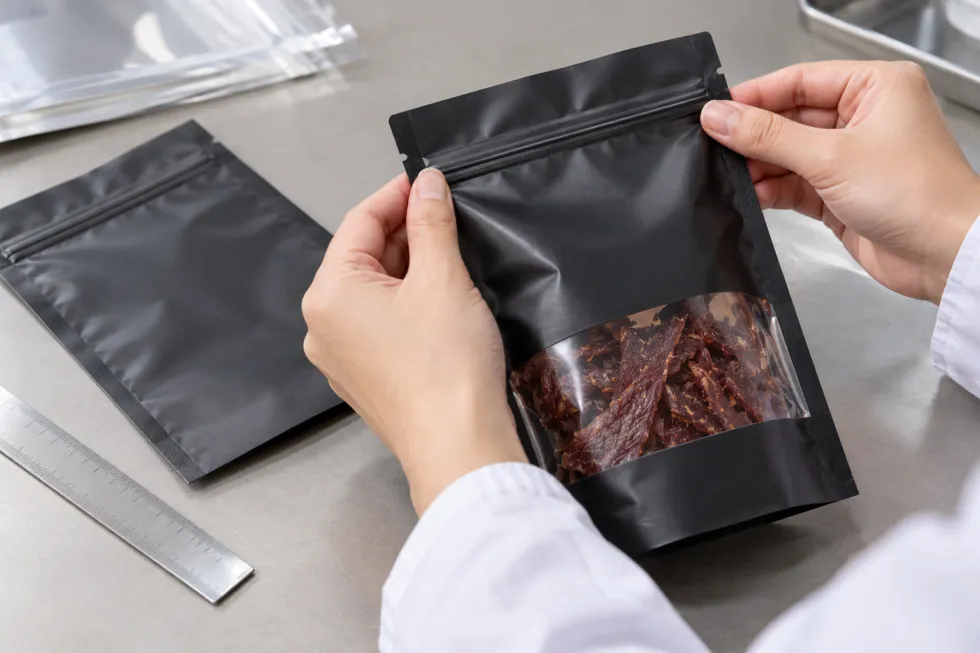
Inspect the pouch after filling.
The jerky should not obstruct the heat-sealing area or interfere with zipper operation. The filled bag should have the intended shape, and the transparent window should remain appropriately positioned.
Practical tests may examine:
- Filling and handling performance.
- Final heat-seal consistency.
- Tear-notch operation.
- Zipper opening and reclosing.
- Film damage or excessive local stress.
- Package condition under relevant handling and storage conditions.
Where appropriate, seal-strength testing can form part of the validation plan.
ASTM F88/F88M describes a recognized method for measuring seal strength in flexible barrier materials.
However, a seal-strength result alone does not prove complete package integrity or food safety.
Review Barrier Documentation and Food-Contact Requirements
Request documentation relevant to the actual material structure and intended food-contact conditions.
This may include technical datasheets, appropriate barrier reports and food-contact documents applicable to the target market.
Check whether the documentation covers the proposed construction, including any transparent window material.
Regulatory requirements depend on the market, materials, intended food-contact conditions and applicable responsibilities.
General descriptions such as “food-grade” should not replace an assessment of the relevant documentation.
The food producer must also validate the product’s safety and intended shelf life.
Approve Artwork and Specifications Before Production
The final approval should identify:
- Pouch dimensions and gusset construction.
- Material structure and agreed thickness.
- Transparent window specifications.
- Zipper, tear notch and top seal locations.
- Printing and finishing requirements.
- Artwork and product information.
- Inspection and acceptance requirements.
- Quantity per size and design.
A physical approved sample and corresponding written specification can support subsequent production checks.
For a custom food pouch, approval should cover how the package performs—not only how it looks.
What Information Should You Send for a Custom Beef Jerky Packaging Quote?
A complete quotation request should describe the jerky product, proposed packaging and commercial requirements. A reference picture alone cannot establish the material structure, final dimensions, sealing conditions or production cost.
The RFQ should distinguish confirmed requirements from design preferences that can still be adjusted.
Product, Filling and Storage Information
| RFQ field | Information to provide |
|---|---|
| Product | Beef jerky type and relevant product characteristics |
| Fill weight | Intended quantity per pouch |
| Product form | Piece shape, size and packing characteristics |
| Storage | Intended storage and distribution conditions |
| Product protection | Established oxygen, moisture and other protection requirements |
| Filling | Manual or automated process and relevant sealing conditions |
| Market | Intended country or countries of sale |
| Technical documentation | Relevant barrier and food-contact requirements |
If some technical requirements are not yet available, identify them before final approval.
Bag Dimensions, Window, Zipper and Artwork Requirements
Provide a drawing or description showing:
- External width and height.
- Bottom gusset dimensions and measurement convention.
- Desired window position and shape.
- Zipper type and location.
- Tear notch and top heat-seal requirements.
- Matte and metallic design preferences.
- Front and back printing.
- Any required hanging or display features.
If the artwork is preliminary, indicate which details are fixed and which can be adjusted following manufacturing review.
Quantity per Design, Samples and Commercial Terms
State the immediate sample requirement separately from the anticipated commercial order.
For multiple sizes or artwork versions, specify the quantity of each.
Also provide the destination and required quotation terms.
Sample costs, production schedules and delivery charges must be confirmed for the specific project.
This distinction helps avoid comparing quotations based on different assumptions.
What the Supplier Must Confirm Before Quotation
Before approving a production proposal, confirm:
- Whether the requested pouch construction is manufacturable.
- Which candidate materials can meet the defined requirements.
- Whether the window, zipper and decorative finishes can be combined.
- What technical documentation is available.
- Which sample arrangements can be considered.
- How MOQ applies to the proposed sizes and designs.
- Which specifications and services are included in the quotation.
Honghai Packaging supports custom premade pouch formats, digital and rotogravure printing, and selected closure and surface-finishing options. The suitability of a specific jerky pouch design must still be confirmed against its material, artwork, functional and purchasing requirements.
For an initial technical review, send the product fill weight, proposed pouch dimensions, window layout, sealing requirements, artwork and quantity per design.
These details provide a basis for reviewing sample and production options through Honghai’s Custom Beef Jerky Bags offering.
Frequently Asked Questions
Do All Beef Jerky Pouches Need Aluminum Foil?
No. Aluminum foil is one possible barrier-material direction, but it is not mandatory for every beef jerky product.
The actual choice depends on the product’s protection requirements, the film’s documented performance and the complete packaging design.
Transparent barrier films may also be evaluated when visibility is important.
A material should be chosen because its verified properties meet the application requirements, not because it is described as a universally suitable jerky packaging material.
Do All Jerky Packages Need Vacuum Sealing or Oxygen Absorbers?
No. The appropriate packaging atmosphere and any oxygen-control components depend on the product’s validated processing, safety and storage requirements.
A brand should not add vacuum packaging or oxygen absorbers based solely on a generic packaging recommendation.
Any such system must be assessed for the actual food product, package construction and intended conditions.
Does a Resealable Zipper Protect Jerky After Opening?
A zipper allows consumers to close the pouch again, but it does not recreate the original heat seal.
How the product should be stored after opening depends on its formulation, storage requirements and validated instructions.
The zipper is a convenience feature, not an independent shelf-life guarantee.
Can One Printed Pouch Design Be Used for Different Jerky Pack Sizes?
A common visual design may be suitable for multiple product sizes, but each fill quantity still requires physical fit verification.
Different pack sizes may require different pouch dimensions, artwork information or production arrangements.
Provide the quantity per pouch specification and design rather than assuming all variants can be combined under one MOQ.
What Food-Contact Documents Should Buyers Request?
Buyers should request documentation relevant to the intended food-contact conditions, material structure and destination market.
The applicable requirements may cover the food-contact materials and other relevant components of the finished packaging.
Documents should be checked for the specific proposed construction rather than assumed to apply because another material has a similar name.
The responsible business should confirm the packaging and labeling requirements for its intended market before commercial use.
For a beef jerky brand developing a clear-window package, the first meaningful approval is a specification that fits the product, supports the required protection and works with the intended filling and sealing process.
Window visibility, matte surfaces and metallic details can then be evaluated within that specification rather than selected as unrelated decorative features.
Once the material and design requirements are clear, sample validation and a properly prepared RFQ can establish whether the proposed pouch is suitable for commercial production—and whether its appearance, performance and purchasing cost justify the chosen construction.