
How to Specify Custom Printed Snack Mix Pouches for Bulk Orders
A packaging supplier receives a reference snack bag, a target size, a request for metallized film and instructions to print the artwork directly on both sides. The buyer also wants a price that includes delivery to a U.S. address.
That may sound like a complete purchasing specification. It is not.
The reference bag shows the desired appearance, but it does not necessarily identify the laminate structure, usable filling space, printing separations or sealing requirements. Even a detailed quotation can leave important costs unresolved if the artwork, quantities by design and shipping responsibilities have not been confirmed.
For buyers sourcing custom printed snack mix pouches, the practical goal is to turn those preliminary requirements into a specification that can be manufactured, tested, approved and priced consistently.
The process starts with the snack product and its filling requirements. Material selection, zipper design, printing and delivered cost should follow from those decisions.
What Should a Snack Mix Pouch Protect?
A snack mix pouch should protect the product against unwanted moisture exposure, physical damage and other environmental conditions relevant to its ingredients. The necessary oxygen and light barrier depends on the recipe, packaging process and intended storage conditions.
Not every snack mix needs the same laminate. Two products with similar packaging appearances may have different protection requirements because their ingredients, seasonings and moisture sensitivity differ.
Moisture, Texture and Product Condition
Many dry snack products depend on maintaining their intended texture during storage and distribution.
Moisture entering the package can change the texture of moisture-sensitive components. Oxygen exposure may also matter for products containing ingredients susceptible to oxidation, particularly where fats or oils are involved.
However, moisture protection and oxygen protection are separate material properties. A laminate described as “high barrier” should be evaluated against the actual product requirements rather than accepted as a complete performance specification.
Before asking a supplier to recommend a film, document:
- The snack’s main ingredients and physical characteristics.
- Whether the product contains oil-coated or seasoned components.
- Whether the packaging process involves ambient-temperature filling or another condition.
- The expected storage and distribution environment.
- The desired shelf-life target and any existing product stability data.
A moisture barrier helps limit water vapor transmission. It does not remove moisture already present in the product or guarantee a specific shelf life.
The packaging film, finished seals and storage conditions all contribute to the product’s final protection.
Why Mixed Ingredients Need Physical Packaging Trials
A mixed snack behaves differently during filling from a uniform product such as fine powder.
Large cereal pieces, pretzels, nuts or other components may settle differently. The ratio of ingredients can affect the occupied volume, while fragile pieces may break under excessive pressure during handling.
A pouch that accommodates one snack mix may not fit another mix at the same net weight.
For this reason, packaging dimensions should be evaluated using the actual finished product rather than an assumed weight-to-volume conversion.
The buyer should also check whether the product creates crumbs or seasoning residues near the pouch opening. Material trapped in the heat-seal area can interfere with reliable sealing.
The first packaging decision is not how much the empty pouch can theoretically hold. It is whether the actual product can be filled, sealed and handled in that pouch without compromising its condition.
How Do You Confirm Stand-Up Pouch Size and Gusset Capacity?
The correct stand-up pouch size must accommodate the intended net weight, product volume, bottom gusset and required sealing space.
Width, height and gusset dimensions alone cannot establish the usable capacity. The pouch’s construction and the physical behavior of the snack mix must also be considered.
Width, Height and Gusset Measurement
Stand-up pouches use a bottom gusset to create space for the filled product and help the pouch remain upright.
A specification may be written as:
Width × Height × Gusset
However, buyers should confirm exactly how the manufacturer defines each measurement.
In particular, the gusset measurement may refer to a folded dimension or the expanded bottom depth, depending on the drawing and measurement convention.
The finished pouch height also includes areas that cannot be filled completely, such as the top seal and zipper region.
A purchasing specification should therefore distinguish between the outside dimensions and the space available to the product.
If a reference bag is available, send it to the manufacturer together with the requested dimensions. A physical sample can reveal construction details that may not be obvious from a photograph.
For a broader review of pouch construction, buyers can compare custom stand-up pouch options before approving the final dimensions.
Fill Weight, Bulk Volume and Headspace
Net weight and package volume are related, but they are not interchangeable.
A mixed snack contains irregular pieces and spaces between them. Its bulk density can change with the ingredients, particle sizes and handling conditions.
This is why specifying only the number of ounces or grams is insufficient to confirm pouch dimensions.
A practical evaluation should consider three separate factors:
| Factor | What the Buyer Should Confirm | Risk if Overlooked |
|---|---|---|
| Net fill weight | Intended weight of finished product per pouch | Incorrect pack specification |
| Occupied volume | Space taken by the actual snack mix | Overfilled or underfilled appearance |
| Headspace and seal clearance | Room above the product for closing and sealing | Product trapped near the seal |
The correct balance depends on the product and filling process.
Excessive empty space may create an undesirable retail appearance. Insufficient space can make filling difficult or place pressure on the zipper and heat-seal area.
Neither condition can be evaluated reliably from the outside dimensions alone.
Why a Physical Filling Trial Matters
A filling trial should use representative finished product and the intended filling method.
The buyer should check whether the pouch can be filled consistently, whether the product settles as expected and whether there is enough clear space to make the final seal.
If the product is filled by a co-packer, its operating requirements should be included in the evaluation.
A manual filling trial may help establish product fit, but it does not automatically prove compatibility with an automated filling line.
For an automated application, the packaging developer and co-packer should also review the relevant machine settings, pouch handling method and sealing conditions.
Approve the final pouch dimensions after the filling trial, not solely after reviewing a dimensional drawing.

Which Metallized Film and Thickness Should You Specify?
A metallized laminate can be considered for snack packaging when the project requires a metallic appearance or specific barrier properties. However, the desired silver finish, laminate structure and overall thickness should be specified separately.
A buyer asking for “120-micron silver metallized film” has described an appearance and a proposed thickness, but has not necessarily defined the complete material construction.
Metallic Appearance vs Metallized Barrier Film
A silver-looking pouch does not automatically identify the material inside it.
The metallic appearance may result from a metallized film layer, a foil-containing laminate or a printing and finishing arrangement.
Different constructions can produce superficially similar results.
For procurement purposes, separate the requirements into two categories:
Appearance requirements: Silver tone, metallic effect, gloss or matte finish, artwork colors and the desired appearance of the printed panels.
Material requirements: Laminate structure, food-contact layer, barrier properties, overall thickness, sealing behavior and other necessary performance characteristics.
This distinction prevents a common purchasing mistake: approving a material because it looks like the existing pouch without establishing whether its functional properties are suitable.
PET/VMPET/PE and Other Candidate Laminates
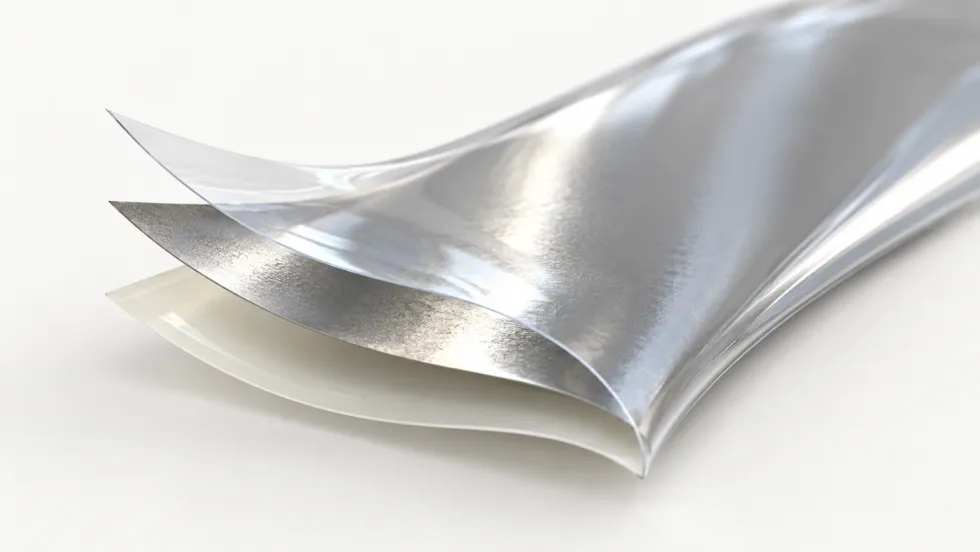
PET/VMPET/PE is one possible structure for a metallized flexible pouch.
In this construction, PET provides an outer film layer, VMPET refers to metallized polyester film, and PE can serve as the inner heat-sealing layer.
Other laminates, including foil-containing structures, may be considered when the product requires a different combination of properties.
The appropriate structure depends on the packaging objective.
| Evaluation Point | Metallized Laminate | Alternative Laminate |
|---|---|---|
| Metallic appearance | May provide a reflective metallic background | Appearance depends on structure and finishing |
| Moisture protection | Requires relevant material data | Requires relevant material data |
| Oxygen protection | Requires relevant material data | Requires relevant material data |
| Heat sealing | Depends on sealant layer and process | Depends on sealant layer and process |
| Filling and handling | Requires finished-pouch evaluation | Requires finished-pouch evaluation |
| Cost | Compare project-specific quotation | Compare project-specific quotation |
This is a selection framework, not a performance ranking.
The same laminate name can cover different specifications. Buyers should request the proposed layer structure and appropriate technical documentation rather than assuming that all metallized films perform identically.
Is a 120-Micron Laminate Necessary?
Not necessarily.
An overall thickness of 120 microns may be proposed for a custom pouch, but suitability cannot be established from the total thickness alone.
A multilayer laminate contains individual layers with different functions. The outer printing layer, barrier layer and inner sealant layer do not contribute identical properties.
Increasing one layer’s thickness may affect handling or sealing characteristics without creating the intended improvement in barrier performance.
A technical review should consider:
- The proposed complete layer structure.
- The physical characteristics of the snack mix.
- Potential pressure or abrasion from the contents.
- The intended filling and sealing process.
- The pouch dimensions and gusset construction.
- The storage and transportation requirements.
A thicker film may also change pouch flexibility and cost.
The better comparison is between complete material specifications that meet the same packaging requirements, not between total thickness figures in isolation.
What WVTR and OTR Data Can Confirm
Two relevant measures for packaging material evaluation are:
WVTR — Water Vapor Transmission Rate: Used to assess water vapor transmission through a material under specified conditions.
OTR — Oxygen Transmission Rate: Used to assess oxygen transmission through a material under specified conditions.
Recognized methods include ASTM F1249-25 for water vapor transmission and ASTM D3985-24 for oxygen transmission.
These methods provide a basis for testing and comparing suitable film samples.
However, a reported transmission rate must be interpreted with the tested material and test conditions in mind.
Film testing alone does not establish the overall performance of the finished pouch, which also includes seals, the zipper area and other construction details.
Nor does an OTR or WVTR figure automatically establish how long a particular snack mix will retain its desired texture or flavor.
For a material quotation, buyers should ask whether relevant test reports are available for the proposed construction and whether additional finished-pouch validation is appropriate.
How Should the Zipper and Heat-Seal Areas Be Designed?
A resealable snack pouch normally needs its initial closure and consumer reclosure functions evaluated separately.
The top heat seal provides the initial package closure, while the press-to-close zipper allows the consumer to close the pouch again after opening.
Both features should be positioned to work with the product and the filling process.
Press-to-Close Zipper vs Initial Heat Seal
A common arrangement places the zipper below the initial heat-sealed area.
The consumer opens the sealed top section first and then uses the zipper for repeated access.
These functions should not be treated as equivalent.
The intact heat seal and the reclosed zipper may provide different levels of protection. A resealable closure should not be assumed to reproduce the original sealed package’s barrier performance.
The zipper must also remain accessible after the top section has been opened.
Keep Snack Pieces and Seasoning Away from the Seal
Mixed snacks may produce crumbs, fragments or seasoning residues during filling.
When product material enters the intended sealing area, it can interfere with the formation of a reliable seal.
The packaging and filling process should therefore be reviewed together.
Possible considerations include filling speed, product settling, pouch opening width and the amount of clear space above the product.
The final sealing conditions should be validated for the selected laminate and actual operating process rather than assumed from another pouch project.
Opening Width and Filling Compatibility
The opening must accommodate the intended snack pieces without creating unnecessary handling difficulty.
A zipper reduces the available space near the pouch opening and can affect the filling operation.
For manual packing, confirm that the product can enter the pouch without damaging fragile components.
For automated filling, confirm the equipment’s requirements for opening, holding and sealing the pouch.
A completed sample should be evaluated both before filling and after the intended filling procedure.

How Do You Reproduce Existing Pouch Artwork with Gravure Printing?
To reproduce an existing printed snack pouch, the manufacturer needs more than a reference photograph.
The buyer should provide the available artwork, the physical packaging reference when possible, the intended colors and the front-and-back layout requirements. Printing feasibility and tooling should then be confirmed before production approval.
Direct Printing vs Applying Stickers
“Direct printed packaging” generally means the graphics are printed as part of the flexible packaging material, rather than supplied as separate stickers applied to otherwise blank pouches.
In many custom laminated packaging projects, the artwork is printed on film before the subsequent lamination and pouch-converting operations.
Depending on the construction, printing may be positioned on the reverse side of a transparent outer layer or use another suitable arrangement.
The production sequence and print position should be confirmed for the specific structure.
This distinction matters when requesting a quotation.
A supplier offering a blank metallic pouch with a printed label has not necessarily quoted the same product as a custom printed laminate with the artwork integrated into the pouch.
Buyers should state clearly when adhesive labels are not acceptable.
What Three-Color Gravure Means for Artwork Preparation
Gravure printing uses engraved cylinders to transfer ink to the film.
It can be evaluated for repeat bulk packaging orders, particularly when the artwork is established and future quantities are expected.
However, a request for “three-color printing” needs further clarification.
The buyer may be counting three visible design colors without considering how the artwork will be separated for the selected substrate.
For example, a metallic background may affect the appearance of printed colors. Depending on the artwork and construction, an additional white ink layer or another printing adjustment may need consideration.
This does not mean every metallic design requires white ink. The actual separation plan must be determined during prepress review.
Before confirming printing costs, the supplier should establish the intended colors, printing positions and cylinder requirements.
Honghai provides both digital and rotogravure printing options for custom pouch projects. The appropriate method and tooling arrangement depend on the artwork, material, design quantities and manufacturing requirements.
Front-and-Back Printing and Metallic Backgrounds
Front-and-back printing should be included in the approved artwork layout.
The front panel may emphasize brand recognition and product presentation, while the back panel may contain ingredients, nutrition information, product identification and other required details.
Both panels must account for the actual pouch construction.
Artwork should not be positioned without considering side seals, the bottom gusset, the zipper and the final trim areas.
Metallic materials introduce another visual consideration: printed colors may appear different over a reflective background than they do on a white proof.
For this reason, a digital artwork preview and a physical printed reference do not necessarily demonstrate identical color appearance.
If matching an existing package is important, provide the original physical sample when available and identify the elements that require close visual matching.
Approving Artwork, Colors and Printing Tooling
Reference artwork is not automatically a production-ready print file.
A screenshot, photograph or low-resolution design may communicate the desired appearance but lack the information needed for accurate prepress preparation.
A useful artwork approval package should include:
| Item | Why It Matters |
|---|---|
| Existing physical pouch | Shows the intended appearance and construction |
| Available editable artwork | Allows the prepress team to review design elements |
| Approved brand colors | Helps establish color expectations |
| Front-and-back layout | Defines all required printed areas |
| Final pouch dieline | Connects the design to the manufacturing dimensions |
| Product and regulatory text | Prevents outdated information from being printed |
| Artwork approval authority | Establishes who can authorize the final version |
The brand should also confirm that it has the necessary rights to reproduce the supplied artwork, trademarks and other protected design elements.
A packaging manufacturer should not assume that any reference image can be copied commercially without appropriate authorization.
Gravure tooling can introduce additional costs when the design changes. Ask how cylinder preparation, revisions, ownership and future reorders will be handled.
Printing approval should follow confirmation of the pouch dimensions, material structure and final artwork—not precede them.

What Food-Contact and Labeling Documents Should Buyers Check?
For snack packaging intended for the United States, buyers should verify that the proposed food-contact material is suitable for the intended food and conditions of use. They should also confirm that the final retail label accurately reflects the product being packed.
These are related but separate responsibilities.
Packaging material documentation does not replace food-label review, and a correctly designed label does not establish material suitability.
Food-Contact Material Documentation
The U.S. Food and Drug Administration explains that the regulatory status of a food-contact material depends on the substances comprising it and their applicable authorizations.
The intended use also matters.
For a laminated pouch, the relevant review may include the food-contact surface, material composition and applicable restrictions or conditions of use.
The FDA’s guidance on determining the regulatory status of food-contact materials provides an official framework.
When reviewing a packaging supplier’s documentation, ask:
- Which material structure is being proposed?
- What supporting documentation applies to the intended food-contact use?
- Does the documentation identify relevant use conditions or limitations?
- Does it apply to the proposed materials rather than a different generic film?
- Are additional documents required by the buyer’s QA process?
A statement such as “FDA approved packaging” should not substitute for identifying the actual basis of material compliance.
The documents supplied for a specific project must be reviewed for their relevance and scope.
Ingredient, Allergen and Retail Label Approval
The food brand is responsible for verifying that the printed label accurately describes the product and meets applicable requirements.
This is especially important when the same packaging design is adapted for different snack flavors.
Two flavors may have different ingredients, nutrition information or allergen declarations.
An existing reference package should therefore not be treated as automatic approval to reuse the original ingredient statement or other regulatory content.
Relevant FDA resources include the Food Labeling Guide and the more recent food allergen labeling guidance.
The older general labeling guide contains sections under revision, so the latest applicable requirements should be checked rather than relying on an archived packaging design.
Why Generic Certification Claims Are Not Enough
A supplier’s general quality-system certification does not automatically establish that a particular laminated pouch meets every food-contact requirement.
Buyers should confirm the certificate holder, current validity, scope and relationship to the actual project.
Where material specifications or test reports are required, those documents should be reviewed separately.
Before approving printing, the brand should ensure that the artwork has received the necessary internal regulatory and product-label approval.
Changing ingredients, allergens or required printed information after tooling preparation may cause additional cost and delay.
What Should Be Tested Before Bulk Production?
Bulk production should be approved only after the buyer has reviewed the relevant pouch dimensions, material construction, filling behavior, sealing function and printed appearance.
A visual sample alone is not enough to establish all of these requirements.
The scope of validation should reflect the actual snack product and purchasing risks.
Physical Fill and Seal Trials
A useful trial uses representative snack mix and the intended filling process.
The buyer should observe how the product enters the pouch, settles in the gusset and affects the finished package shape.
The sealing area should remain suitable for the intended closing process.
For products containing fragile or irregular pieces, handling and breakage may also need assessment.
If the buyer uses a co-packer, its input can help establish whether the pouch design fits the operation.
Material and Barrier Document Review
The final material specification should identify the agreed laminate structure and other relevant properties.
Where barrier performance is important, request suitable data for the proposed material and review the test conditions.
If the finished package requires additional validation, define that requirement separately.
A practical approval checklist can distinguish what is being checked and why.
| Validation Area | Buyer Check | Risk Addressed |
|---|---|---|
| Product fit | Actual fill weight and occupied space | Overfilling or excessive empty space |
| Gusset | Filled pouch shape and stability | Poor shelf presentation |
| Material | Agreed laminate structure | Incorrect material supplied |
| Barrier | Applicable data and conditions | Unsupported protection assumptions |
| Zipper | Alignment and repeated operation | Poor resealing performance |
| Heat seal | Suitability under intended sealing conditions | Seal failure |
| Artwork | Approved colors, layout and content | Printing rework |
| Handling | Relevant product and pouch condition checks | Damage during distribution |
The buyer and supplier should agree on applicable acceptance criteria, sample types and responsibilities.
Not every check requires the same equipment or testing method, and not every packaging supplier provides every type of laboratory test.
Printed Sample and Artwork Approval
Different samples answer different questions.
An existing stock pouch can demonstrate general material feel or closure construction. A visual proof can show the proposed artwork. A sample using the specified laminate and dimensions may provide more relevant evidence about the intended finished packaging.
Before approval, confirm what the sample actually represents.
If its material, printing method or construction differs from the proposed bulk pouch, those differences should be understood.
Keep the final approved artwork, dieline and material specification together with any agreed reference samples.

These documents provide a clearer basis for production and future repeat orders than an instruction to manufacture something “similar to the previous sample.”
If the material, pouch dimensions or artwork are still under review, Honghai can discuss the relevant customization options before a bulk order is finalized. The available sample method, associated costs and technical verification requirements need project-specific confirmation.
How Do You Compare Bulk Pouch Quotes Including U.S. Doorstep Delivery?
A delivered packaging quotation should identify the pouch specification, manufacturing costs, shipping arrangements and responsibilities for import-related charges.
“Door-to-door” does not, by itself, define who pays customs duties or handles import clearance.
Buyers should compare quotations only after these terms are clearly stated.
Unit Price, MOQ and Quantity per Artwork
Honghai’s standard MOQ for custom premade pouches starts from 1,000 pieces, excluding rollstock film.
That is a general commercial starting point, not a fixed quotation or an unconditional production arrangement for every laminate and printing combination.
A custom gravure project still requires confirmation of the material, artwork, number of designs, quantities and tooling requirements.
For a snack brand ordering several flavors, the supplier should receive both the total order quantity and the quantity assigned to each artwork.
Do not assume that multiple designs can automatically be combined for identical pricing or tooling.
When comparing unit prices, ensure all suppliers are using the same finished pouch dimensions, structure, zipper, artwork and surface finish.
Otherwise, the quotations may describe different products.
Printing Cylinders, Samples and Other Project Costs
The purchase cost can include more than the unit pouch price.
A complete comparison should address the following:
| Quotation Item | What to Confirm |
|---|---|
| Unit price | Currency, quantity and exact pouch specification |
| Printing | Method, artwork count and color requirements |
| Cylinder/tooling cost | Initial charges and future revision arrangements |
| Samples | Type, availability, cost and delivery arrangement |
| Material | Agreed structure and thickness |
| Cartons | Pouches per carton, dimensions and gross weight |
| Freight | Transport method and included destination |
| Import charges | Customs and tax responsibilities |
| Payment | Agreed payment schedule and conditions |
| Quotation validity | How long the quoted terms remain applicable |
For gravure printing, discuss what happens if the artwork changes after the initial tooling has been prepared.
A lower unit price may still result in a higher overall project cost when the quotation excludes significant one-time or delivery charges.
DAP vs DDP: What Does Door-to-Door Include?
DAP and DDP are internationally recognized Incoterms, but they allocate responsibilities differently.
Under Incoterms 2020:
DAP — Delivered at Place: The seller delivers the goods to the named destination, ready for unloading. Import clearance and applicable import duties and taxes are generally the buyer’s responsibility.
DDP — Delivered Duty Paid: The seller takes on the specified import clearance and duty-paid delivery obligations at the named destination, subject to the arrangement being legally and operationally feasible.
Neither term should be reduced to the phrase “shipping included.”
The U.S. International Trade Administration’s Incoterms guidance explains the allocation of tasks, risks and costs under the recognized rules.
Before accepting a delivered quotation, buyers should confirm:
- The named delivery address.
- The agreed Incoterm and version.
- Who acts as importer of record.
- Who handles customs clearance.
- Whether applicable duties and taxes are included.
- Whether unloading and any special delivery services are included.
The supplier’s ability to offer a particular delivered term should be confirmed for the actual shipment. A request for DDP does not establish that the seller can automatically fulfill every import-related obligation.
Carton Data, Customs and Final Delivery
Carton information is important for estimating freight and managing warehouse receiving.
A quotation may need to identify the number of finished pouches per carton, carton dimensions, weight and estimated shipment volume.
These figures should be based on the actual packing configuration, rather than assumed from the pouch size alone.
For U.S. delivery, the buyer should also clarify whether the destination is a commercial facility, warehouse or another receiving location and whether there are specific unloading or delivery restrictions.
Shipping charges can depend on those arrangements as well as the route and service selected.
No reliable door-to-door price can be established from the destination postal code alone without the shipment details and confirmed commercial terms.
What Should You Include in a Custom Snack Pouch RFQ?
A complete snack pouch RFQ should identify the product, physical package, material, printing design, quantity and delivery requirements.
It should also distinguish specifications already approved from those that still require a supplier recommendation or technical review.
The objective is to make the quotation accurate enough for purchasing approval without forcing the manufacturer to guess missing requirements.
Product and Pouch Specification Checklist
For a custom snack mix stand-up pouch, the following information provides a useful starting point.
| RFQ Category | Information to Provide |
|---|---|
| Product | Snack type, ingredient characteristics and intended use |
| Net content | Target fill weight per pouch |
| Pouch format | Stand-up pouch and preferred gusset construction |
| Dimensions | Finished width, height and defined gusset measurement |
| Filling process | Manual, semi-automatic or automatic |
| Material | Preferred laminate or required barrier properties |
| Thickness | Target specification, if established |
| Closure | Zipper and top-sealing requirements |
| Appearance | Metallic or silver appearance and other finishing details |
| Quantity | Total order and quantity per design |
| Validation | Samples, documents and required approval checks |
| Destination | Complete delivery address and shipping requirements |
Where a requirement is uncertain, describe the intended result and ask the supplier to review the feasibility.
For example, requesting a pouch that fits a specified snack weight is different from asserting that a particular size has already been proven to hold that weight.
Artwork and SKU Information
Supply the available reference pouch, artwork and brand color information.
If there are several flavors, identify which design belongs to each SKU and specify the required quantity separately.
The quotation should also clarify whether both sides will be printed, whether the design requires specific metallic effects and whether any printing details remain subject to prepress review.
If the buyer has only a reference photograph, the supplier can review what it communicates visually. However, that photograph should not be treated as a complete production specification or evidence of artwork reproduction rights.
Any necessary artwork development, editing or conversion should be discussed before final printing approval.
Samples, Documents and Delivery Requirements
The RFQ should also state which supporting information the purchasing team needs.
That may include a material specification, relevant food-contact documentation, applicable test reports, sample options and carton information.
A request for samples should explain what the buyer intends to verify. The sample arrangement, fee and timing should then be confirmed with the supplier.
For delivery, identify the receiving destination and whether the buyer needs a factory-price quotation, freight quotation or a delivered-price proposal under a specified trade term.
The supplier can then clarify what is included in its offer.
For a custom printed snack pouch quotation from Honghai Packaging, provide the available reference bag or artwork, intended pouch dimensions, snack fill requirements, material preference, printing details, quantities by design and final delivery address.
If the material or size remains preliminary, request a specification review before treating the project as print-ready.
Frequently Asked Questions
Can multiple snack flavors share one packaging order?
Multiple flavor designs can be included in a purchasing discussion, but their manufacturing and pricing arrangements depend on the artwork, quantities per design, printing method and other project conditions.
Provide a separate quantity for each flavor and confirm whether any costs or production arrangements can be shared. Do not assume that the overall order quantity automatically determines the price for every design.
What should I send if I only have a physical reference pouch?
Send clear photographs showing the front, back, bottom gusset, opening and zipper, along with the measured dimensions if available.
If possible, provide the physical pouch itself so the manufacturer can review its construction and visual appearance.
Also identify which features must be reproduced and which can be changed. The reference can guide the review, but the final material, printing requirements and production artwork still need confirmation.
A custom snack pouch order is ready for production approval when the product fit, laminate, closure, artwork and acceptance requirements are sufficiently defined.
A quotation becomes useful for procurement when it prices that same approved specification and clearly identifies tooling, samples, shipping and delivery responsibilities.
Those two steps—specification approval and quotation consistency—give purchasing, packaging development and operations teams a shared basis for evaluating the first order and managing future production without repeatedly resolving the same questions.