
How to Specify Custom Tobacco Leaf Wrap Packaging for U.S. Retail
A pouch can look correct on a packaging drawing and still cause problems during filling. The tobacco leaf wraps may press against the zipper, the heat-seal area may be too narrow, or the selected laminate may lack evidence that it provides the required protection.
For brands sourcing custom tobacco leaf wrap pouches, the purchasing decision should begin with the product, not the printed bag. The actual wraps, filling process, storage conditions and U.S. retail requirements determine which pouch specifications need to be confirmed.
A reliable specification connects five things: product fit, barrier material, closure design, approved artwork and measurable acceptance criteria. Once these are defined, suppliers can prepare more comparable quotations and buyers can evaluate samples before committing to bulk production.
What Should Tobacco Leaf Wrap Packaging Protect?
Tobacco leaf wrap packaging should limit unwanted moisture exchange, protect the wraps during handling and provide appropriate protection against oxygen, light and aroma changes where required. The necessary barrier level depends on the leaf product, its condition at packing and its expected distribution environment.
A high-barrier pouch can reduce exposure to external conditions, but it cannot correct an unsuitable moisture level at filling or guarantee a particular shelf life without product-specific validation.
Moisture Changes, Flexibility and Aroma
Natural tobacco leaves can respond to changes in moisture. Excessive drying may make wraps less flexible and more vulnerable to cracking during handling. Unwanted moisture changes can also affect their texture and condition.
Packaging buyers should therefore distinguish between two objectives:
- Limiting moisture exchange: Selecting a suitable barrier structure and maintaining effective seals to reduce interaction with surrounding humidity.
- Controlling the product’s moisture condition: Managing the condition of the wraps before packing, along with any separate humidity-control method used in the product system.
These are not interchangeable. A foil laminate does not actively maintain a selected internal humidity level.
Aroma protection also requires care. Buyers should consider both the barrier properties of the film and possible pathways through seals or closures. Claims such as “completely smell-proof” or “guaranteed freshness” should not be accepted without evidence relevant to the finished package.
Why the Filled Product and Storage Conditions Matter
Before selecting a material, confirm whether the wraps are packed flat, folded or rolled, whether they include a separate liner or insert, and how much physical movement is expected inside the pouch.
The storage and distribution route matters as well. A product moving through warehouses, international freight and retail storage may experience conditions different from those used to evaluate an empty film sample.
The practical starting point is to document the product’s current condition, desired condition at sale, intended storage environment and any proposed shelf-life target. Those details provide a basis for discussing barrier requirements with a packaging manufacturer.
How Do You Size a Flat Pouch for Tobacco Leaf Wraps?
The correct pouch size is the smallest practical finished format that accommodates the actual wraps, the required closure system and the available sealing area without damaging the product.
Do not approve pouch dimensions solely because the stated width and height appear large enough. External dimensions are not the same as usable internal space.
Three-Side Seal and Other Flat Pouch Configurations
A flat three-side seal pouch is a reasonable format to evaluate for a compact pack of tobacco leaf wraps. It can accommodate custom printing and, subject to design approval, a resealable zipper and heat-sealable top.
The flat format also avoids the additional bottom structure associated with a stand-up pouch. However, that does not automatically make it the cheapest or most suitable choice. Filling requirements, material usage and retail presentation still affect the decision.
Buyers comparing constructions can review custom three-side seal bag options before finalizing a format.
Check Product Dimensions, Folded Shape and Usable Space
For a three-wrap retail pack, the number of wraps alone is insufficient to determine the pouch size.
The packaging developer needs to know the maximum dimensions of the wraps in their final packed arrangement. Folded edges, overlapping leaves, protective inserts and changes in stack thickness can all influence the fit.
Check the following before approving a dieline:
- Whether the specified dimensions represent width × height in the intended orientation.
- The space occupied by side and bottom seals.
- The clear distance between the product and zipper.
- The room needed for the final top heat seal.
- Whether the wraps can be inserted and removed without catching or folding unintentionally.
A physical fit trial is particularly useful when the contents are delicate or vary naturally in shape.

Zipper, Seal Area and Artwork Space
Adding a zipper changes the usable area of a flat pouch. The manufacturer must allow for the zipper attachment, the opening arrangement and the final heat-seal location.
These features also affect the printable area. A large brand logo, product description, barcode and any required regulatory information must fit within the approved design without interfering with seals or being obscured by the final pack construction.
Buyer recommendation: Approve the dimensions and functional layout with a sample before treating the artwork dieline as final.
Which Barrier Material Is Suitable for Tobacco Wrap Pouches?
PET/AL/PE is a high-barrier laminate option worth evaluating for tobacco leaf wrap packaging. PET/VMPET/PE is another candidate when buyers want to compare metallized-film construction with an aluminum-foil laminate.
Neither should be selected solely by name. The final choice should reflect the required moisture and oxygen barrier, physical handling conditions, pouch design and available supporting test data.
PET/AL/PE vs PET/VMPET/PE
These structures use different barrier layers.
In PET/AL/PE, the middle layer is aluminum foil. In PET/VMPET/PE, the barrier layer is vacuum-metallized polyester film. The exact laminate design, individual layer specifications and production conditions affect the resulting properties.
| Evaluation Point | PET/AL/PE | PET/VMPET/PE |
|---|---|---|
| Barrier layer | Aluminum foil | Metallized PET |
| Typical selection purpose | Evaluate where a foil barrier is desired | Evaluate a metallized-film alternative |
| Moisture and oxygen performance | Requires data for the specified construction | Requires data for the specified construction |
| Handling considerations | Review resistance to damage during folding and pouch conversion | Review barrier consistency after converting and handling |
| Sealing performance | Depends on sealant layer and process | Depends on sealant layer and process |
| Printing and finishes | Confirm proposed combinations | Confirm proposed combinations |
| Cost | Compare actual project quotations | Compare actual project quotations |
The comparison should use the same target pouch dimensions, closure requirements, artwork and purchasing quantities.
If one structure has stronger documented barrier performance under the relevant test conditions but adds cost or handling concerns, the buyer needs to decide whether that difference delivers meaningful protection for the actual product.
A supplier’s material specification and sample evaluation are more useful than a blanket statement that one laminate is always better.

Does a Thicker Laminate Always Provide Better Protection?
No. Greater overall thickness does not automatically produce better moisture protection, oxygen resistance or seal integrity.
A multilayer pouch may contain an outer printing layer, a barrier layer, adhesives and an inner heat-sealing layer. Changing the thickness of one layer can affect the finished package differently from changing another.
A buyer considering a target thickness such as 120–140 microns should treat it as a proposed specification until the complete structure and its performance have been reviewed.
Thickness selection should also account for pouch flexibility, the packed product, filling conditions, seals and transport handling.
A practical decision rule: Compare complete laminate specifications, not just total microns. A thicker pouch with an unsuitable barrier layer or a weak seal may not perform as intended.
What OTR and WVTR Reports Can—and Cannot—Tell You
Two useful measures in barrier-film evaluation are:
OTR — Oxygen Transmission Rate: Measures oxygen passing through a material under specified test conditions.
WVTR — Water Vapor Transmission Rate: Measures water vapor passing through a material under specified test conditions.
Relevant methods include ASTM D3985-24 for oxygen transmission and ASTM F1249 for water vapor transmission.
These reports can help compare materials when the measurement conditions and sample constructions are understood.
They do not, by themselves, establish the performance of a finished tobacco pouch.
A completed pouch also has side seals, a bottom seal, a zipper attachment and a top sealing area. Damage during conversion or handling can affect the result. Product shelf life also depends on the packed contents and storage conditions.
When requesting a test report, ask which laminate was tested, what conditions were used and whether the data applies to the proposed construction. If the project requires finished-pouch testing, agree on that scope separately.
For buyers still comparing material categories, custom Mylar bag structures and closure options provide additional context for the specification discussion.
How Should the Zipper, Heat Seal and Opening Features Work?
A resealable zipper and a heat-sealable top serve different purposes. The top seal provides the initial package closure, while the press-to-close zipper allows the pouch to be closed again after opening.
Both functions should be reviewed together before the pouch dimensions and artwork are approved.
Heat-Sealable Top vs Press-to-Close Zipper
A common construction places the zipper below a heat-sealed header.
The consumer opens the sealed section first and then uses the zipper for subsequent access. This arrangement can provide a distinct initial closure while retaining the convenience of resealing.
The actual sealing method and closure configuration must be suitable for the selected laminate.
A zipper alone should not be treated as proof that the package will prevent moisture or aroma exchange to the same extent as an intact heat seal.
If repeat opening is an important part of the product’s use, evaluate the zipper after opening and closing it under realistic conditions.
Tear Notch Position and Opening Experience
A tear notch should allow the user to remove the intended section without damaging the zipper or exposing the product to an uncontrolled tear.
Its position depends on the header height, seal construction and desired opening path.
The buyer should review where the tear starts, whether the material tears as expected and whether the remaining zipper is accessible.

Rounded Corners and Seal Integrity
Rounded corners may be requested for appearance and handling, but their suitability depends on the finished pouch dimensions and construction.
Corner shaping must not compromise the necessary seal area. The final design should be reviewed for manufacturability rather than approved from a visual mockup alone.
A physical sample allows the buyer to check the combined effect of the tear notch, corner shape, top seal and zipper.
What U.S. Labeling Requirements Should Be Reviewed Before Printing?
Tobacco leaf wrap packaging intended for the United States should not enter final artwork production until the brand has confirmed the product’s regulatory classification and applicable labeling requirements.
Different tobacco product categories can have different requirements. The packaging supplier should work from brand-approved regulatory information rather than independently choosing warning statements or label layouts.
Confirm the Tobacco Product Classification
Tobacco leaf wraps, finished cigars, roll-your-own tobacco and tobacco-free wraps should not be treated as automatically interchangeable product categories.
The product’s composition, intended use and commercial presentation can affect the regulatory analysis.
The U.S. Food and Drug Administration provides tobacco product labeling and warning guidance.
One important distinction is that a 2020 federal court order vacated certain FDA health-warning requirements for cigars and pipe tobacco. That decision did not remove warning requirements across all tobacco product categories.
For this reason, a generic cigar warning template is not sufficient evidence that a tobacco leaf wrap label is compliant.
The brand owner or importer should obtain an appropriate regulatory review before approving the artwork.
Reserve the Correct Labeling and Warning Space
The packaging layout may need to accommodate product identity, quantity statements, business information, applicable warnings and other required information.
The precise content, placement and formatting depend on the applicable requirements.
State and local rules may also need review for the intended sales markets.
Brands importing finished tobacco products should separately consider FDA requirements for imported products, including applicable market authorization and labeling obligations. FDA provides an overview of importing tobacco products.
Approve Artwork Before Printing Cylinders Are Made
Artwork approval should cover more than brand colors and graphics.
Before the manufacturer proceeds with production printing, the buyer should confirm that regulatory text, product identification, barcodes, graphics and print positions have been approved.
The final dieline must also reflect the pouch seals, zipper and opening features.
Late changes to mandatory labeling or other printed content may affect printing preparation, cylinder costs and the production schedule.
Regulatory responsibility remains with the relevant brand owner, manufacturer and importer. A packaging supplier’s material documents or general factory certifications do not establish that the finished tobacco product is authorized for U.S. sale.
How Should Brands Choose Printing and Surface Finishes?
Printing should be selected according to order quantity, number of designs, artwork stability and the required appearance of the finished pouch.
For repeat bulk orders with established artwork, rotogravure printing is worth evaluating. Digital printing may offer greater flexibility when design variations or frequent changes are important.
The better choice is determined by the full project cost and production requirements, not by a universal quantity threshold.
Gravure Printing for Repeat Bulk Orders
Gravure printing uses engraved cylinders to transfer the artwork. These cylinders introduce an initial tooling consideration, but may support repeat production when the design remains stable.
A buyer comparing gravure quotations should confirm:
- The number of cylinders required for the artwork.
- Whether cylinder costs are included or quoted separately.
- How artwork changes affect tooling costs.
- The arrangement for future reorders using approved artwork.
These details influence the cost of a long-term packaging program.
Honghai offers digital and rotogravure printing for custom pouch projects. The appropriate method and final printing arrangement should be confirmed against the actual design, materials and quantities.
Four-Color Artwork and Print File Review
A request for “four-color printing” should be clarified before quotation.
It may refer to a CMYK process design, a limited number of specified colors or another printing requirement. These interpretations can affect prepress preparation and the proposed production method.
Send the available artwork to the packaging supplier for review, including any brand color references and instructions for the front and back panels.
The final file requirements, color arrangement and proofing method should be confirmed by the prepress team rather than assumed from a generic file-format list.
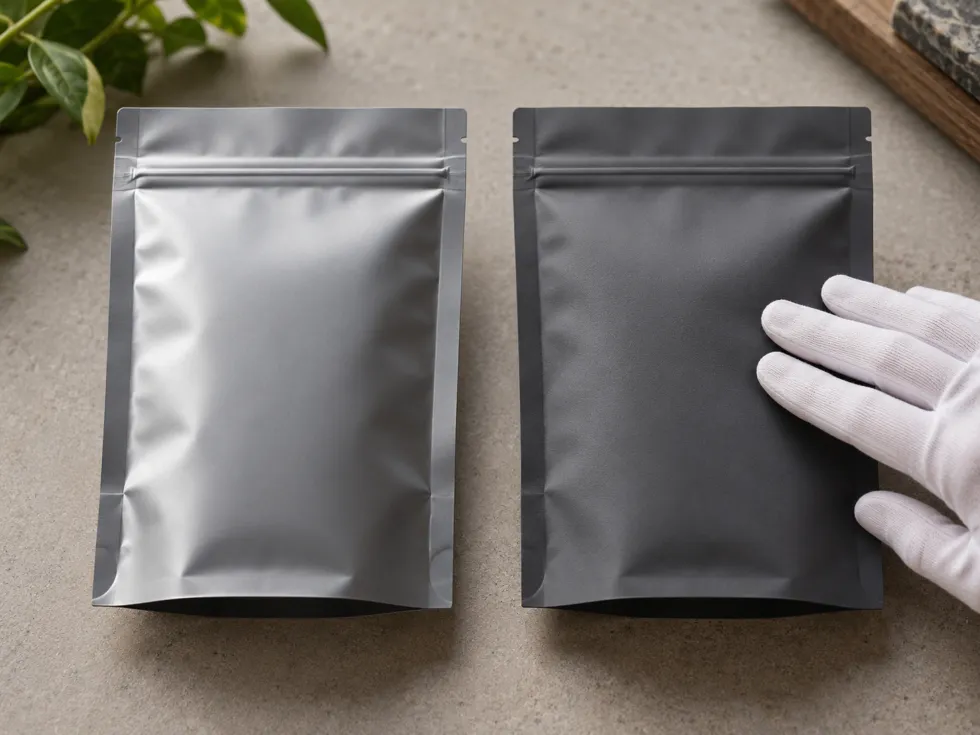
Matte vs Soft-Touch: Appearance, Handling and Cost
Matte and soft-touch finishes are not interchangeable specifications.
Matte describes a lower-gloss visual appearance. Soft-touch generally describes a tactile surface effect, which may involve a different material or finishing treatment.
| Evaluation | Matte Finish | Soft-Touch Finish |
|---|---|---|
| Main design objective | Lower-gloss appearance | Distinct tactile feel |
| Visual result | Confirm with printed sample | Confirm with printed sample |
| Surface durability | Evaluate under expected handling | Evaluate under expected handling |
| Material compatibility | Confirm proposed laminate combination | Confirm proposed laminate combination |
| Cost | Request project-specific quote | Request separate quote |
Neither finish should be selected purely because it is described as more luxurious.
A brand expecting substantial retail handling should assess rub marks, print appearance and surface condition using representative samples.
Where cost matters, request two otherwise identical quotations: one for matte and one for soft-touch. This makes the incremental finishing cost easier to evaluate.
What Should Be Validated Before Bulk Pouch Production?
Before approving a bulk order, buyers should validate product fit, closure function, artwork, material specifications and any required performance properties.
An attractive printed sample does not establish that the finished package is suitable for the contents or filling process.
Physical Fit and Filling Trials
Begin with the actual tobacco leaf wraps and the intended pack arrangement.
Check whether the wraps can be loaded without damage, whether the filled pouch closes correctly and whether the product interferes with the heat-seal area.
For manual packing, the loading method should be repeatable. For automated or semi-automated filling, the package also needs to be compatible with the relevant equipment and operating conditions.
Test the package as it will actually be used, not only when empty.
Barrier, Seal and Zipper Validation
A useful approval plan separates the following checks:
| Validation Area | What to Check | Purchasing Risk Addressed |
|---|---|---|
| Product fit | Usable space, loading and removal | Incorrect dimensions or product damage |
| Material specification | Layer structure and agreed thickness | Wrong laminate supplied |
| Barrier performance | Relevant OTR/WVTR data and test conditions | Unsupported protection claims |
| Seal performance | Integrity of the intended seals under agreed conditions | Leakage or closure failure |
| Zipper function | Alignment, closing and repeated opening | Poor consumer use experience |
| Artwork | Color, text, position and approved version | Printing errors or rework |
| Handling | Pouch condition after relevant transport and use simulation | Damage during distribution |
The buyer and manufacturer should agree on which checks are appropriate, who performs them and what constitutes an acceptable result.
Not every project requires the same testing program. The validation scope depends on the product, intended protection and commercial risk.

Artwork Proofs, Approved Samples and Acceptance Criteria
Buyers should distinguish between different sample purposes.
A visual mockup can help assess artwork positioning and appearance. An existing pouch sample may demonstrate a closure or material feel. A sample made to the proposed construction can provide more relevant information about the intended specification.
Ask whether the sample uses the same laminate, pouch dimensions, zipper and finishing treatment proposed for production.
Before issuing the final purchase order, establish which approved documents and samples will control the order.
This might include a material specification, final dieline, approved artwork, physical reference sample and agreed inspection or acceptance criteria.
A packaging project becomes easier to repeat when suppliers and buyers refer to the same approved specifications rather than relying on descriptions such as “the same as last time.”
If your pouch dimensions, laminate or closure are still preliminary, discuss those requirements with Honghai before committing to printing tooling or bulk quantities. Sample availability, test arrangements, costs and timing should be confirmed for the specific project.
How Do You Compare Bulk Tobacco Pouch Quotations?
Bulk pouch quotations are comparable only when suppliers are pricing equivalent specifications and clearly identifying what is included.
A lower unit price may not represent the lower total purchasing cost if tooling, samples, packaging, freight or future design changes are treated differently.
MOQ, Quantity Tiers and Total Project Cost
Honghai’s standard MOQ for custom premade pouches starts from 1,000 pieces, excluding rollstock film. The feasible production arrangement for a particular laminate, printing method, design combination and order quantity must still be confirmed.
For a larger purchasing program, request quotations at several quantity levels using the same specification.
Ask suppliers to separate the following:
| Cost Item | What the Buyer Should Confirm |
|---|---|
| Unit pouch price | Quantity basis, currency and agreed specification |
| Printing tooling | Cylinder or other applicable tooling charges |
| Samples | Sample type, cost, delivery and approval arrangements |
| Surface finish | Difference between finishing options |
| Packaging | Pieces per carton, carton dimensions and gross weight |
| Freight | Named Incoterm, shipment route and included charges |
| Payment | Deposit, balance and other agreed payment conditions |
| Reorders | How approved artwork and tooling are handled |
A formal quotation should also state its validity period and relevant assumptions.
For businesses operating several products or artwork versions, request quantities by SKU as well as a project total. Do not assume multiple designs can automatically share the same MOQ or printing economics.
Cylinder Costs, Samples and Artwork Changes
Tooling costs can influence the economics of gravure printing, particularly when the artwork is likely to change after the first order.
Brands should clarify whether a subsequent order using identical artwork requires new tooling, whether changes to text or graphics create additional charges and what happens when a design is discontinued.
Ownership and storage arrangements for cylinders should be confirmed in the commercial agreement rather than assumed.
Sampling has a different purpose. It reduces the risk of approving an unsuitable specification, and its cost should be evaluated against the potential expense of a rejected bulk shipment or production rework.
FOB vs CIF and the Actual Delivery Destination
FOB and CIF are different international trade terms, not interchangeable descriptions of a delivered price.
Under Incoterms 2020:
- FOB (Free on Board) identifies a named port of shipment. The seller’s delivery obligation is tied to loading the goods on board the vessel at that port.
- CIF (Cost, Insurance and Freight) identifies a named destination port. The seller arranges and pays for the specified freight and insurance, but risk transfers when the goods are delivered on board at the shipment port.
These rules are intended for sea and inland waterway transport. The U.S. International Trade Administration’s Incoterms guidance explains the named-port distinctions and allocation of responsibilities.
CIF should not be confused with door-to-door delivery, full insurance against every loss or payment of all destination import charges.
For containerized shipments or other transport arrangements, buyers can ask their freight forwarder whether a different Incoterm would be more appropriate.
There is another question that should be settled before freight is quoted: Where will the empty pouches actually be used?
If the tobacco wraps are packed in one country and distributed in another, shipping the empty pouches directly to the filling facility may be different from sending them to the eventual retail market.
Confirm the receiving location, named port, freight method, responsible importer and expected delivery route before comparing landed costs.
Planning Repeat Monthly Orders
An annual volume forecast should be separated from confirmed purchase orders.
A buyer may expect substantial growth after launch, but the first monthly requirement, later replenishment quantities and annual forecast may not align.
For repeat supply, discuss the expected monthly consumption, purchasing frequency, inventory buffer, approved artwork versions and how far in advance demand forecasts can be shared.
The supplier should confirm actual production scheduling and delivery arrangements before the buyer makes commitments based on those assumptions.
What Should Buyers Include in a Tobacco Packaging RFQ?
An effective RFQ describes the product, pouch specification, required performance, printing, purchasing quantities and delivery conditions clearly enough for suppliers to price the same project.
The goal is not to produce the longest possible specification. It is to remove assumptions that could change the material, manufacturing process or commercial quotation.
Product, Format, Material and Printing Specifications
Use the following checklist when requesting a custom tobacco leaf wrap pouch quotation.
| RFQ Category | Information to Provide |
|---|---|
| Product | Type of tobacco leaf wrap, packed form and pieces per pouch |
| Pack format | Flat pouch or other construction, width and height |
| Product fit | Wrap dimensions, folded arrangement and filling method |
| Material | Preferred laminate or barrier requirements |
| Thickness | Proposed range, if established |
| Closure | Zipper, heat-sealable top, tear notch and corner requirements |
| Printing | Artwork, number of colors and number of designs |
| Finish | Matte, soft-touch or alternative surface option |
| Performance | Moisture, oxygen, aroma and handling requirements |
| Volume | Quantity per design, total order and repeat-order forecast |
| Approval | Sample type, tests and required technical documentation |
| Delivery | Actual receiving destination, shipping terms and target schedule |
Where a specification is not final, state that clearly and identify the required supplier review.
Required Samples, Documents and Carton Details
The buyer should request documents that address specific purchasing or approval concerns.
Depending on the project, these may include material specifications, relevant barrier test reports, sample information and current certificates with an applicable scope.
For supplier evaluation, a company profile, relevant factory information and actual product samples may also be useful.
If customer references are important to the purchasing process, ask whether the supplier can share authorized references or other evidence of relevant export experience.
Certificates should be checked for the issuing organization, named company, validity and scope. A general certification does not automatically establish compliance with every product-specific or U.S. tobacco regulation.
Carton information matters for both freight planning and warehouse operations. Request the number of pouches per carton, carton dimensions and gross weight for the proposed packing arrangement.
These values should come from the actual project rather than a generic pouch specification.
Supplier Qualification and Repeat-Order Expectations
Price is only one part of supplier qualification.
Procurement teams should also establish who will approve technical questions, how artwork revisions are managed, how product specifications are recorded and which inspection documents are relevant to the order.
For recurring purchases, confirm how revisions will be communicated and how the approved construction will be identified in future orders.
For a specification review or quotation from Honghai Packaging, provide the intended pouch size, product details, candidate material, closure requirements, artwork, quantities by design and delivery destination.
If the structure is still under evaluation, identify the unresolved requirements first. If the specification is approved, request a formal quantity-based quotation covering tooling, samples, manufacturing arrangements and shipping terms.
Frequently Asked Questions
Can one tobacco pouch order include several artwork designs?
Multiple designs can be considered, but the production arrangement depends on the number of SKUs, quantities per design, printing method and material requirements.
Provide a separate quantity for each design rather than assuming the entire order can be priced as one artwork.
Are child-resistant zippers automatically required for tobacco leaf wrap pouches in the U.S.?
A universal requirement should not be assumed from the product description alone.
The brand should establish its specific product classification and applicable federal, state and local requirements. A child-resistant zipper option does not, by itself, establish regulatory compliance.
What artwork file format should I send to a pouch manufacturer?
Send the best available artwork and identify any approved brand colors, text and layout requirements.
The manufacturer or prepress team should then confirm the acceptable production file format, dieline, resolution and other requirements for the selected printing method.
Should I ask for supplier references before placing a bulk order?
For a new supplier relationship, relevant references or other verifiable evidence can support qualification.
Ask for information the supplier is authorized to share. Factory information, actual samples, applicable documents and clear technical communication can also contribute to the assessment.
A bulk tobacco wrap pouch order should move forward when the product fit, material structure, closure design, artwork, validation requirements and commercial terms are sufficiently defined.
That shared specification gives the buyer a practical basis for approving the first production run, comparing quotations and managing subsequent orders without having to resolve the same technical questions each time.