
Can You Order 250g and 500g Custom Coffee Bags Together?
A coffee brand wants 750 printed bags for 500g coffee and another 250 for 250g coffee. Both should be flat-bottom pouches with full-colour artwork, a resealable zipper and a one-way degassing valve.
The order adds up to 1,000 bags. But that doesn’t necessarily mean the factory can produce both sizes under a single minimum order quantity (MOQ).
The reason is fairly simple: one purchase order can contain two different production specifications. The bags may share a brand design and material, but their dimensions, artwork layouts and manufacturing requirements aren’t identical.
For a small coffee brand, that distinction matters. Ordering more of the smaller pack just to meet a production minimum could leave the business holding packaging it won’t use. On the other hand, choosing a different production method or bag specification may affect the original design.
Here’s what a buyer should establish before placing a mixed-size order.
The MOQ Problem Behind a 1,000-Bag Order
You can request 250g and 500g custom coffee bags together. Whether the manufacturer can accept the proposed quantities depends on how its MOQ applies to each size, design and production method.
Consider the following order:
| Specification | Requested Quantity | What the Factory Needs to Check |
|---|---|---|
| 500g flat-bottom pouch | 750 pcs | Size, printing method and minimum production quantity |
| 250g flat-bottom pouch | 250 pcs | Separate dimensions and minimum production quantity |
| Total | 1,000 pcs | Whether the two quantities can form a workable production order |
Honghai Packaging publishes a digital-printing MOQ starting from 1,000 pieces for custom coffee bags. The applicable minimum can vary with the pouch size, material structure, printing method and number of designs.
That published starting quantity does not establish that a 750/250 split is available.
Why the total quantity may not be enough
The factory isn’t only printing graphics. It also has to manufacture the finished pouches.
A 250g flat-bottom bag will normally have different cutting dimensions and panel proportions from the 500g version. Even with matching materials and artwork, those differences can affect production preparation.
Printing is another consideration. Digital printing avoids the cylinders used in gravure, but it doesn’t eliminate every minimum associated with pouch production.
Ask the manufacturer which part of the proposed specification determines the minimum quantity. A size-specific minimum and a design-specific minimum are not necessarily the same thing.
What if the smaller quantity can’t be produced?
Don’t increase the order immediately.
First, find out whether another available specification or production arrangement could work. An existing pouch size, a different printing approach or a revised quantity split may be worth reviewing, subject to the manufacturer’s actual options.
There are commercial trade-offs.
If the 250g pack is intended for a new product launch, ordering considerably more printed bags than expected sales may create unnecessary inventory. Labels, product information or even the packaging design might change before those bags are used.
A suitable alternative is only useful if the brand can still accept the finished product.
The first decision, then, isn’t how to make the total reach a particular number. It’s whether each SKU can be manufactured in the quantity the business actually needs.
Two Pack Weights Don’t Tell You the Bag Dimensions
A 250g coffee bag isn’t a fixed size. Neither is a 500g bag.
The final dimensions depend on the coffee itself, the shape of the pouch and the space needed for filling and sealing. Whole beans and ground coffee of the same weight can occupy different volumes. Bean density can vary as well.
For flat-bottom packaging, the front width, side gussets and rectangular base all contribute to the usable capacity.
Choosing dimensions from a supplier’s weight label alone can lead to a bag that looks appropriate when empty but doesn’t fill properly.
Test the coffee, not just the empty pouch
Suppose the brand wants the 250g and 500g packs to look like a matching pair on a retail shelf.
The smaller bag shouldn’t automatically be half the height or half the width of the larger one. Changes in proportions affect how the coffee settles, how much room remains at the top and how the bag stands after filling.
It’s more useful to test the two sizes separately.
A filled sample should answer these questions:
- Does the intended weight fit without forcing the pouch out of shape?
- Is there enough space above the coffee for the zipper and final heat seal?
- Does the filled bag stand as expected?
- Can the roaster fill it using the intended equipment or manual process?
- Is the finished shape suitable for the planned retail display and shipping cartons?
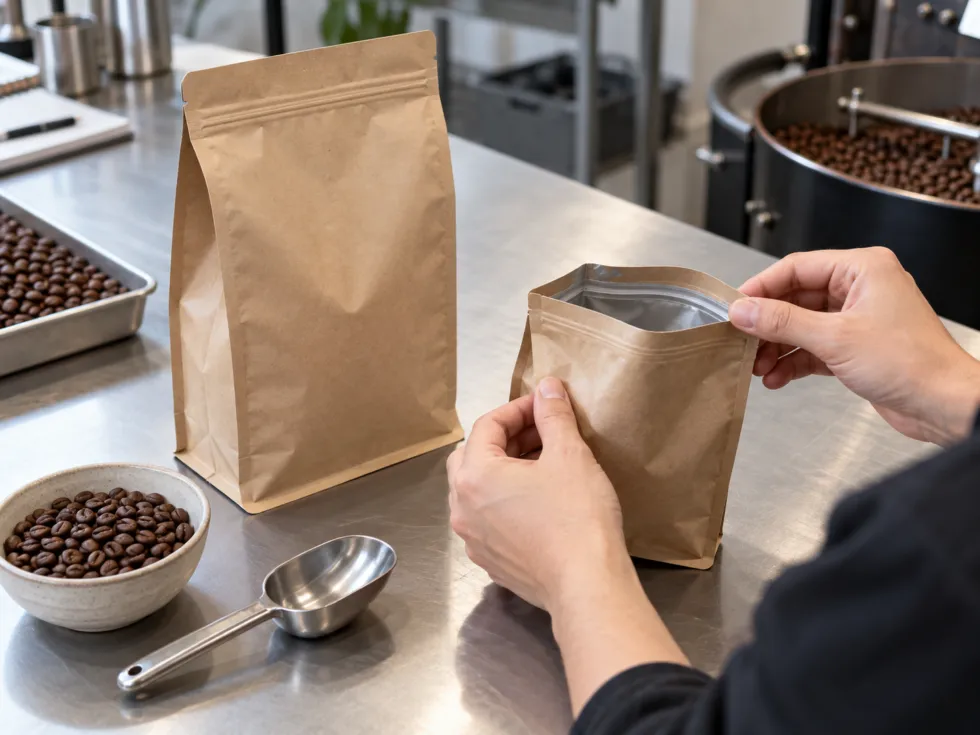
The larger sample cannot answer those questions for the smaller bag.
If the brand sells both whole-bean and ground coffee, that may require another fit check, even when the printed net weight stays the same.
For a closer look at the construction, Honghai’s custom flat-bottom pouches page covers the bag format and available accessory options.
One Brand Design Still Means Two Print Layouts
Using the same design across 250g and 500g coffee bags is possible. Using the exact same production file generally isn’t.
A flat-bottom pouch has more than a front panel. The back, side gussets and bottom also have defined dimensions, folds and sealing areas.
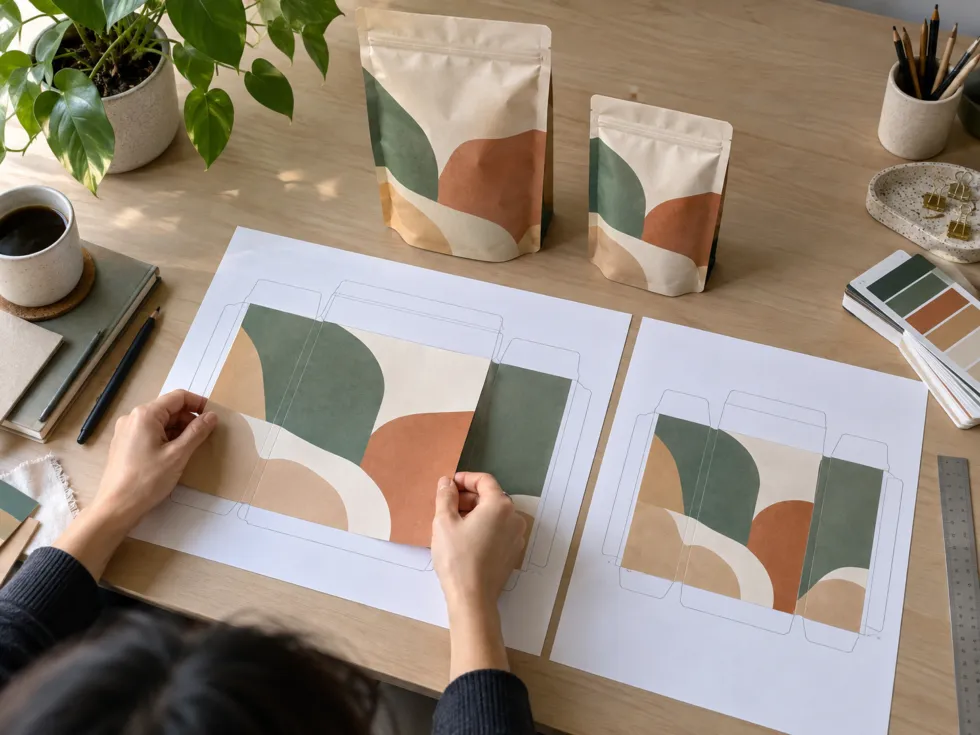
The brand can keep its logo, colours and overall visual identity consistent, but each size needs artwork prepared against its own approved dieline.
A common problem appears when the designer simply scales down the larger layout.
The logo might still fit, but the smaller pack could have crowded product details, a barcode too close to a fold or graphics overlapping the area reserved for the valve.
What needs to change?
The adjustments are usually practical rather than creative.
The front panel may need a different arrangement of the logo and product name. Side-panel information may need repositioning. Each pack should carry the correct net weight and other applicable product information.
Valve placement also affects the layout. A circular valve positioned comfortably on the larger pack could interfere with a prominent graphic on the smaller version.
And if the buyer only has a screenshot or photograph of the desired design, that isn’t necessarily a production-ready artwork file.
A reference image can help the manufacturer understand the intended appearance. Final printing normally needs suitable artwork files, approved dimensions and clear information about the colours and printed content.
Before approving production, check one completed dieline for each size rather than approving one design and assuming the second will follow automatically.
Zipper, Valve and Barrier Film Need to Work Together
Flat-bottom coffee bags can be specified with a resealable zipper and a one-way degassing valve. The question is how those features will work with the coffee, bag dimensions and packing process.
Freshly roasted coffee releases carbon dioxide. When coffee is packed while degassing continues, gas may build up inside a sealed pouch.
A one-way valve is intended to let gas escape while limiting outside air entry. Its suitability depends on the coffee and the time between roasting, packing and distribution.
That means the buyer should tell the manufacturer whether the product is whole-bean or ground coffee and when it will be packed after roasting.
The zipper addresses a different need. It allows customers to reseal the package after opening it.
For many retail applications, the roaster will also make a final heat seal above the zipper. That requires space in the upper part of the bag.
On the smaller 250g pouch, the distance between the filling level, zipper and top seal deserves particular attention.

Don’t choose the film from thickness alone
Coffee brands often ask for “food-grade, high-barrier material”. That describes the intended application and protection level, but not a finished material specification.
Different laminates can provide different oxygen, moisture and light barriers. Their suitability also depends on sealing conditions and the intended storage period.
A thicker film isn’t automatically a better barrier. Nor does a stated film barrier property, by itself, establish the shelf life of coffee in a finished pouch.
Ask for the proposed laminate structure, its total thickness and relevant supporting information. Food-contact documentation should relate to the actual packaging material and intended use.
There’s no need to select an arbitrary thickness before the manufacturer has reviewed the product. The buyer’s job is to explain what the bag must protect and how it will be filled, stored and sold.
Honghai’s existing coffee packaging design guide covers material and valve selection in more detail.
Samples Are Where the Two-Size Plan Gets Tested
Before paying for custom printed stock, establish which questions the samples need to answer.
A sample isn’t automatically representative of the final order simply because it has the right general shape.
There are three useful stages:
| Sample | What the Buyer Can Check | What It Doesn’t Establish |
|---|---|---|
| Existing stock pouch | Bag construction, zipper, valve and material feel | Exact custom dimensions or final printing |
| Unprinted size sample | Coffee capacity, filling, opening and finished shape | Printed colour and artwork appearance |
| Printed proof or sample | Layout, graphics, colour references and finish, according to how it was produced | Untested barrier, seal or shelf-life performance |
For a two-size order, the unprinted size samples are particularly valuable.
The roaster can put 250g of the intended coffee into one pouch and 500g into the other, then check how both behave before commissioning final artwork.
If a colour or finish is important, find out whether the available printed sample will use the intended substrate and printing method. A digital proof is useful for checking artwork, but it can’t show every aspect of a metallic or matte finish.

Sample charges and production timing
These should be discussed as separate items in the enquiry.
An existing bag sample doesn’t necessarily involve the same preparation as a custom-size or printed sample. International sample shipping may also need to be arranged.
Ask what type of sample Honghai can provide for the proposed sizes, whether any charges apply and what the sample is intended to demonstrate.
The production schedule should be discussed after the specification, artwork and sample requirements are understood. It should distinguish approval work, manufacturing and international transport.
A production completion date is not the same as a delivered-to-Kigali date.
Shipping Coffee Pouches to Rwanda: Check Import Requirements Early
For a buyer importing empty coffee bags to Kigali, the shipping arrangement is only one part of the delivery question.
Rwanda also has legal controls concerning plastic carry bags and certain single-use plastic items under Law No. 17/2019. The Rwanda Environment Management Authority (REMA) operates an authorisation process for relevant plastic packaging uses.
That doesn’t mean a particular multilayer coffee pouch is automatically prohibited. It also doesn’t mean the pouch is automatically exempt.
The importer needs to establish how the proposed packaging is classified and whether authorisation or other documentation is required.
This should happen before the bags are manufactured for shipment.
Useful official starting points are:
- Rwanda Environment Management Authority — Plastic Packaging Authorisation
- Rwanda Revenue Authority — Prohibited and Restricted Goods
The local importer or customs agent should check the applicable requirements using the actual bag material, product application and planned use.
For freight planning, provide the delivery address in Kigali and ask which shipping terms are available. Clarify who will handle import clearance, what documentation is needed and which charges fall within the proposed shipping arrangement.
Honghai’s ability to support a particular delivery arrangement needs to be confirmed for the project.
What to Send Honghai for a Mixed-Size Coffee Bag Enquiry
For an order with 250g and 500g bags, the most useful approach is to send one enquiry containing two clearly identified specifications.
The manufacturer can then assess both sizes and explain whether the proposed quantities are workable.
Include:
Coffee and packing details
- Whole-bean or ground coffee
- Intended filling weight for each size
- Time between roasting and packing
- Manual or machine filling
- Storage and distribution requirements
Bag requirements
- Flat-bottom construction
- Proposed dimensions, if available
- Resealable zipper and one-way valve
- Preferred material or required protection
- Surface finish and printing requirements
Two separate SKUs
- 500g bag — proposed quantity: 750 pieces
- 250g bag — proposed quantity: 250 pieces
- Artwork reference and available design files
- Any differences between the two designs
Sampling and delivery
- Type of sample required
- Intended order schedule
- Kigali delivery destination
- Requested shipping terms
- Any import documentation or authorisation requirements already identified
The manufacturer may need additional details before confirming production feasibility.
For a coffee brand testing two retail pack sizes, the objective is to establish a workable specification without ordering quantities that don’t fit its sales plans.
Honghai Packaging supplies custom coffee bags with flat-bottom construction, printing, zipper and valve options. The proposed 750/250 split still needs its own manufacturing review.
If you’re planning a similar mixed-size order, send the two specifications together and ask Honghai to assess the quantity arrangement, samples and production options before preparing the final quotation.
Discuss Your Custom Coffee Bag Project With Honghai Packaging