
Custom Seed Packaging Pouches: How to Prepare an Accurate RFQ for Suppliers
An accurate quote for custom seed packaging requires more than the total bag quantity. For a multi-SKU project, the supplier needs the seed product, pouch dimensions, protection requirements, printing specification, quantity by SKU, annual forecast and the quantities you want priced.
Otherwise, two suppliers may appear to quote the same pouch while working from different assumptions.
Start with the basic requirement:
What does the seed need from the package during filling, distribution and storage?
Material, pouch style and commercial quantities should follow that requirement.
What Should Seed Packaging Actually Protect?
Seed packaging should be selected around the seed and its storage conditions. There is no single packaging material that is best for every seed type or storage objective.
FAO guidance identifies seed characteristics and storage conditions as factors in storage decisions, and distinguishes between seeds that tolerate drying and sealed storage and those that do not. (fao.org)
Moisture exposure
For many dry-stored seeds, controlling moisture uptake is important. Properly dried seeds may need protection from humid external conditions, while sealing seed at an unsuitable moisture condition can create problems rather than prevent them. (fao.org)
Useful RFQ inputs include:
- seed type
- intended storage condition
- distribution environment
- expected storage period
- whether the seed has already been dried or conditioned
- how the package will be used after opening
If the required barrier performance has not been established, provide these conditions instead of inventing a WVTR or OTR target.
Oxygen and light
Some applications may also require control of gas exchange or light exposure. That depends on the product and storage method.
FAO guidance distinguishes permeable, moisture-resistant and sealed impermeable storage materials, and includes laminated aluminum foil packages among moistureproof options for appropriate dry seed applications. It also notes that sealed impermeable storage is not suitable for every seed condition. (fao.org)
For a flexible pouch project, review the proposed structure against the seed, storage conditions, filling process, sealing process, distribution environment and required packaging documentation.
Do not infer shelf life from the pouch alone
A target storage period is useful for the supplier, but it is not evidence that a particular pouch guarantees a specific shelf life.
Seed species, initial condition, moisture, storage temperature and handling can affect storage performance. Packaging is one part of that system. (fao.org)
Key point: define the storage requirement first. Do not select a structure only because terms such as “foil” or “Mylar” appear more protective.
Paper, Plastic or Foil-Lined Pouch: Which Direction Fits the Project?
The right packaging option depends on the seed, storage conditions and project requirements. Compare packaging formats against the required protection, filling process, printing needs and commercial quantities.
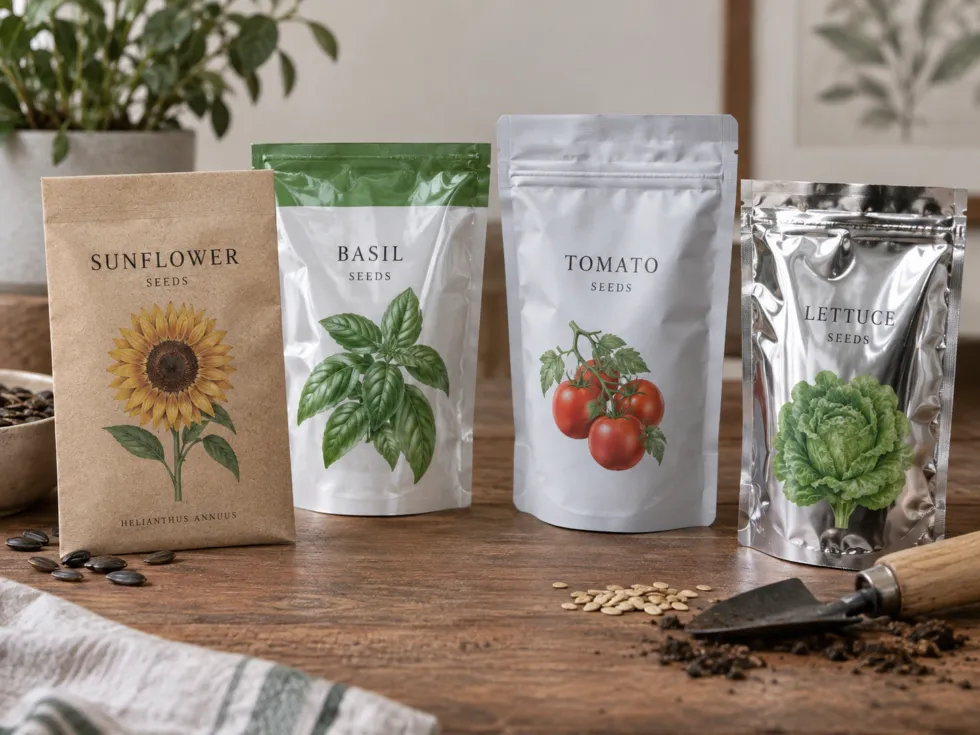
| Packaging Direction | When Buyers May Consider It | Main Decision Issue | Limitation to Check |
|---|---|---|---|
| Paper-based packet | When strong moisture or gas protection is not required | Storage environment and print format | Paper-based materials are permeable to moisture and gases |
| Laminated flexible pouch | When heat sealing, custom printing or a defined barrier structure is needed | Exact laminate and seal layer | Performance depends on the actual structure |
| Foil-containing laminate | When stronger barrier and opacity are required | Whether that barrier is necessary | “Foil lined” does not define the complete laminate |
| Metallized laminate | When a metallic barrier layer fits the application | Required barrier and final structure | Do not assume it is equivalent to every aluminum-foil laminate |
| Resealable pouch | When the package will be opened repeatedly | Zipper position and sealing area | The zipper does not replace the original production seal |
FAO guidance confirms that permeable and moistureproof materials serve different storage purposes and that no one packaging material is best for every seed condition and objective. (fao.org)
Honghai Packaging lists laminated structures, aluminum-foil structures, metallized film, kraft structures, custom sizes, zippers, tear notches, hang holes and clear windows among its flexible-packaging options. (honghaipackaging.com)
The final structure still has to be confirmed for the individual project.
Why “foil lined” is not a complete specification
Consider this requirement:
180 × 290 mm, 90 mm bottom gusset, foil lined.
It defines the pouch dimensions and indicates a barrier direction, but it does not establish:
- the complete laminate
- total thickness
- sealant layer
- required barrier performance
- seed condition
- filling and sealing conditions
- storage environment
Those items must either be specified by the buyer or proposed and confirmed during technical review.
Common sourcing issue: comparing two “foil lined” quotations as equivalent without checking what each supplier has actually priced.
How to Specify Seed Pouch Size and Bottom Gusset
Specify the finished pouch dimensions clearly and provide information about the product being filled.
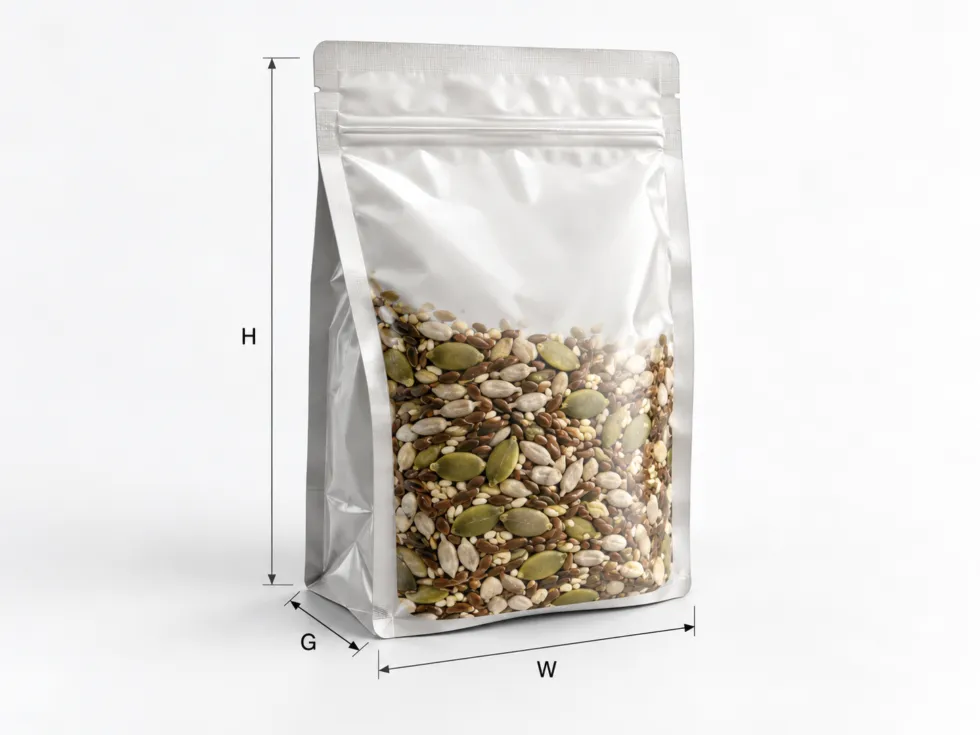
For a bottom-gusset pouch, a practical RFQ format is:
Width × Height × Bottom Gusset
For example:
180 × 290 mm + 90 mm bottom gusset
Before artwork or production approval, confirm how the supplier’s drawing defines the gusset measurement.
Dimensions do not guarantee fill capacity
A pouch dimension alone does not establish how many grams of seed it will hold.
Products with the same net weight may occupy different volumes because of seed size, shape, bulk density, packing behavior and required headspace. The filling process also affects usable volume.
If you know the pouch dimensions, provide them together with the expected fill amount. For a new size, validation with the actual seed is more reliable than estimating capacity from dimensions alone.
Allow for filling and sealing
The pouch needs usable space above the product. Features such as a zipper, tear notch, top heat seal or hang hole can affect the layout and filling area.
Tell the supplier whether the pouch will be manually filled, machine filled, heat sealed above a zipper, or repeatedly opened by the end user.
Recommended approach: validate a new pouch size with the actual product and intended filling method before committing to a large production run.
How to Plan a Multi-SKU Seed Packaging Program
Treat each meaningful combination of pouch size, artwork and print specification as a separate SKU in the RFQ.
A total requirement of 30,000 pouches does not tell the supplier whether that means one design or several smaller production lots.
A seed packaging program might contain several sizes, branded and unbranded versions, different quantities by size and different replenishment patterns. Build the SKU structure before asking for final pricing.
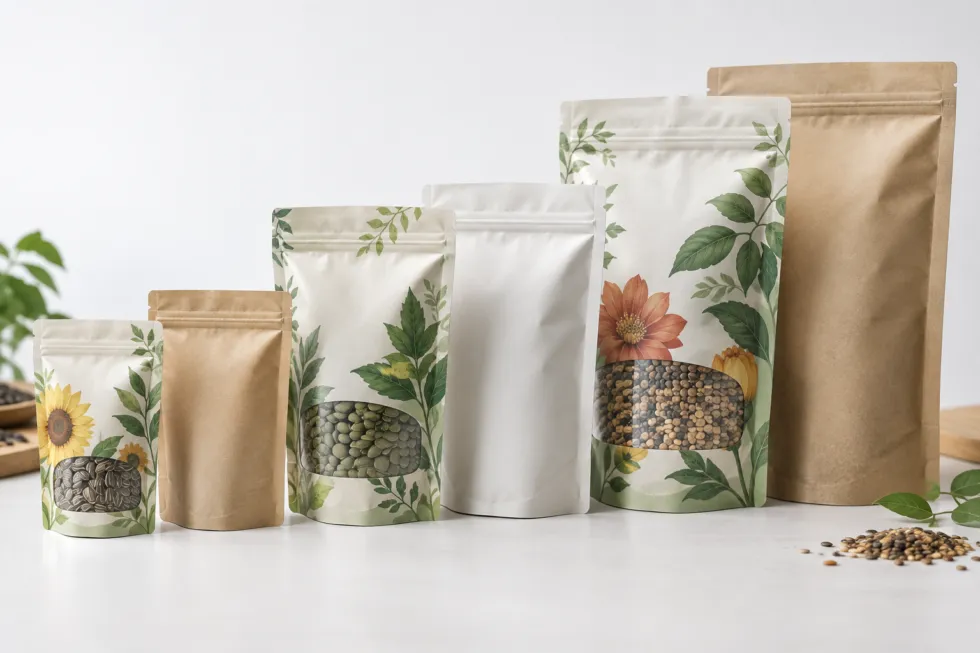
| SKU | Pouch Size | Gusset | Branding | Printing | Annual Forecast |
|---|---|---|---|---|---|
| A | 130 × 185 mm | 70 mm | Branded | 3 colors / 2 sides | 30,000 |
| B | 180 × 290 mm | 90 mm | Branded | 3 colors / 2 sides | 12,000 |
| C | 250 × 340 mm | 130 mm | Branded | 3 colors / 2 sides | 30,000 |
| D | 130 × 185 mm | 70 mm | Unbranded | 1 color / 1 side | Confirm |
| E | 180 × 290 mm | 90 mm | Unbranded | 1 color / 1 side | 500 |
| F | 250 × 340 mm | 130 mm | Unbranded | 1 color / 1 side | 1,600 |
Keep branded and unbranded versions separate
Even when they use the same pouch size, branded and unbranded versions may have different artwork, print specifications, quantities and replenishment patterns.
List them separately rather than combining them into one total.
Total volume can hide production complexity
Thirty thousand identical pouches and 30,000 pouches divided across six artworks and three sizes are different manufacturing projects.
The supplier therefore needs the quantity per SKU, not only the total program volume. That distinction also matters when evaluating printing methods, setup requirements and repeat-order strategy.
Annual Demand vs Order Quantity: How to Request Useful Price Breaks
Provide both annual demand and the quantities you want quoted.
Annual demand shows the potential scale of the program. Quote quantities show the actual production volumes you may place per order.
| SKU | Annual Forecast | Quote Quantity 1 | Quote Quantity 2 |
|---|---|---|---|
| Size A Branded | 30,000 | 7,500 | 15,000 |
| Size B Branded | 12,000 | 3,000 | 6,000 |
| Size C Branded | 30,000 | 7,500 | 15,000 |
| Size C Unbranded | 1,600 | 800 | 1,600 |
Why annual demand alone is not enough
“Annual requirement: 30,000” could mean one order of 30,000, two orders of 15,000, four orders of 7,500 or irregular releases during the year. Those scenarios create different production and inventory implications.
The lowest unit price may not mean the lowest sourcing cost
Larger production quantities can change unit economics, but holding more packaging also increases exposure to artwork changes, product-name changes, regulatory text changes, obsolete packaging, slow-moving SKUs and forecast error.
Key point: request price breaks at quantities you could realistically purchase and hold, not arbitrary volumes chosen only to reduce the quoted unit price.
How Printing Requirements Change the RFQ
Specify the number of artworks, printed sides, color requirements and finish before comparing quotations.
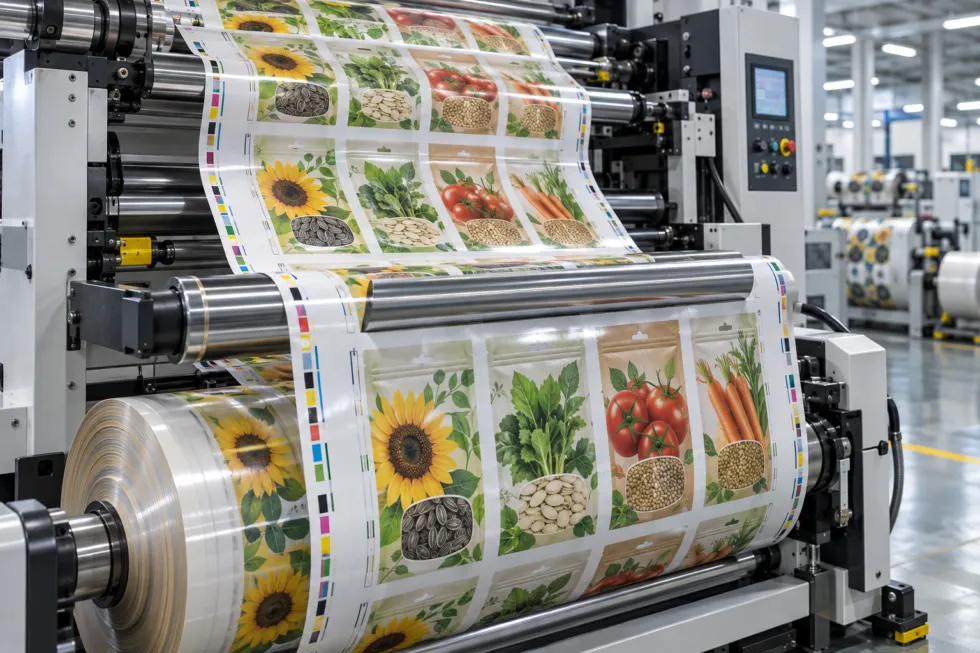
“Custom printed seed pouch” is too broad for a precise production quote. A clearer specification is:
3 colors, 2 printed sides, 3 artwork versions.
Separate print sides from artwork count
A pouch may use the front for brand, seed variety and product graphics, while the back carries product information, planting instructions, barcode, variable-code area or required label information.
If both sides are printed, state that explicitly. The supplier also needs to know whether several seed varieties share one artwork, use minor variations or require separate designs.
Printing method should follow order structure
Honghai Packaging lists both digital printing and rotogravure printing among its flexible-packaging capabilities. Its current factory information also states 10-color gravure capability and 36 automatic bag-making machines. (honghaipackaging.com)
That does not mean every seed pouch should use gravure printing or a high color count.
Printing selection should be reviewed against quantity per artwork, number of SKUs, repeat-order volume, artwork stability, color requirements and pouch structure.
The useful buyer question is:
“Which printing route fits these quantities and artwork versions?”
What Information Should You Send for an Accurate Seed Pouch Quote?
Send enough information for the supplier to identify the pouch, product requirement, printing scope and quantity by SKU. Do not invent technical values you do not know.
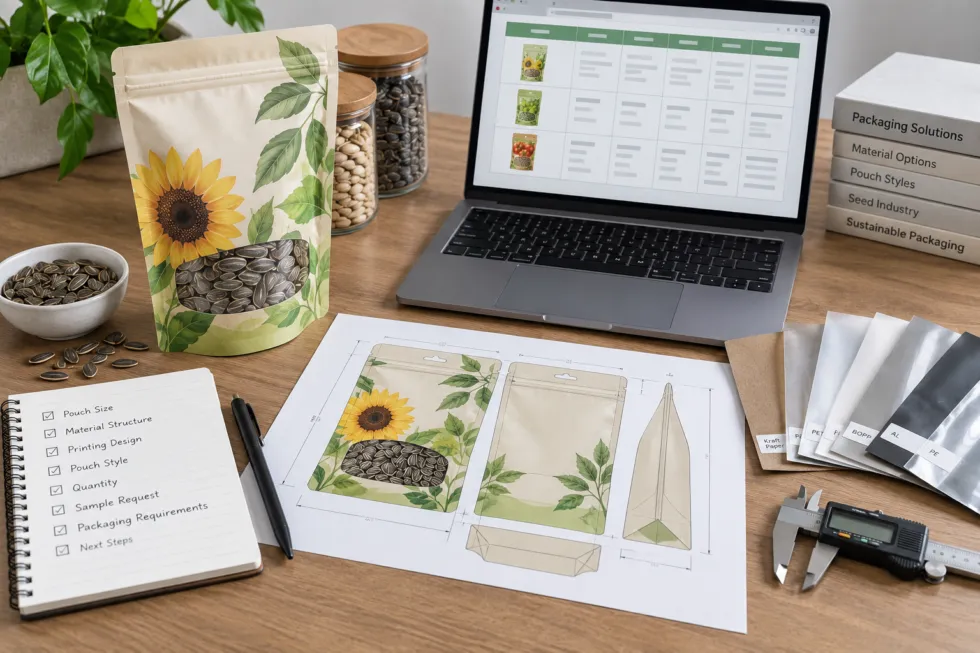
Seed Packaging RFQ Checklist
Include:
- seed or product type
- destination market
- pouch style
- finished width and height
- bottom or side gusset
- product fill amount
- existing pouch sample, if available
- preferred material, if already specified
- required protection or storage objective
- zipper, tear notch, hang hole or window, if required
- printing colors and printed sides
- surface finish
- number of artwork versions
- quantity for each SKU
- annual forecast
- quantities to quote
- filling and sealing method
- artwork or dieline, if available
- required documents or testing
- delivery destination
If you do not know the material structure
If the material structure is unknown, ask the supplier to recommend a suitable structure.
Provide the seed type, storage requirement, destination market, filling and sealing method, expected storage period and current packaging information if available. Then ask the supplier to propose a structure and explain the assumptions behind it.
This keeps supplier recommendations separate from buyer-confirmed requirements.
If you have an existing pouch
Send clear photographs, finished dimensions, a physical sample if available, known material information, artwork or dieline, and the current fill amount.
A photograph can identify visible pouch features, but it does not establish the complete laminate structure.
How to Compare Seed Packaging Supplier Quotes Correctly
Compare the specification first and the unit price second.
If two suppliers have priced different materials, print scopes, SKU quantities or delivery assumptions, their unit prices are not directly comparable.
| Item to Compare | Supplier A | Supplier B | Why It Matters |
|---|---|---|---|
| Finished dimensions | Confirms the same pouch size | ||
| Gusset | Affects pouch geometry and usable volume | ||
| Material structure | Confirms what is actually being supplied | ||
| Printing method | May differ by quantity and artwork structure | ||
| Printed sides | Prevents incomplete print comparisons | ||
| Number of artworks | Important for multi-SKU programs | ||
| Quantity per SKU | Total volume can hide smaller runs | ||
| Unit price | Meaningful only when the quotation basis matches | ||
| Tooling / setup | Check what is included or separate | ||
| Sample / proof | Clarifies the approval process | ||
| Delivery basis | Affects total sourcing cost | ||
| Documentation | Confirms project-specific requirements |
Common sourcing issue: comparing descriptions instead of structures
Supplier A might quote a foil-containing laminate while Supplier B quotes a metallized laminate. Both could describe the product as a “high-barrier seed pouch.”
Before comparing price, ask both suppliers to identify the proposed structure and the assumptions used for the quote.
Separate confirmed requirements from recommendations
A clean RFQ distinguishes what the buyer has already decided from what still needs technical confirmation.
For example:
Confirmed
- 180 × 290 mm
- 90 mm bottom gusset
- zipper
- 2-side printing
- 6,000 pieces
To confirm
- final laminate
- final thickness
This makes quotation revisions easier to track.
What UK Seed Buyers Should Confirm Before Final Artwork
UK buyers should identify which seed-marketing and labeling rules apply to the specific seed category and destination before approving final artwork.
For England and Wales, GOV.UK guidance states that marketing of covered agricultural and vegetable seeds is regulated and includes certification, packing, sealing and labeling requirements. It also distinguishes requirements for certified seed from supplier labeling for standard vegetable seed or small packets. (gov.uk)
This should not be generalized to every seed product or every part of the UK.
Reserve required information space before artwork approval
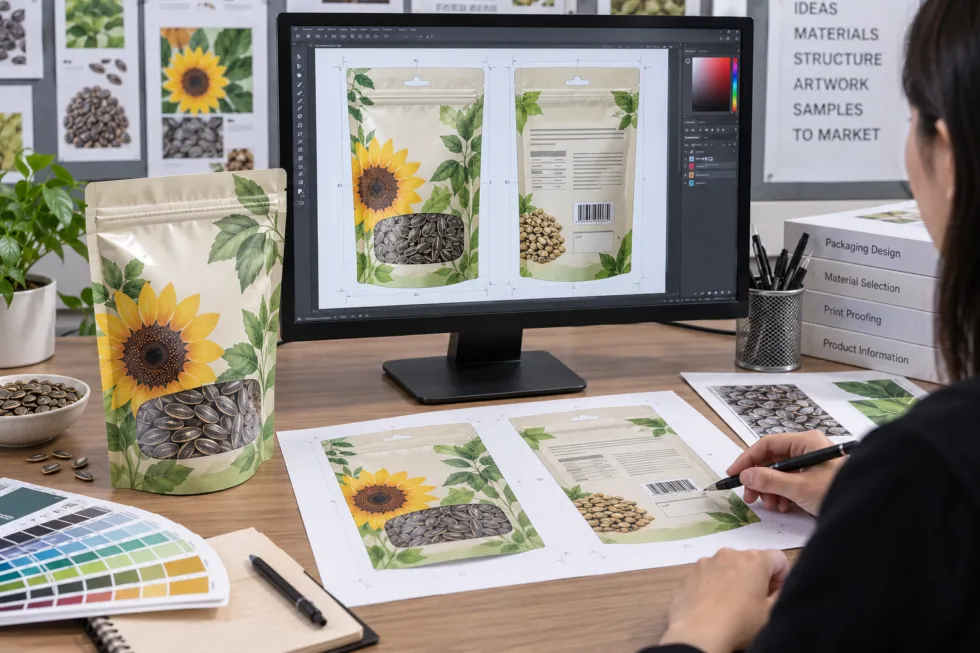
Depending on the applicable rules and product, the buyer may need space for seed identification, supplier or marketer information, lot or batch identification, barcode, planting information, variable coding or other required market information.
The exact content must come from the requirements applicable to the product and market.
Packaging compliance and seed-marketing compliance are separate issues
A packaging manufacturer can provide information about its materials and manufacturing process. That does not determine whether the seed itself can be marketed or what statutory information must appear on the final package.
For projects subject to seed-marketing rules, involve the buyer’s QA or regulatory personnel before artwork approval rather than after printing.
Seed Packaging RFQ Example for a Multi-SKU Program
A multi-SKU RFQ should let the supplier quote each pouch variant separately.
| SKU | Size | Bottom Gusset | Version | Printing | Annual Forecast | Quote Quantities |
|---|---|---|---|---|---|---|
| A | 130 × 185 mm | 70 mm | Branded | 3 colors / 2 sides | 30,000 | 7,500 / 15,000 |
| B | 180 × 290 mm | 90 mm | Branded | 3 colors / 2 sides | 12,000 | 3,000 / 6,000 |
| C | 250 × 340 mm | 130 mm | Branded | 3 colors / 2 sides | 30,000 | 7,500 / 15,000 |
| D | 130 × 185 mm | 70 mm | Unbranded | 1 color / 1 side | Confirm | Confirm |
| E | 180 × 290 mm | 90 mm | Unbranded | 1 color / 1 side | 500 | 500 |
| F | 250 × 340 mm | 130 mm | Unbranded | 1 color / 1 side | 1,600 | 800 / 1,600 |
Then list unresolved technical questions separately:
- Is “foil lined” based on an existing approved structure, or should the supplier propose one?
- What seed will be packed?
- What is the fill amount for each size?
- Is a zipper required?
- What filling and sealing method will be used?
- Is an existing pouch available for review?
- What destination-market documentation is required?
- Which SKUs are required in the first production order?
This keeps technical assumptions clear during quotation and production.
When the project is ready for quotation
If dimensions, artwork versions and quantities are already known, send them as a SKU table rather than one combined total.
If the material is still open, provide the seed type, fill information, storage requirement, destination market and existing packaging reference where available. Honghai Packaging can then review the pouch format, printing requirements and proposed flexible-packaging structure against those inputs.
FAQ
Do all seed pouches need foil?
No. Packaging choice depends on the seed, storage conditions and required protection. FAO guidance states that no single container or packaging material is best for every seed condition and storage objective. (fao.org)
Is “foil lined seed pouch” a complete material specification?
No. It indicates a general construction direction but does not identify the complete laminate, thickness, sealant layer or verified barrier performance.
Can pouch dimensions tell me how many grams of seed will fit?
Not reliably. Capacity also depends on seed size, shape, bulk density, gusset geometry, headspace and filling method. Validate a new size with the actual product.
Can several seed varieties use the same pouch size?
Potentially, if their product volume, filling process and packaging requirements are compatible. Keep each artwork and quantity as a separate SKU in the RFQ.
Should I provide annual demand or the quantity for my next order?
Provide both. Annual demand gives program context; the quantity per production order is needed for relevant pricing.
Can branded and unbranded seed pouches be quoted together?
Yes, but list them separately when the print specification or quantity differs.
What is the MOQ for custom seed packaging?
The MOQ for a specific project must be confirmed against pouch construction, size, printing method, SKU count and customization requirements.
Can I send an existing seed pouch for quotation?
Yes. A sample helps communicate dimensions, format and visible features. Include known material information, artwork and fill information where available.
What should I send if I do not know the material structure?
Send the seed type, pouch size or fill amount, storage requirement, destination market, filling and sealing method, required features, quantities per SKU and any existing packaging reference. The structure can then be proposed and confirmed separately.
What should UK seed brands check before approving artwork?
Determine whether the seed is covered by specific seed-marketing, certification, packing, sealing or labeling rules in the destination market. For England and Wales, official guidance covers specified agricultural and vegetable seed categories. (gov.uk)
For a quote-ready project, the supplier should be able to identify:
- The exact pouch or SKU being priced
- What the package needs to do for the product and filling process
- The quantity required for each SKU and purchasing cycle
When those inputs are separated from items still awaiting technical confirmation, procurement teams can compare quotations on the same basis.