
Custom Candy Bags for 300g, 500g, and 1kg: What Buyers Need to Specify
A packaging inquiry often starts with a simple request:
“I need custom design bags that hold 300g, 500g, and 1kg.”
That is a useful starting point, but it is not enough to determine the finished bag specifications.
For custom candy bags, the target fill weight is only one part of the packaging requirement. The supplier may also need to understand the type and size of the candy, preferred bag format, required features, artwork, material or barrier requirements, and order quantity for each size.
For brands, importers, distributors, contract manufacturers, and packaging buyers, providing these details early can make the packaging discussion much more efficient.
Can You Choose a Candy Bag Size by Product Weight Alone?
No. A target fill weight such as 300g, 500g, or 1kg does not by itself determine the correct bag dimensions.
Two candies with the same net weight can occupy very different amounts of space.
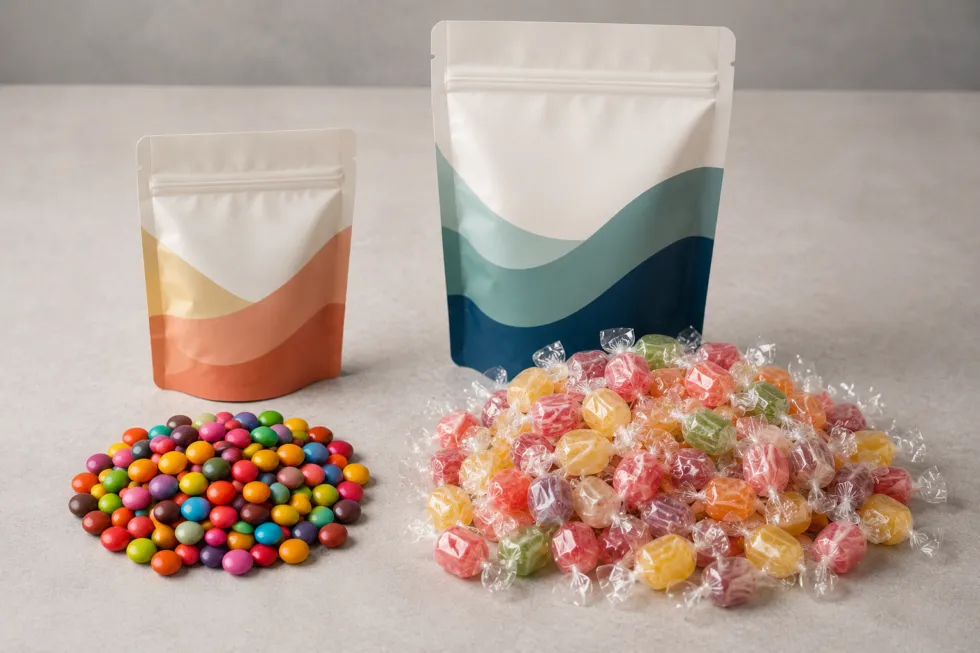
Why 300g of One Candy May Take More Space Than 300g of Another
Consider 300g of small, dense candies compared with 300g of large individually wrapped sweets. Their weights may be identical, but the volume required inside the package can be very different.
Product shape also matters. Round candies, irregular pieces, gummies, chocolates, hard candy, and individually wrapped products do not necessarily pack into a pouch in the same way.
This is why asking for a “300g candy bag” without describing the product can leave an important part of the specification unresolved.
Product Dimensions and Bulk Volume Matter
When determining bag dimensions, buyers should consider how much physical space the product occupies rather than looking only at net weight.
Useful information can include:
- Approximate dimensions of individual pieces
- Whether the candy is loose or individually wrapped
- Approximate volume of the intended fill quantity
- How full the finished package should appear
- Whether additional usable space is needed for closing and handling
These details give the packaging supplier a better basis for discussing dimensions.
Why the Actual Product Should Be Considered Before Finalizing Dimensions
A bag can look suitable on a drawing and still be a poor fit for the actual product.
Whenever possible, final dimensions should be considered against the real candy or representative product samples. This helps evaluate how the product settles inside the package and whether the proposed format works as intended.
The key purchasing rule is simple: do not finalize custom candy bag dimensions from fill weight alone.
300g vs. 500g vs. 1kg Candy Bags: What Actually Changes?
If a product line needs 300g, 500g, and 1kg packs, each size should be treated as an individual packaging specification.
The larger pack will normally require more usable capacity, but that does not mean every dimension should simply increase by the same percentage.
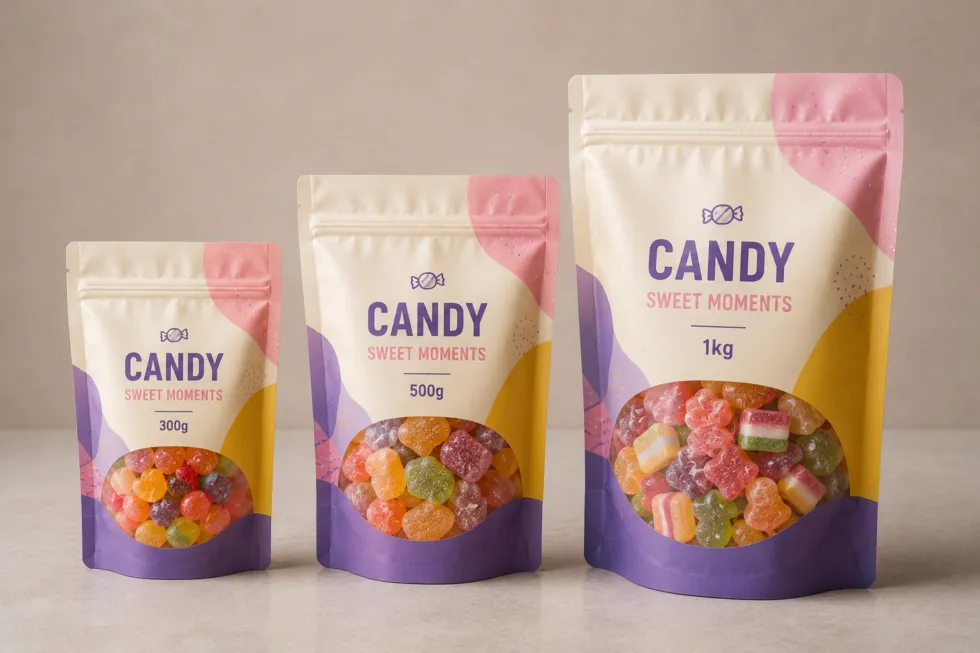
Bag Dimensions
Width, height, and gusset or depth can affect the usable capacity and appearance of a pouch.
For example, increasing height may create a different shelf appearance from increasing width or gusset depth. The preferred proportions can also depend on the selected bag format and how the package will be displayed.
For this reason, it is better to evaluate each pack size rather than mechanically scaling one design.
Product-to-Package Ratio and Usable Internal Space
A package needs to contain the required product quantity while still functioning as a package.
A buyer should therefore think beyond nominal dimensions and consider:
- How the candy fills the bag
- How much empty space remains
- Whether the closure area remains usable
- How the filled bag stands, hangs, or lies on display
- Whether the final proportions suit the brand’s presentation
The objective is not simply to find a bag that can physically contain the product. It is to find a format and size that work for the intended use.
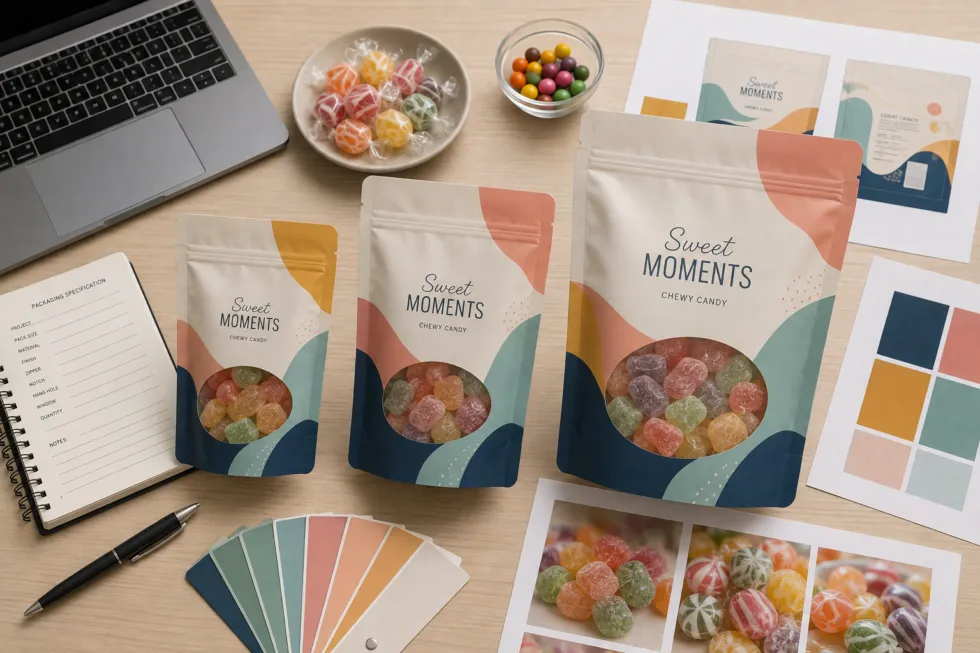
Keeping Three Pack Sizes Visually Consistent
For a product range with 300g, 500g, and 1kg options, buyers usually want consumers to recognize all three packages as part of the same brand family.
That does not require identical proportions.
Logo placement, colors, typography, product naming, and other core design elements can remain consistent while the artwork is adapted to the printable area of each package.
| Purchasing consideration | 300g | 500g | 1kg |
|---|---|---|---|
| Product volume | Confirm with actual product | Confirm with actual product | Confirm with actual product |
| Bag dimensions | Specify separately | Specify separately | Specify separately |
| Bag format | Confirm for this SKU | Confirm for this SKU | Confirm for this SKU |
| Features | Confirm required features | Confirm required features | Confirm required features |
| Artwork | Adapt to final dimensions | Adapt to final dimensions | Adapt to final dimensions |
| Order quantity | State separately | State separately | State separately |
The important point is that 300g, 500g, and 1kg should be treated as three defined SKUs, not simply one bag in three assumed sizes.
Which Bag Format Works for Custom Candy Packaging?
There is no single bag format that is automatically best for every candy product.
The right choice depends on factors such as retail presentation, product volume, how consumers use the package, and how the finished packs will be handled and distributed.
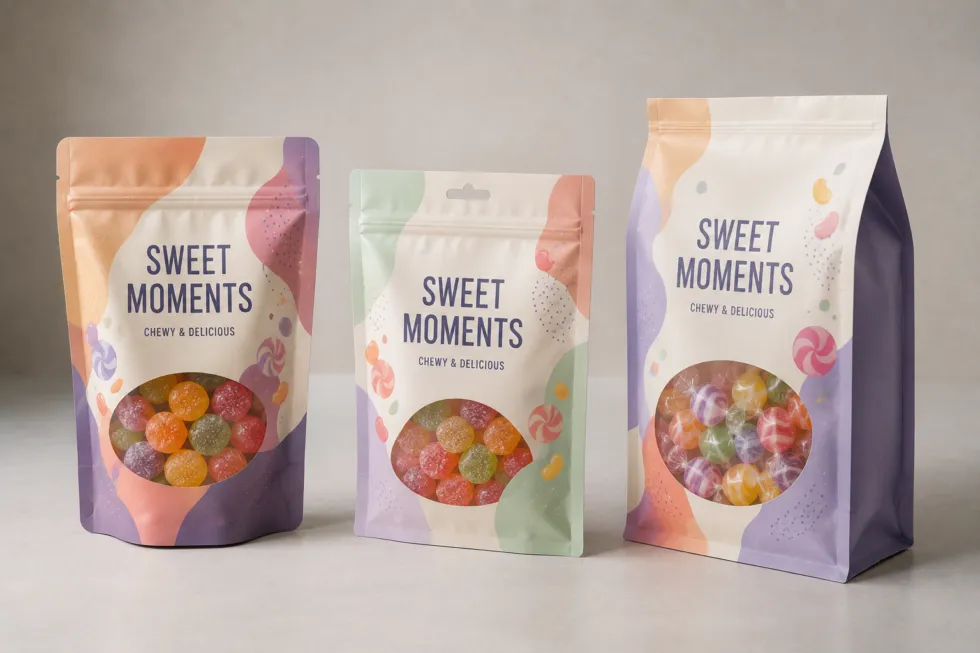
Stand-Up Pouches
Stand-up pouches are worth considering when shelf presentation is important and the buyer wants the package to stand upright.
They also provide front and back surfaces for branding and product information.
For buyers considering stand up pouches for candy, the gusset and finished dimensions need to be evaluated together with the product volume.
Flat Pouches
A flat pouch may be suitable when a stand-up format is not required or when the intended product and sales format work better with a simpler pouch structure.
Again, the decision should be based on the actual application rather than the product weight alone.
Side-Gusset or Other Larger-Capacity Formats
For higher-volume packs, buyers may also evaluate formats that provide additional internal space through gussets or a different bag construction.
A 1kg requirement, for example, should prompt a discussion about both capacity and the way the filled package needs to perform in storage, transport, and display.
It should not automatically lead to a particular bag style without considering the product.
How Retail Display and Distribution Affect the Choice
Before selecting a format, ask practical questions:
Will the bag stand on a shelf? Will it hang from a display? Will consumers open it multiple times? Will the packs be placed inside cartons for distribution? How much front-facing space does the brand need?
These questions can narrow down the appropriate packaging format more effectively than starting with appearance alone.
What Features Should You Consider for Custom Candy Bags?
Custom candy packaging can include different functional and visual features. Buyers should identify which ones are actually required rather than adding features without a clear purpose.
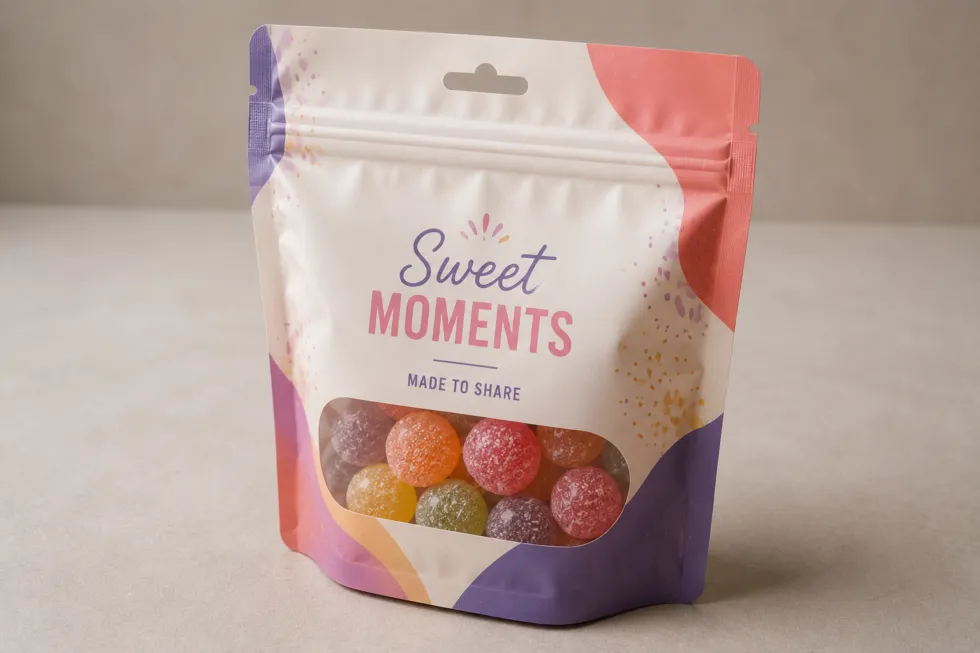
Resealable Zipper
A zipper can be considered when the package is expected to be opened and closed multiple times.
This may be particularly relevant for larger packs or products that consumers are unlikely to finish immediately.
When requesting resealable candy bags, specify the zipper requirement as part of the RFQ rather than assuming it is included.
Tear Notch
A tear notch is intended to make the package easier to start opening.
If opening convenience is important to the product format, buyers can include this requirement when discussing the bag specification.
Hang Hole
For products intended for peg or hanging displays, a hang hole may be relevant.
This decision should be made with the intended retail display method in mind.
Clear Window
A clear window can allow consumers to see the candy inside the package.
Whether a window is appropriate depends on the desired visual presentation as well as the product’s packaging requirements. Buyers should therefore treat it as a design and packaging decision, not simply a decorative addition.
Surface Finish and Printed Appearance
The visual character of custom printed candy bags is influenced by artwork, colors, surface appearance, and the overall package design.
Buyers should communicate the intended appearance clearly and make sure artwork is reviewed against the final dimensions of each SKU.
How Should You Choose the Material for a Candy Bag?
Start with the product requirements, not with a generic material recommendation.
A packaging material should not be selected simply because another candy brand uses it or because the bag needs to hold 300g, 500g, or 1kg.
Start With the Candy Itself
Different confectionery products can have different packaging needs.
Before discussing material options, provide the supplier with a clear description of what will be packed. This is especially important when the product has particular sensitivity or storage requirements.
Consider Moisture, Oxygen, Light, and Aroma Sensitivity
Depending on the product, buyers may need to consider exposure to moisture, oxygen, light, or loss and transfer of aroma.
The relevant factors depend on the actual candy and its intended storage conditions.
If your company already has defined packaging performance requirements, include them in the inquiry. If it does not, avoid substituting assumptions for product-specific evaluation.
Consider Storage and Distribution Conditions
Packaging is not used only on a retail shelf.
Buyers should also consider how the finished candy will be packed, stored, shipped, and distributed. Relevant conditions may influence the packaging specification.
The supplier should therefore receive enough information to understand the intended application.
Why Material Structure Should Not Be Selected From Bag Weight Alone
A 1kg bag does not automatically require a particular material structure simply because it contains more product than a 300g bag.
Likewise, two 500g candy products may have different packaging requirements.
Fill weight, product characteristics, bag format, distribution conditions, and required packaging performance should be considered together before the material specification is finalized.
How to Plan One Custom Design Across 300g, 500g, and 1kg Bags
Ordering several sizes creates another purchasing question: how do you maintain a consistent brand while working with different package dimensions?
The answer is to build one visual system, then adapt it deliberately for each SKU.
Keep the Core Brand Identity Consistent
The main brand elements can remain recognizable across all three sizes.
These may include:
- Logo
- Brand colors
- Typography
- Product naming system
- Main visual style
- Key front-of-pack hierarchy
This makes it easier for buyers and consumers to recognize the product family.
Adapt Artwork to Different Bag Dimensions
Do not assume that artwork created for a 300g package can simply be enlarged for a 1kg package.
Changes in width, height, gussets, seals, and other structural areas can affect the available design space.
Artwork should therefore be adapted to the final dimensions of each bag.
Make Pack Size Differences Easy to Recognize
When several sizes are sold together, the net weight should be easy to identify.
Brands may also choose to differentiate SKUs visually while keeping the overall design system consistent.
The goal is to avoid creating three packages that either look unrelated or are unnecessarily difficult to distinguish.
Check Artwork Separately for Each Final Size
Each size should receive its own artwork check before the specification is finalized.
This helps confirm that important elements are positioned appropriately for the actual package layout rather than relying on assumptions from another SKU.
What Information Should You Send When Requesting a Quote?
A useful RFQ for custom candy bags should tell the packaging supplier more than the required fill weights.
The more clearly the application is described, the easier it is to identify which details still need to be confirmed.
| Information to provide | Why it matters |
|---|---|
| Candy type | Helps define the packaging application |
| Product shape and approximate dimensions | Helps assess the space the product occupies |
| Fill weight for each SKU | Defines the required 300g, 500g, and 1kg packs |
| Preferred bag style | Establishes the starting packaging format |
| Required features | Clarifies zipper, tear notch, hang hole, window, or other needs |
| Material or performance requirements | Communicates requirements already defined by the buyer |
| Artwork requirements | Helps clarify the custom printing project |
| Quantity for each size | Defines the purchasing requirement for each SKU |
| Storage or distribution requirements | Provides context for the intended application |
Product Type and Product Dimensions
Instead of writing only “candy,” describe the product more specifically.
For example, tell the supplier whether the product consists of small loose pieces, larger sweets, chocolates, gummies, or individually wrapped pieces.
Approximate product dimensions can also be useful.
Target Fill Weight: 300g, 500g, and 1kg
List each required SKU clearly.
If all three sizes are required, state that directly rather than requesting one size first and adding the others later.
Preferred Bag Style
If you already know that you want a stand-up pouch, flat pouch, or another format, include it.
If the format has not been decided, describe how you want the finished package to be displayed and used.
Required Packaging Features
State which features you need.
For example:
- Resealable zipper
- Tear notch
- Hang hole
- Clear window
- Specific surface appearance
This separates essential requirements from optional ideas.
Material or Performance Requirements, If Already Known
If your company has an existing material specification or defined performance requirements, provide them.
If not, describe the product and application rather than guessing technical values.
Artwork and Printing Requirements
Tell the supplier whether artwork is already available and whether the three sizes will share the same design system.
For candy bags with logo printing, providing the artwork status early helps clarify what still needs to be prepared.
Quantity Required for Each Size
Do not provide only one combined quantity if you need several SKUs.
State the expected quantity separately for 300g, 500g, and 1kg bags so the supplier can understand the purchasing requirement accurately.
A Better Way to Request Custom Candy Bags
A short inquiry can still be effective if it contains the right information.
Before sending an RFQ for custom candy packaging, use this checklist:
Custom Candy Bag RFQ Checklist
- Candy type
- Product shape and approximate dimensions
- Whether pieces are loose or individually wrapped
- Target fill weight for each SKU
- 300g, 500g, and/or 1kg requirements clearly listed
- Preferred bag format
- Required zipper or closure features
- Tear notch requirement
- Hang hole requirement
- Clear window requirement
- Desired surface appearance
- Existing material or barrier requirements, if known
- Artwork status and printing requirements
- Quantity required for each bag size
- Relevant storage, packing, or distribution requirements
Instead of sending:
“I need custom design bags for 300g, 500g, and 1kg.”
a buyer can provide the same basic request together with the product type, preferred format, required features, artwork status, and quantity for each size.
That gives the packaging discussion a much stronger starting point without forcing the buyer to invent technical specifications they do not yet know.
Frequently Asked Questions About Custom Candy Bags
What Size Bag Do I Need for 300g of Candy?
There is no reliable universal bag dimension based only on a 300g fill weight.
The required dimensions depend on the candy’s size, shape, bulk volume, selected bag format, and desired fill appearance. The actual product or representative samples should be considered before finalizing dimensions.
The same principle applies to 500g and 1kg candy bags.
Can the Same Bag Design Be Used for 300g, 500g, and 1kg?
The same brand design system can be used across all three sizes, but the artwork may need to be adapted for each bag’s final dimensions and layout.
Simply scaling the complete artwork up or down may not produce the best result.
Are Resealable Bags Suitable for Candy Packaging?
A resealable zipper can be considered when consumers are expected to open and close the package multiple times.
Whether it is needed depends on the product, pack size, intended use, and buyer requirements. Buyers who require a zipper should state this clearly in the RFQ.
What Information Does a Packaging Supplier Need Before Recommending Bag Dimensions?
At minimum, it is useful to provide the product type, target fill weight, approximate product dimensions or volume, preferred bag format, and desired package appearance.
Information about required features, artwork, quantities, and the intended storage and distribution conditions can further clarify the project.
Can I Choose the Packaging Material Before the Final Bag Size Is Confirmed?
Material and bag dimensions are related parts of the overall packaging specification, but material selection should primarily reflect the actual product, required packaging performance, bag format, and intended use.
Do not choose a material structure solely because the package will contain 300g, 500g, or 1kg.
For B2B buyers sourcing custom candy bags, the most useful first step is not to guess every technical detail. It is to provide a clear description of the product and purchasing requirements. From there, bag dimensions, format, features, material requirements, artwork, and the specifications for each SKU can be evaluated systematically.