
Custom Shoe Insole Packaging Bags: What Buyers Need to Specify Before Ordering
A custom packaging inquiry can start with a specification that already sounds fairly detailed:
“5" width × 14" height. Plastic package for shoe insoles. Hang hole at the top, full color printing, matte finish preferred.”
This gives a packaging supplier several useful requirements. The target dimensions, product application, hanging feature, printing, and preferred finish are already identified.
But it is not yet a complete packaging specification.
For B2B buyers sourcing custom shoe insole packaging bags, the next step is to confirm how the dimensions relate to the actual insoles, whether the selected bag format fits the product and retail display, how the hang hole should work, and what artwork and material requirements still need to be defined.
Is 5" × 14" Enough to Specify a Shoe Insole Packaging Bag?
No. A requested size such as 5" × 14" is an important starting specification, but the actual product and finished-bag requirements should be checked before dimensions are finalized.
A width and height tell the supplier the target footprint of the package. They do not describe the thickness and profile of the product inside it.
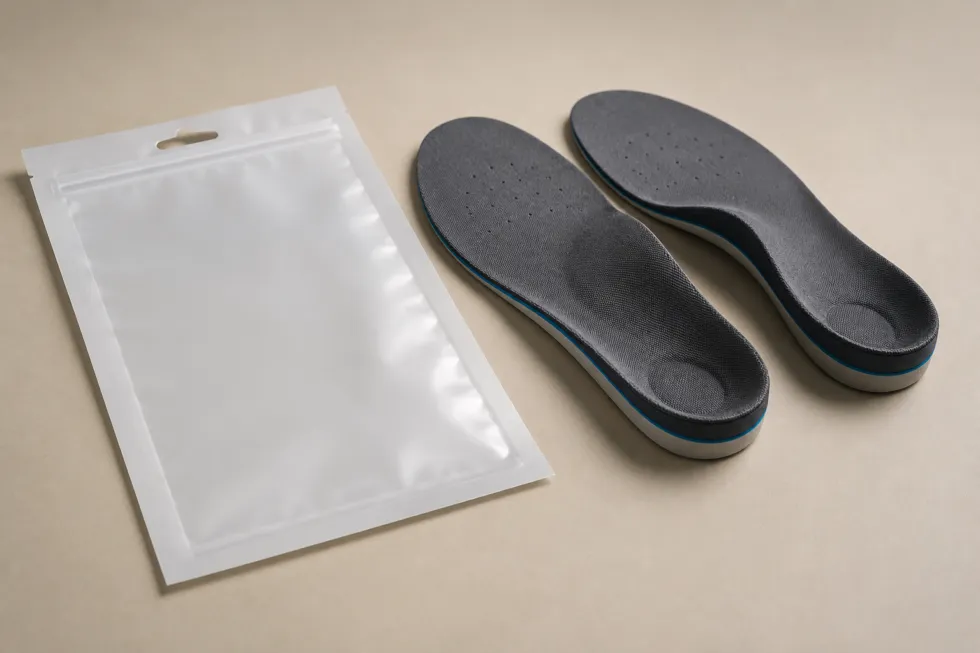
They also do not automatically establish whether the dimensions refer to the finished bag or another measurement used during the buyer’s initial planning.
Confirm Whether the Dimensions Refer to the Finished Bag
If your RFQ specifies 5" × 14", make it clear what those dimensions represent.
For example, are you requesting a finished bag with that width and height? Or are those approximate dimensions based on the product?
This distinction matters because the supplier needs to understand exactly what the buyer is specifying rather than interpret an ambiguous measurement.
If you already have an existing package that fits correctly, providing its finished dimensions can also give useful context.
Check the Actual Insole Dimensions and Thickness
Shoe insoles are relatively flat products, but they are not dimensionless.
Measure the actual product at its widest and longest points. Thickness and overall profile should also be considered.
Two insole products with similar length and width may not occupy the package in exactly the same way if their thickness, contour, cushioning, or shape differs.
This is why custom insole bags should be evaluated against the actual product rather than selected from width and height alone.
Allow for Loading, Sealing, and Product Fit
The bag must do more than surround the product.
The insoles need to be inserted into the package, positioned correctly, and enclosed without interfering with the functional areas of the bag.
A package that is extremely tight around the product may also be less convenient to load or remove.
For procurement purposes, the question is therefore not simply:
“Are the insoles smaller than 5" × 14"?”
The better question is:
“Does the proposed finished bag size work with the actual product, bag construction, sealing area, and intended packing process?”
How Should You Check Whether the Bag Fits the Insoles?
The safest way to evaluate shoe insole packaging is to start with the physical product.
Do not rely only on a product description or shoe size.
Measure the Product at Its Widest and Longest Points
Record the maximum length and width of the insoles that will go into the package.
If several insole sizes will use the same packaging, identify which products the bag needs to accommodate.
This prevents a package from being developed around only one product when the buyer actually intends to use it for multiple variants.
Consider Thickness and Product Profile
Length and width describe only two dimensions.
Some insoles are thin and relatively flat. Others may have a more pronounced heel area, cushioning, contour, or other three-dimensional profile.
That profile affects how the product sits inside a flat flexible package.
Buyers do not need to guess a technical packaging specification from this information. They simply need to provide an accurate description of the product.
Consider How the Insoles Will Be Inserted and Removed
Think about the actual packing process.
Will a pair of insoles be inserted together? How will they be oriented? Will any paper insert, card, instructions, or other component be placed in the same package?
If additional components are part of the intended pack, they should be considered when evaluating product fit.
Test the Package With the Actual Product Before Finalizing
A drawing can help establish dimensions, but the actual product provides a better reference for fit.
Whenever possible, evaluate the proposed package with the insoles or representative samples before finalizing the specification.
This helps answer practical questions about loading, product position, appearance, and usable space without relying on assumptions.
Is a Three-Side Seal Bag Suitable for Insole Packaging?
A three-side seal bag can be a format to evaluate for shoe insole packaging, particularly when the application calls for a relatively flat flexible package. Whether it is the right choice depends on the actual product and packaging requirements.
The bag format should follow the application rather than the other way around.
How a Three-Side Seal Format Works
A three-side seal bag is a flat pouch format with sealed edges around three sides.
For a buyer considering custom three side seal bags, important questions include whether the available internal space suits the product, how the package will be filled and closed, and where functional features need to be positioned.
The exact construction should be confirmed as part of the final packaging specification.
When a Flat Packaging Format Makes Sense
A flat format can be worth considering when the product itself has a relatively flat profile and the buyer does not need a package designed to stand upright on a shelf.
Shoe insoles can fit this general application, but the specific product still needs to be evaluated.
A flat pouch should not be selected simply because another insole product uses one.
Product Fit and Retail Presentation Should Drive the Decision
Consider how the finished package will be sold.
If it will hang in a retail display, the overall package proportions and hanging area matter. If it will be packed into cartons or displayed another way, different considerations may become more important.
The preferred packaging format should therefore reflect both the product and its intended presentation.
What Should Buyers Confirm About the Hang Hole?
A request for a hang hole at the top sounds straightforward, but the feature should be considered as part of the complete package.
The purpose of the hang hole is not simply to add an opening to the bag. It needs to work with the intended retail display and the finished package.
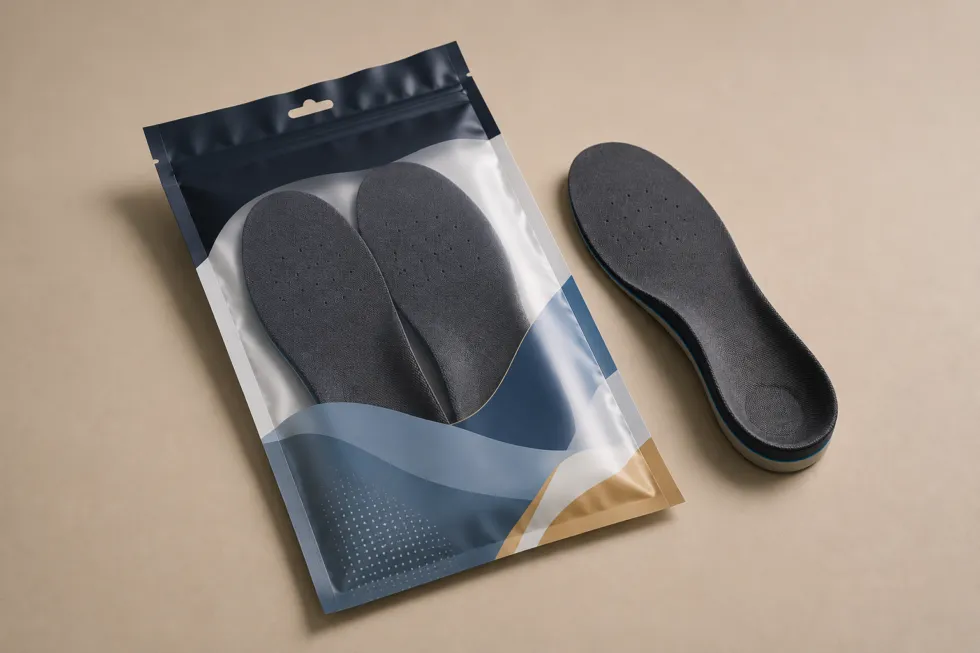
Start With the Intended Retail Display
Tell the packaging supplier that the product is intended to hang if that is part of the retail plan.
This provides context for the hang hole requirement.
If the buyer already has specific display requirements, those should be communicated as part of the packaging brief rather than assumed.
Consider the Hang Hole Position and Top Area
The hang hole occupies part of the upper area of the package.
That same general area may also involve seals, opening features, artwork, and other structural elements.
For this reason, the hang hole should be considered when the final package layout is prepared.
Important branding or product information should also be positioned with the functional areas of the bag in mind.
Check the Filled Package, Not Only the Empty Bag
An empty hanging packaging bag can look correct while lying flat on a desk.
The real question is how the finished package works when the product is inside.
The insoles affect the package’s shape and balance. Buyers should therefore evaluate the hang-hole requirement in the context of the filled package and intended retail display.
What Does “Full-Color Printing” Require From the Buyer?
If custom printing is required, stating “full color printing” is a useful start.
The next step is to prepare the artwork and define how it should appear on the actual package.
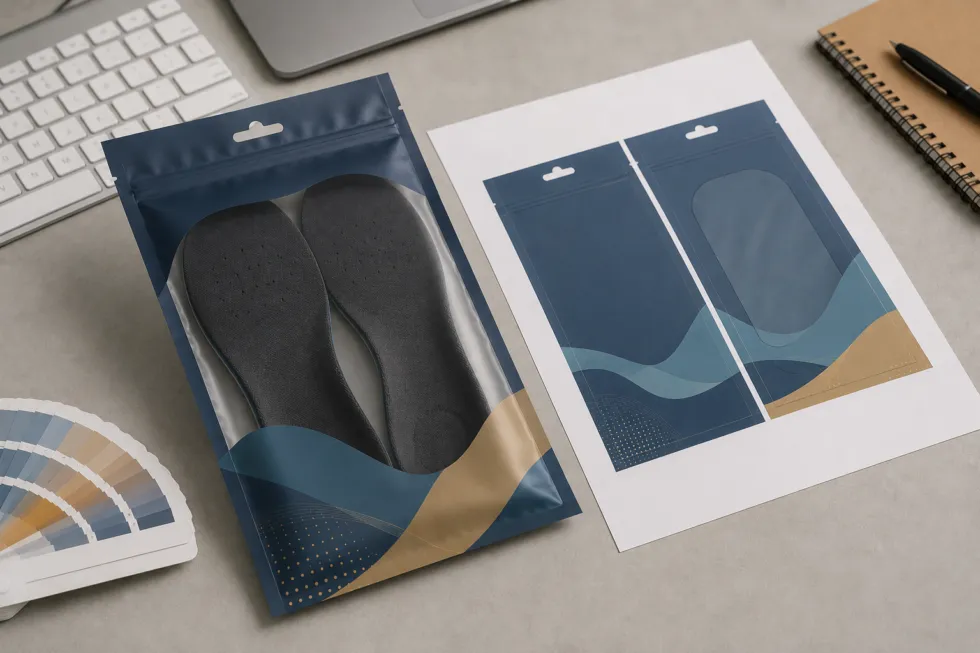
Prepare Artwork for the Final Bag Dimensions
Artwork should be developed or adapted to the confirmed package layout.
Do not assume that artwork created for a different bag size can simply be transferred without adjustment.
The available printed area depends on the final dimensions and construction of the package.
Identify Front and Back Printing Requirements
Tell the supplier what needs to appear on each side of the package.
The front may contain the primary branding and product presentation, while the back may contain other information required by the buyer.
Providing clear front and back artwork reduces ambiguity during the packaging development process.
Keep Important Artwork Away From Functional Areas
The design needs to work with the physical bag.
Sealed edges, the hang-hole area, opening areas, and other functional parts of the package should be considered when positioning important visual elements.
A logo or critical design element that looks correct on a flat artwork file may not be ideally positioned if the bag construction was not considered.
Review Artwork Against the Final Packaging Layout
Before the custom printed insole bags are finalized, review the artwork against the confirmed package layout.
Check that the design hierarchy, product information, branding, and functional areas work together.
For multi-SKU projects, review each final layout rather than assuming one artwork setup works unchanged across every package.
How Should You Specify a Matte Finish?
If matte finish is preferred, state it clearly in the RFQ rather than treating it as an assumed default.
“Matte finish preferred” communicates the intended visual direction, but the final appearance should still be discussed as part of the overall packaging specification.
Treat Matte Finish as Part of the Visual Requirement
Surface appearance influences how custom retail packaging looks and feels as a finished product.
If the brand is aiming for a matte appearance, include that preference together with the artwork and other visual requirements.
This makes the design intent clear from the beginning.
Confirm the Desired Appearance With the Packaging Supplier
Words such as “matte” describe a visual direction, but buyers should make sure the expected appearance is understood.
If there is an existing package or visual reference that represents the desired look, it can provide additional context during the discussion.
Avoid assuming a particular material structure or manufacturing process simply from the desired appearance.
Evaluate Finish Together With Artwork and Packaging Structure
The surface finish is one part of the complete package.
It should be reviewed together with the artwork, bag format, and other confirmed packaging requirements rather than treated as an isolated specification.
This is particularly useful when the buyer’s priority is achieving a consistent retail presentation.
How Should Buyers Discuss the Packaging Material?
A request may simply say:
“Plastic package for shoe insoles.”
That describes the general packaging category, but it does not define a specific material structure.
Buyers should not guess one if they do not already have a defined requirement.
Start With the Product and Intended Use
Provide information about the insoles, the selected packaging format, how the product will be displayed, and other relevant packing or distribution conditions.
This gives the packaging discussion a practical starting point.
The material decision should follow the actual application and required packaging performance.
Provide Any Existing Material Requirements
If your company already has an established packaging specification, include it in the RFQ.
Likewise, if there are particular packaging requirements your supplier needs to consider, state them clearly.
This is more useful than describing the material only as “plastic.”
Do Not Guess a Material Structure When Requirements Are Unknown
If you do not know the appropriate structure, describe what the package needs to do instead of inventing technical specifications.
For example, provide the product information, bag format, display method, printing requirements, finish preference, and any known performance requirements.
That allows the material discussion to be based on the actual project rather than an unsupported assumption.
What Information Should You Include in a Shoe Insole Packaging RFQ?
A useful RFQ brings the product, package, printing, and purchasing requirements together.
For example, a request for a 5" × 14" plastic package with a top hang hole, full-color printing, and a matte finish already provides several important details.
The following information makes the packaging brief more complete:
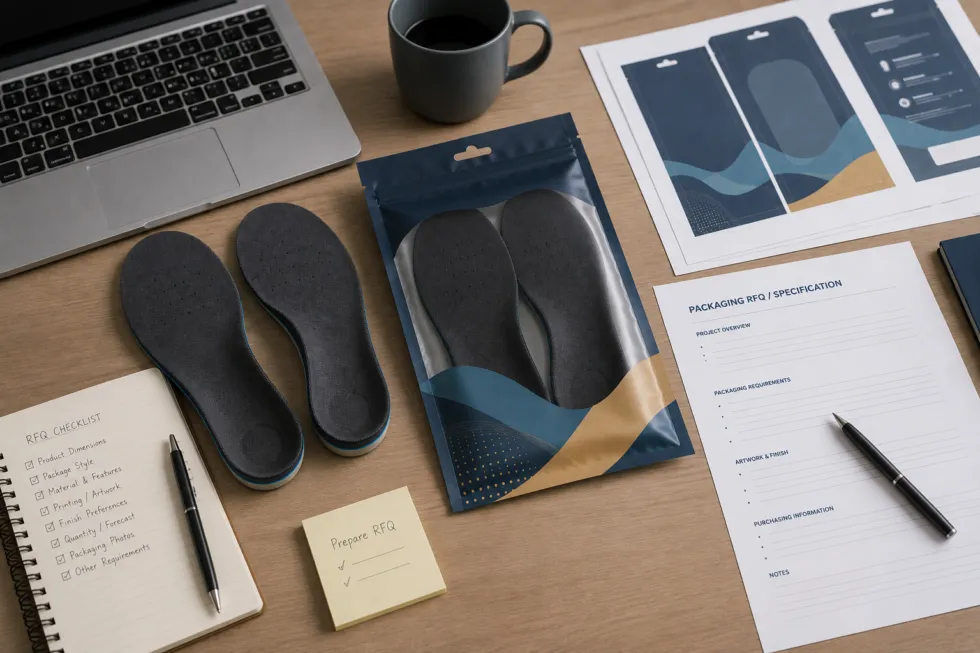
| Information to Provide | Why It Matters |
|---|---|
| Insole dimensions | Helps evaluate product fit |
| Product thickness or profile | Adds information that length and width alone cannot provide |
| Target finished bag dimensions | Establishes the buyer’s requested package size |
| Bag format | Defines the packaging format being evaluated |
| Hang hole requirement | Defines the retail hanging requirement |
| Artwork | Clarifies the custom printing project |
| Surface finish | Records the requested visual appearance |
| Quantity | Defines the purchasing volume |
| Known material or packaging requirements | Communicates requirements already established by the buyer |
Product Dimensions and Thickness
Provide the maximum product length and width, along with relevant information about thickness and profile.
If multiple insole sizes need to fit the same package, make that clear.
Target Finished Bag Dimensions
If you require a 5" × 14" bag, specify that these are the intended finished dimensions.
If the dimensions are preliminary rather than fixed, state that as well.
Clear terminology helps prevent unnecessary assumptions.
Bag Format
State whether you are requesting a three-side seal bag or evaluating different packaging formats.
If you are unsure, describe the product and intended presentation so the format can be discussed in context.
Hang Hole Requirement
State that a top hang hole is required and provide any existing retail display requirements that may affect the package.
This allows the hanging feature to be considered as part of the complete layout.
Printing and Artwork
Indicate that full-color custom printing is required and provide the artwork status.
Is the final artwork ready? Is the design still being developed? Will both sides of the package be printed?
These are useful details for the supplier to know.
Surface Finish
If matte finish is preferred, include it explicitly.
Do not rely on a visual reference alone to communicate this requirement.
Quantity
Provide the required quantity for the packaging order or, for multiple SKUs, the quantity required for each version.
Quantity is a basic part of a complete B2B packaging inquiry.
Any Known Material or Packaging Requirements
Include any material or performance requirements that your company has already established.
If these have not yet been defined, describe the application rather than guessing technical values.
Shoe Insole Packaging RFQ Checklist
Before sending an inquiry for custom shoe insole packaging bags, check whether you can provide the following:
- Insole length
- Insole width
- Insole thickness or product profile
- Target finished bag dimensions
- Confirmation of whether dimensions are fixed or preliminary
- Preferred bag format
- Hang hole requirement
- Intended retail display
- Full-color printing requirement
- Artwork status
- Front and back printing requirements
- Matte finish preference
- Existing material requirements, if any
- Quantity
- Other known packing or distribution requirements
You do not need to invent technical specifications that have not been determined.
The purpose of the RFQ is to communicate what you know clearly and identify what still needs to be confirmed.
Frequently Asked Questions About Custom Insole Packaging
What Size Bag Do I Need for Shoe Insoles?
Start by measuring the actual insoles at their widest and longest points.
Length and width are important, but thickness, product profile, loading space, sealing area, and the intended bag format can also affect the final dimensions.
A requested 5" × 14" bag should therefore be checked against the actual product before the packaging specification is finalized.
Can a Three-Side Seal Bag Be Used for Insole Packaging?
A three-side seal bag can be evaluated for relatively flat products such as shoe insoles.
Whether it is appropriate for a specific project depends on product fit, filling and closing requirements, retail presentation, and the other requirements of the finished package.
The bag format should be selected based on the actual application.
Can a Hang Hole Be Added to an Insole Packaging Bag?
A hang hole can be included as a packaging requirement when the product is intended for hanging retail display.
The buyer should communicate the intended display method so the hang-hole requirement can be considered together with the top area, bag construction, artwork, and filled-package presentation.
What Information Is Needed for Custom Printed Insole Bags?
Provide the product dimensions and profile, target bag dimensions, preferred bag format, hang-hole requirement, artwork status, printing requirements, surface-finish preference, quantity, and any material or packaging requirements already established.
If some specifications are still unknown, describe the product and intended use rather than guessing technical values.
Should I Specify Matte Finish When Requesting a Quote?
Yes. If a matte appearance is part of the desired packaging design, include matte finish preferred or the appropriate confirmed finish requirement in your RFQ.
This ensures that the surface appearance is discussed together with the artwork and other packaging specifications rather than being assumed later.
For B2B buyers sourcing custom shoe insole packaging bags, a clear RFQ does not need to contain every technical answer from the beginning. It does need to distinguish confirmed requirements from assumptions. Product dimensions, bag size, format, hang hole, artwork, finish, quantity, and known packaging requirements provide a practical foundation for evaluating the project.