
Custom Food Pouch MOQ: What Buyers Need to Know Before Ordering
Quick Answer
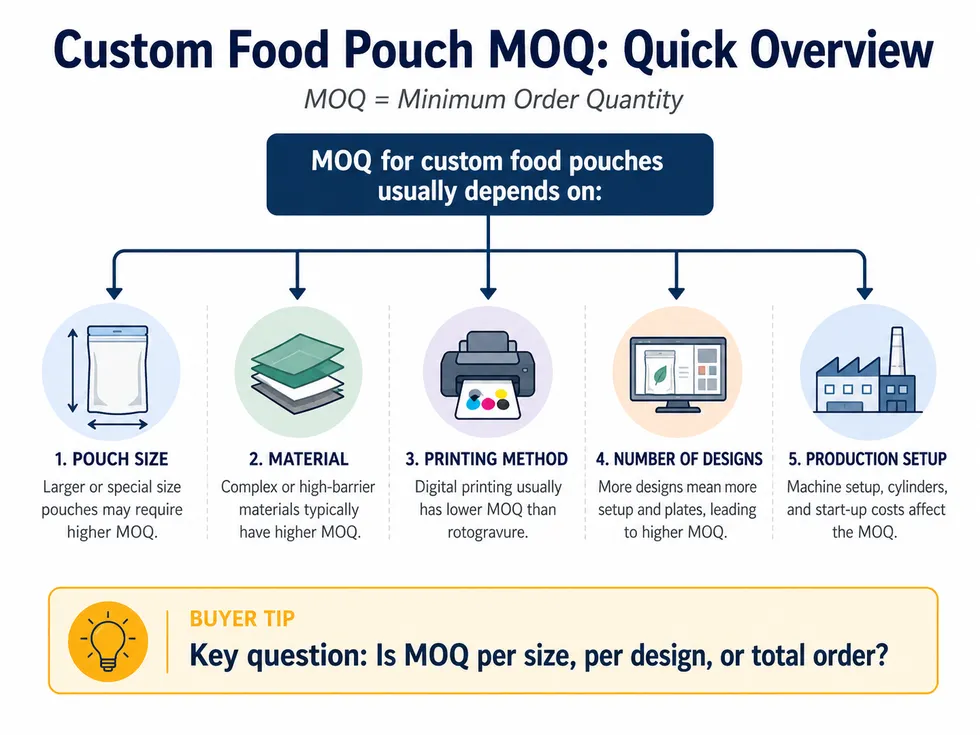
MOQ means Minimum Order Quantity — the smallest quantity a supplier can produce for a specific pouch specification.
For custom food pouches, MOQ usually depends on:
- pouch size,
- material,
- printing method,
- number of designs,
- and production setup.
The most important question is not only:
“What is your MOQ?”
Ask:
“Is the MOQ per size, per design, or for the total order?”
If you have several sizes and designs, each combination may be treated as a separate SKU.
That can significantly increase your total packaging quantity.
Is MOQ Per Order, Per Size or Per Design?
It depends on the project.
A custom pouch is usually defined by:
Size + Material + Design + Pouch Type
If any of these change, the supplier may treat it as a separate production item.
For example:
- 250g mango pouch
- 500g mango pouch
- 250g pineapple pouch
may be three separate SKUs, even if they are ordered together.
Before comparing prices, confirm how the MOQ is calculated.
Does Each Pouch Size Have Its Own MOQ?
Often, yes.
Different pouch sizes require different:
- film widths,
- artwork layouts,
- machine settings,
- and production setup.
If you need:
- 250g,
- 500g,
- and 1kg pouches,
ask:
Does the MOQ apply separately to each size?
This is especially important for brands launching several pack sizes at the same time.
Does Each Design Have Its Own MOQ?
It can.
If you have one pouch size but several printed designs, such as:
- Mango
- Pineapple
- Banana
- Mixed Fruit
each artwork may be treated as a separate SKU.
Whether several designs can share one production run depends on the printing method and supplier capability.
Ask:
Can different designs share the MOQ, or does each design have its own minimum quantity?
Why Multiple SKUs Increase Packaging Inventory
This is where buyers often underestimate the real order quantity.
For example:
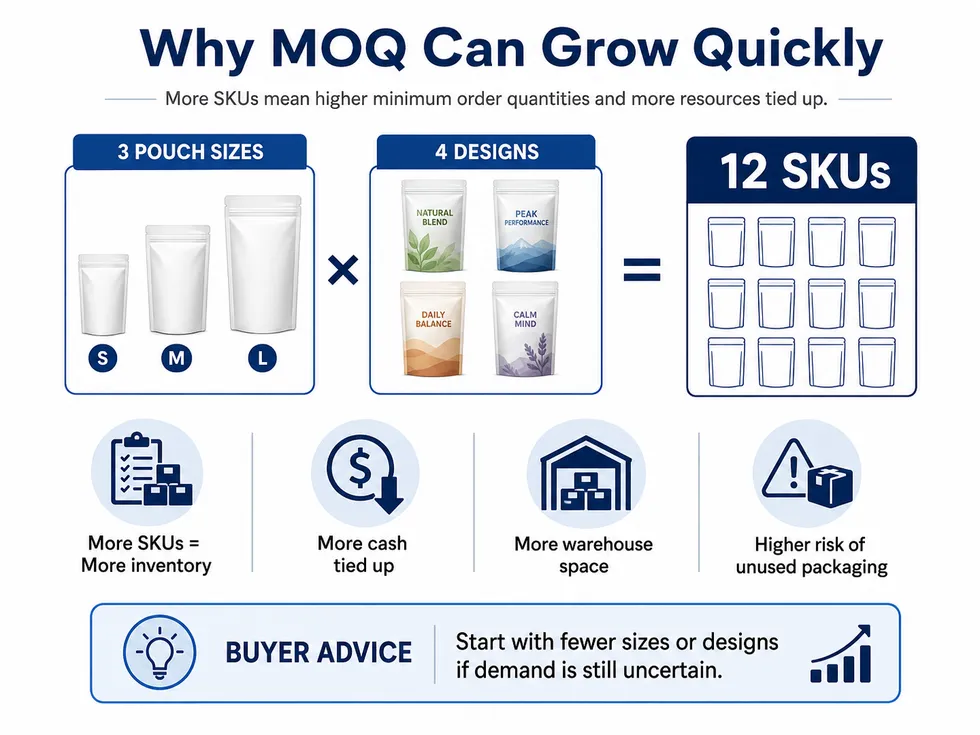
3 pouch sizes × 4 designs = 12 SKUs
Even if the MOQ for one SKU looks reasonable, the total order can become much larger.
This can increase:
- packaging inventory,
- warehouse space,
- cash tied up in stock,
- and the risk of unused packaging.
For new products, fewer packaging SKUs can make purchasing much easier.
Plain Pouches vs Custom Printed Pouches
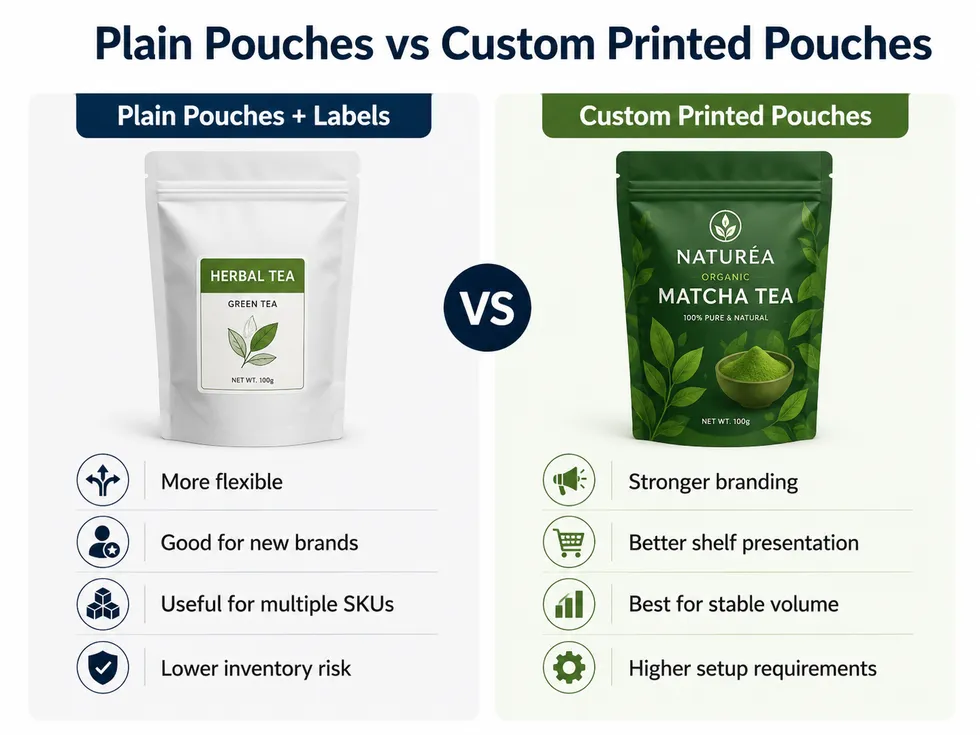
Plain Pouches + Labels
Plain pouches can be a practical option if you:
- have several SKUs,
- are testing the market,
- need smaller quantities,
- or change product information often.
One plain pouch may be used for several products with different adhesive labels.
This can reduce packaging inventory.
Custom Printed Pouches
Custom printing is better suited to:
- established products,
- stable sales volume,
- stronger branding,
- and repeat orders.
The trade-off is that MOQ becomes more important because every size or design may require its own production setup.
Digital Printing vs Gravure Printing
Printing method can affect both MOQ and cost.
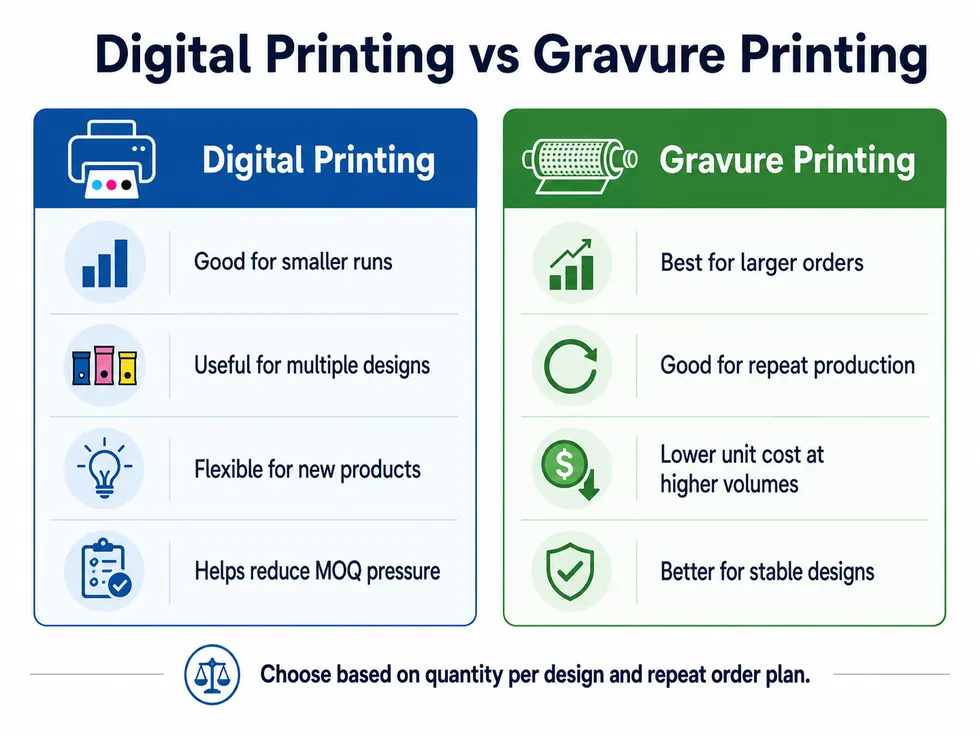
Digital Printing
Digital printing is often useful for:
- smaller runs,
- multiple designs,
- new product launches,
- and frequent artwork changes.
It can be more flexible for brands with several SKUs.
Gravure Printing
Gravure printing is usually better for:
- larger orders,
- established products,
- repeat production,
- and stable designs.
It can provide a lower unit cost at higher quantities, but setup requirements are greater.
Which Printing Method Is Better for Multiple SKUs?
If you have many designs but smaller quantities per design, digital printing may be more practical.
If you have one or two designs and larger repeat orders, gravure printing may offer better cost efficiency.
The right choice depends on:
Number of Designs + Quantity per Design + Repeat Order Plan
Do not choose the printing method based only on the lowest unit price.
How MOQ Affects Unit Price
In most packaging projects:
Higher quantity = Lower unit price
This happens because setup costs are spread across more pouches.
For a better comparison, ask for several quantity levels, such as:
- 1,000 pcs
- 3,000 pcs
- 5,000 pcs
- 10,000 pcs
This helps you see whether ordering more actually makes commercial sense.
The Lowest Unit Price Is Not Always the Best Choice
A larger order may give you a lower price per pouch.
But it can also create more inventory.
Before increasing quantity, consider:
- how fast the packaging will be used,
- how many SKUs you have,
- warehouse space,
- possible design changes,
- product changes,
- and cash flow.
For a new brand, reducing inventory risk can be more important than saving a few cents per pouch.
How Can Buyers Reduce MOQ Pressure?
A few practical options:
Use Fewer Pouch Sizes
If several products can use the same size without affecting filling or presentation, this can reduce the number of SKUs.
Use Plain Pouches With Labels
Useful for testing new products or managing many variations.
Start With Fewer Designs
Launch the most important SKUs first.
Add more designs when sales become stable.
Consider Digital Printing
This may provide more flexibility for smaller quantities and multiple designs.
Standardize Materials Where Possible
If several products have similar barrier requirements, one material structure may simplify purchasing.
Do not standardize if it reduces product protection.
What Should You Ask a Packaging Supplier?
Before placing an order, ask:
- What is the MOQ?
- Is MOQ per size?
- Is MOQ per design?
- Can multiple designs share one production run?
- Which printing method is being quoted?
- Are plain pouches available?
- What are the prices at different quantities?
- Are there setup or cylinder costs?
- What is the production lead time?
These questions make different supplier quotations much easier to compare.
What Information Should You Send for an MOQ Quote?
Provide:
- Product type
- Filling weight or pouch size
- Quantity per size
- Number of designs
- Number of SKUs
- Plain or custom printed
- Preferred material
- Required features
- Destination country
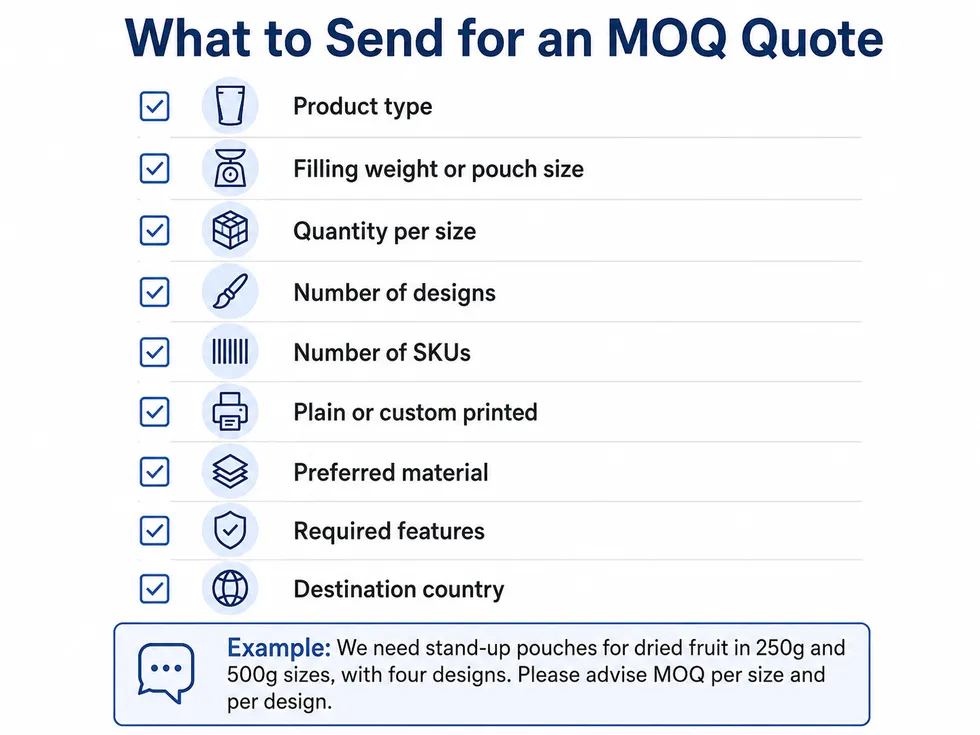
For example:
We need stand-up pouches for dried fruit in 250g and 500g sizes. We have four designs. Please advise the MOQ per size and per design, and quote suitable printing options.
This gives the supplier enough information to provide a meaningful MOQ and price.
Common MOQ Mistakes
Asking Only for the Total MOQ
Always confirm whether the MOQ applies per size or design.
Launching Too Many SKUs
More SKUs can create much more packaging inventory than expected.
Choosing Only by Unit Price
A lower unit price may require a much larger order.
Printing Before Demand Is Clear
For new products, more flexible packaging options may reduce risk.
Comparing Different Specifications
Make sure suppliers are quoting the same:
- material,
- size,
- printing method,
- features,
- and quantity.
Frequently Asked Questions
What is the MOQ for custom food pouches?
There is no universal MOQ.
It depends on pouch size, material, printing method, design count and production setup.
Is MOQ usually per design?
Often, yes.
Different printed artworks may be treated as separate SKUs.
Does each pouch size have a separate MOQ?
Often, yes, because different sizes require different production settings.
Can multiple designs share one MOQ?
Sometimes, depending on the printing method and supplier capability.
Are plain pouches better for small orders?
They can be a good option for brands with several SKUs or uncertain demand.
Why does the unit price decrease at higher quantities?
Because production setup costs are spread across more pouches.
Final Recommendation
When comparing custom food pouch MOQ, do not focus on one number.
Look at the full project:
Pouch Size → Designs → Printing Method → Material → Quantity → Inventory Risk
For new brands, flexibility may be more valuable than the lowest unit price.
For established products with stable demand, larger custom printed runs may offer better cost efficiency.
Before ordering, confirm:
- MOQ per size,
- MOQ per design,
- printing method,
- setup cost,
- price at different quantities,
- and production lead time.
The best MOQ is not simply the lowest minimum.
It is the quantity that keeps your packaging cost reasonable without creating unnecessary inventory.
Need an MOQ and Price for Your Food Pouches?
Send us:
- product,
- filling weight or pouch size,
- quantity,
- number of designs,
- preferred material,
- required features,
- and destination country.
We can help you compare suitable MOQ, printing methods and pouch options before production.