
PET/PE vs VMPET vs Aluminum Foil Pouches: Which Is Better?
Quick Answer
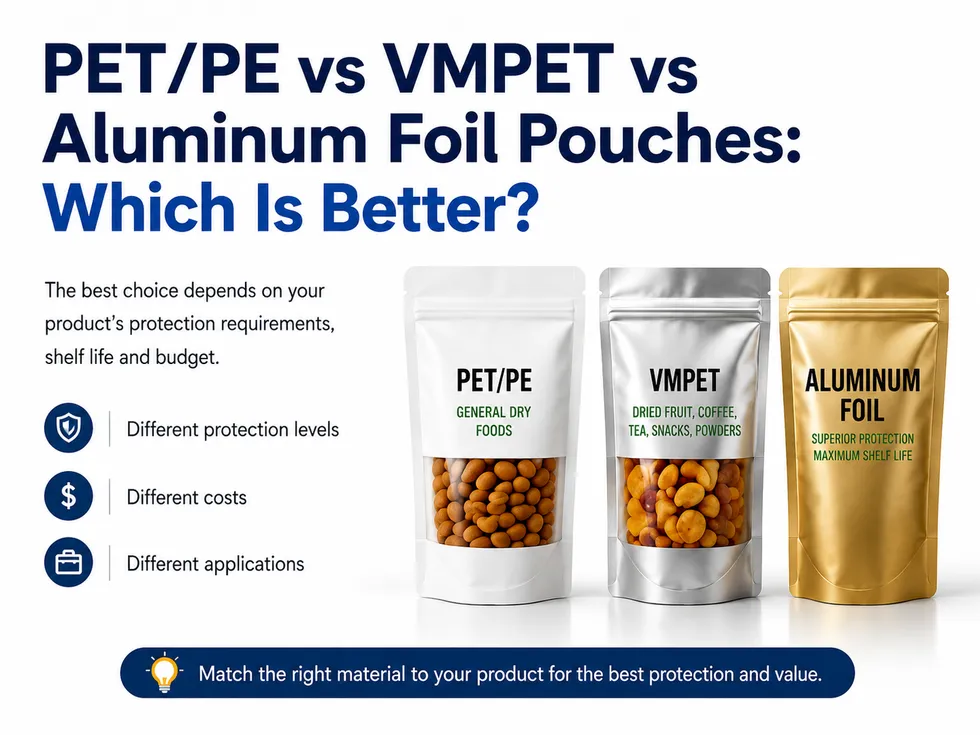
PET/PE, VMPET and aluminum foil are three common materials used for food pouches.
The best choice depends on your product’s protection requirements, shelf life and budget.
| Material Structure | Protection Level | Best For |
|---|---|---|
| PET/PE | Standard | General dry foods |
| PET/VMPET/PE | High | Dried fruit, coffee, tea, snacks, powders |
| PET/AL/PE | Very High | Sensitive products requiring maximum protection |
For most dry food products:
- PET/PE is a practical option for basic protection.
- VMPET laminate offers a good balance between protection and cost.
- Aluminum foil laminate provides the highest barrier performance.
The right material is not always the strongest one. It should match your:
Product → Shelf Life → Storage Conditions → Market Requirements → Budget
Why Choosing the Right Pouch Material Matters
Food packaging does more than hold the product.
The pouch material directly affects:
- moisture protection,
- oxygen protection,
- shelf life,
- product freshness,
- shipping performance,
- and packaging cost.
A pouch that looks similar from the outside may have completely different performance because the internal material structure is different.
For example:
A snack product sold locally may only need standard protection.
A dried fruit product shipped internationally may require stronger barrier performance because of:
- humidity changes,
- longer transportation,
- and extended storage time.
Choosing the correct pouch structure before production helps reduce quality risks and unnecessary packaging costs.
Understanding Food Pouch Material Structures
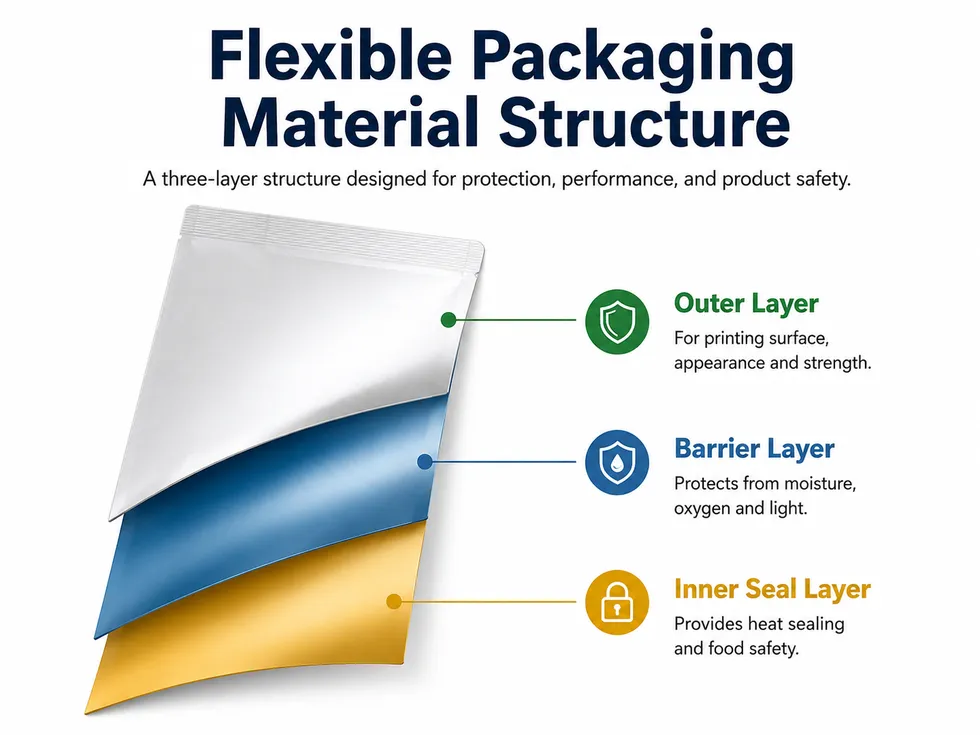
Most flexible food pouches are made from multiple layers.
Each layer has a specific purpose.
Outer Layer
The outer layer provides:
- printing surface,
- appearance,
- strength,
- protection during handling.
Common materials include:
- PET film,
- kraft paper,
- printed films.
Barrier Layer
The barrier layer protects the product from:
- moisture,
- oxygen,
- light.
Common barrier materials include:
- VMPET,
- aluminum foil.
Inner Seal Layer
The inner layer provides:
- heat sealing,
- food contact safety,
- pouch integrity.
Common materials include:
- PE,
- CPP.
The final packaging performance depends on the complete laminate structure, not just one layer.
PET/PE Pouches: A Cost-Effective Option
What Is PET/PE?
PET/PE is one of the most common food packaging structures.
It combines:
- PET outer layer for printing and strength,
- PE inner layer for heat sealing.
Advantages of PET/PE
PET/PE provides:
- good mechanical strength,
- reliable sealing performance,
- good print quality,
- competitive cost.
It is a practical choice for products that do not require extremely high barrier protection.
Common Applications
PET/PE pouches are commonly used for:
- snacks,
- dry foods,
- simple food packaging,
- products with shorter shelf-life requirements.
Considerations
Compared with VMPET and aluminum foil structures, PET/PE provides lower protection against:
- moisture,
- oxygen,
- and light.
For products that are highly sensitive to humidity or oxidation, a higher barrier structure may be more suitable.
VMPET Pouches: The Balance Between Protection and Cost
What Is VMPET?
VMPET means Vacuum Metallized PET.
A thin metallized layer is added to PET film to improve barrier performance.
Advantages of VMPET
VMPET provides improved protection against:
- moisture,
- oxygen,
- light.
It offers a good balance between:
Protection + Cost + Packaging Performance
Common Applications
VMPET laminate structures are widely used for:
- dried fruit,
- coffee,
- tea,
- nuts,
- protein powder,
- snacks,
- pet food.
Why Many Brands Choose VMPET
For many food products, VMPET provides enough protection without the higher cost of full aluminum foil.
It is often selected when brands need:
- longer shelf life,
- international shipping capability,
- better product protection,
- reasonable packaging cost.
Aluminum Foil Pouches: Maximum Barrier Protection
What Is Aluminum Foil Packaging?
A common aluminum foil pouch structure is:
PET / AL / PE
It contains a real aluminum foil layer inside the laminate.
Advantages of Aluminum Foil Pouches
Aluminum foil provides excellent protection against:
- moisture,
- oxygen,
- light.
It is one of the highest barrier options available for flexible food packaging.
Common Applications
Aluminum foil pouches are often used for:
- premium coffee,
- sensitive powders,
- specialty foods,
- products requiring longer shelf life,
- products needing maximum protection.
Considerations
The main disadvantages are:
Higher Cost
Aluminum foil structures usually cost more than PET/PE or VMPET structures.
No Product Visibility
The pouch is opaque, so customers cannot see the product inside.
Less Suitable for Window Designs
If product visibility is important, another structure may be more suitable.
PET/PE vs VMPET vs Aluminum Foil Comparison
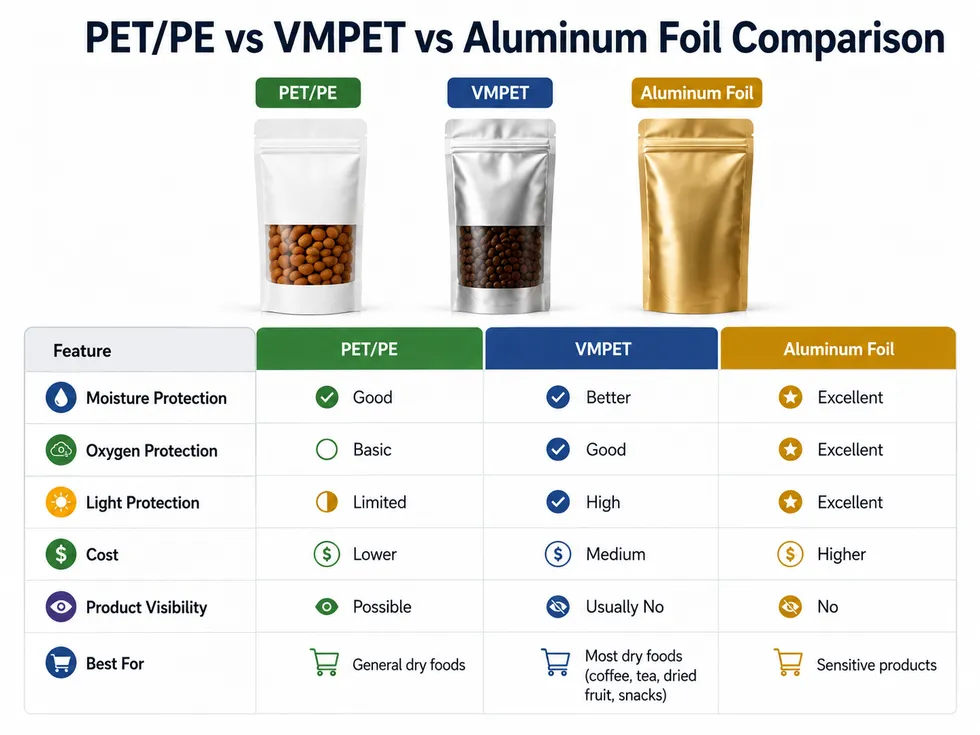
| Feature | PET/PE | VMPET | Aluminum Foil |
|---|---|---|---|
| Moisture Protection | Good | Better | Excellent |
| Oxygen Protection | Basic | Good | Excellent |
| Light Protection | Limited | High | Excellent |
| Cost | Lower | Medium | Higher |
| Product Visibility | Possible | Usually No | No |
| Shelf Life Potential | Medium | Long | Longest |
| Common Use | General foods | Most dry foods | Sensitive products |
Which Material Is Best for Dried Fruit?
There is no single best material for all dried fruit products.
The right choice depends on several factors.
Product Type
Different dried foods have different moisture sensitivity.
Examples:
- dried mango,
- raisins,
- banana chips,
- freeze-dried fruit.
Shelf Life Requirement
A product requiring:
- 6 months shelf life
may need different protection from:
- 18–24 months shelf life.
Longer shelf life usually requires stronger barrier performance.
Shipping Conditions
Export products may face:
- high humidity,
- temperature changes,
- longer storage periods.
A stronger barrier structure may help maintain product quality during transportation.
Brand Positioning
Different brands may have different priorities.
Natural food brands may prefer:
- kraft appearance,
- matte finish,
- small clear window.
Premium products may prioritize:
- maximum protection,
- longer shelf life,
- stronger packaging performance.
How to Choose Between VMPET and Aluminum Foil?
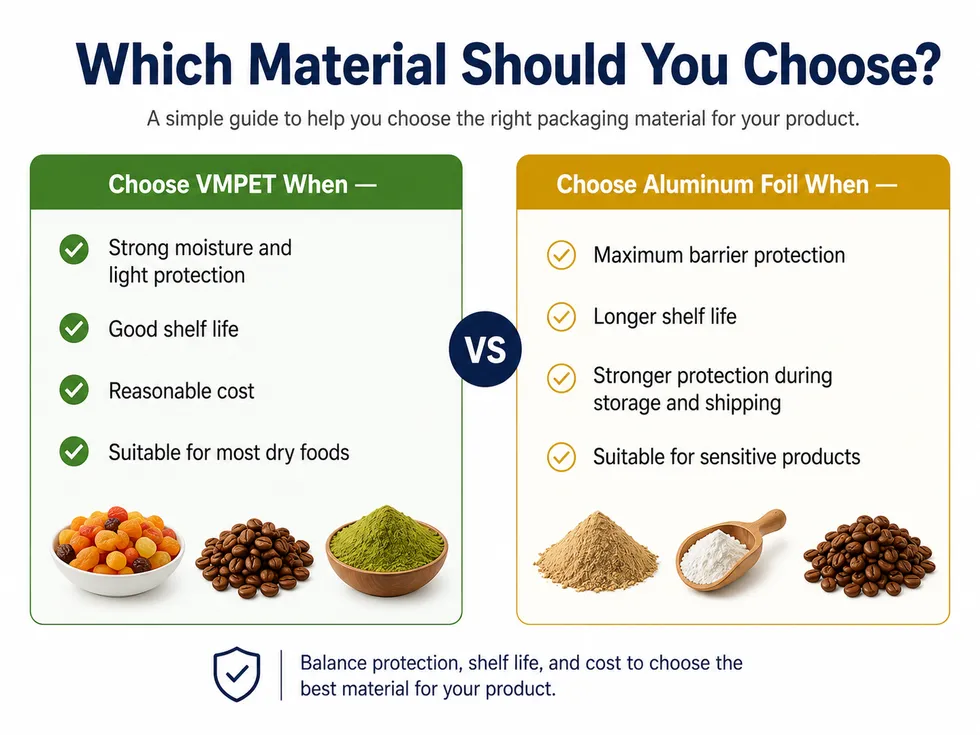
A simple guide:
Choose VMPET When:
You need:
- strong moisture protection,
- good light protection,
- practical cost.
Suitable for:
- dried fruit,
- snacks,
- coffee,
- tea,
- powders.
For many food brands, VMPET provides the best balance between performance and price.
Choose Aluminum Foil When:
You need:
- maximum barrier protection,
- longer shelf life,
- stronger protection during storage and shipping.
Suitable for:
- sensitive ingredients,
- premium products,
- products requiring strict protection.
Does a Clear Window Affect Material Choice?
Yes.
A clear window improves product visibility.
It helps customers see:
- product color,
- texture,
- appearance.
This can be useful for:
- dried fruit,
- snacks,
- nuts,
- natural food products.
However, transparent areas provide less light protection than metallized or foil structures.
If your product is sensitive to light, a fully opaque pouch may provide better protection.
The choice depends on your priority:
Product Visibility vs Maximum Protection
What Should You Tell a Packaging Supplier?
To recommend the right pouch material, provide:
- Product type
- Filling weight
- Shelf life requirement
- Storage conditions
- Destination country
- Pouch size
- Required features
- Order quantity
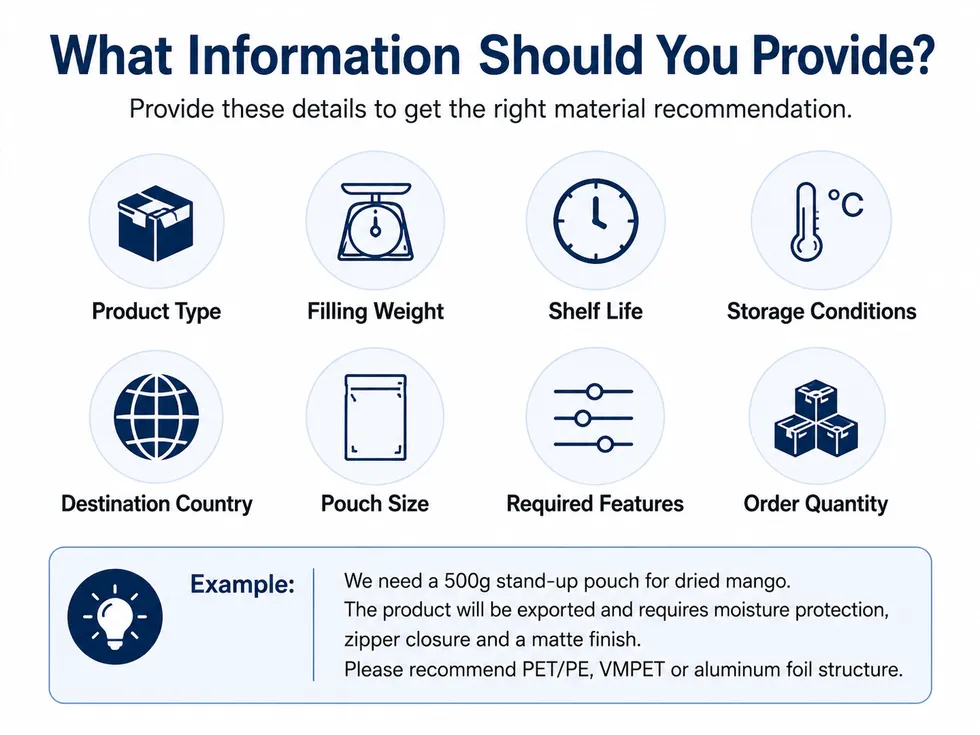
Example:
We need a 500g stand-up pouch for dried mango. The product will be exported internationally and requires moisture protection, zipper closure and a matte finish. Please recommend PET/PE, VMPET or aluminum foil structure.
With this information, a packaging supplier can recommend a more suitable material structure.
Common Mistakes When Choosing Pouch Materials
Choosing Only by Price
The cheapest material may not provide enough protection.
A lower-cost pouch may increase the risk of:
- moisture damage,
- shorter shelf life,
- product quality issues.
Choosing the Highest Barrier Automatically
Maximum protection is not always necessary.
A stronger barrier usually means:
- higher material cost,
- higher packaging cost.
The goal is to choose the right protection level.
Comparing Only Outer Appearance
Two pouches may look similar but have completely different internal structures.
Always confirm:
- material layers,
- barrier performance,
- and sealing requirements.
Ignoring Shipping Conditions
Export products often require stronger protection than locally sold products.
Consider:
- destination climate,
- transportation time,
- storage environment.
Skipping Sample Testing
Before mass production, always test:
- actual product filling,
- sealing performance,
- storage conditions,
- final appearance.
Frequently Asked Questions
Is VMPET better than PET/PE?
Yes, VMPET generally provides better moisture, oxygen and light protection than PET/PE.
However, PET/PE may be sufficient for products with lower protection requirements.
Is aluminum foil better than VMPET?
Aluminum foil provides higher barrier performance.
However, VMPET is often chosen because it provides a better balance between protection and cost.
Which pouch material is best for dried fruit?
For many dried fruit products, PET/VMPET/PE is a practical choice because it provides strong moisture protection at a reasonable cost.
The final choice depends on:
- product type,
- shelf life,
- shipping conditions.
Are PET/PE pouches food safe?
Yes.
PET/PE is widely used for food packaging when produced with suitable food-contact materials and manufacturing standards.
Do all laminated pouches have the same barrier performance?
No.
Different laminate structures provide different levels of:
- moisture protection,
- oxygen protection,
- and light protection.
Always confirm the material structure before ordering.
Final Recommendation
Choosing the right pouch material is about finding the right balance:
Protection → Shelf Life → Cost → Customer Experience
A simple selection guide:
| Product Requirement | Recommended Structure |
|---|---|
| General dry foods | PET/PE |
| Most dried foods and snacks | PET/VMPET/PE |
| Sensitive products | PET/AL/PE |
Before production, confirm:
- material structure,
- barrier requirements,
- sample performance,
- and final product quality.
The best pouch material is not the most expensive option.
It is the material that protects your product while keeping your packaging cost reasonable.
Need Help Choosing Food Pouch Materials?
If you are comparing PET/PE, VMPET or aluminum foil pouches, send us:
- product type,
- filling weight,
- shelf life requirement,
- quantity,
- destination country,
- required pouch features.
We can help you compare suitable materials, barrier levels and pouch structures before production.