
This guide explains the main pouch types, materials, features and purchasing considerations involved in a commercial custom packaging project.
What Are Custom Pouches?
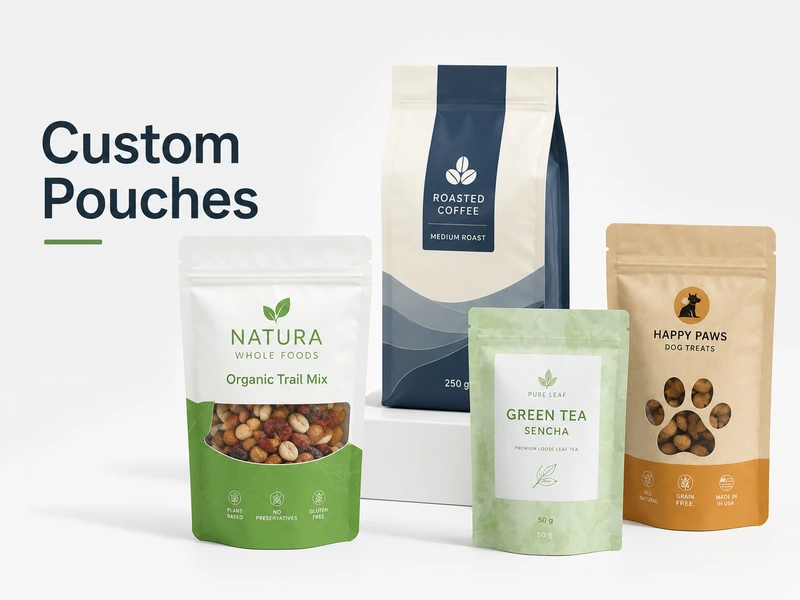
Custom pouches are flexible packages manufactured to a buyer’s specified size, material structure, printing design and functional requirements.
Unlike plain stock bags, a custom pouch can be developed with:
- Custom width, height and gusset depth
- Printed brand graphics and product information
- Product-specific barrier materials
- Zippers, tear notches, valves, spouts and handles
- Transparent or shaped windows
- Gloss, matte, soft-touch and other surface finishes
- Manual or automatic filling compatibility
The objective is not simply to produce a printed bag. The pouch must protect the product, work with the customer’s packing process, withstand transportation and present the brand clearly at the point of sale.
Honghai Packaging manufactures custom pouches for brands, importers, distributors, wholesalers and contract packers that require a packaging solution developed around their commercial application.
Why B2B Buyers Choose Flexible Pouches
Lower Packaging and Shipping Weight
Flexible pouches generally use less material than rigid containers. Their lower empty weight can reduce transportation volume, warehouse space and handling costs.
This is particularly useful for businesses shipping products internationally or supplying several regional distribution centers.
Strong Shelf Presentation
Large printable front and back panels provide room for branding, product benefits, instructions, barcodes and regulatory information.
Stand-up and flat-bottom formats can also improve shelf visibility because the package remains upright and presents the front artwork clearly.
Product-Specific Protection
The material structure can be adjusted to protect against moisture, oxygen, light, grease, aroma loss or puncture.
A dry snack, coffee bean, powder and pet treat may all use a flexible pouch, but they should not automatically use the same film structure.
Flexible Order and SKU Planning
Custom pouches can support different sizes, flavors and product ranges while maintaining a consistent brand system.
Digital printing may be suitable for smaller quantities or multiple designs, while gravure printing is often more economical for larger repeat orders.
Main Types of Custom Pouches
There is no single pouch format that suits every product. The correct style depends on product weight, filling method, shelf presentation and the features required by the end user.
Stand-Up Pouches
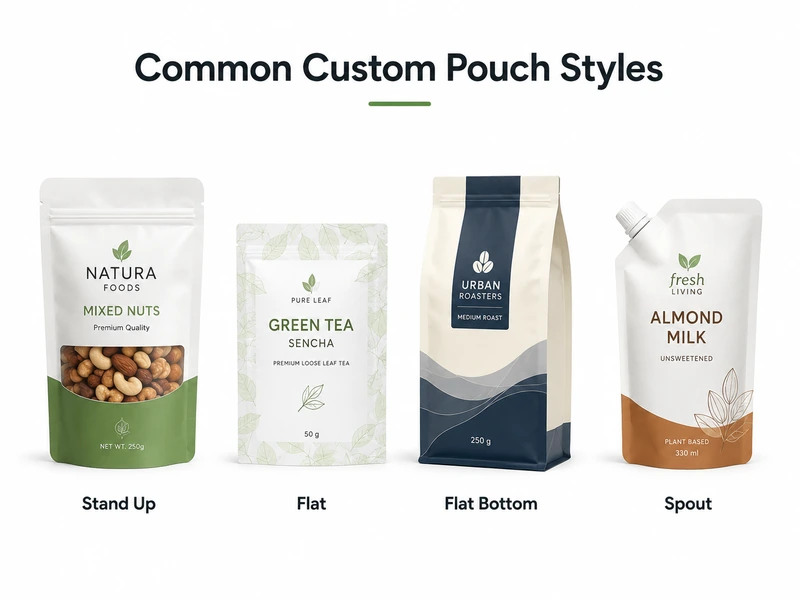
A stand-up pouch uses an expandable bottom gusset that allows the package to remain upright after filling.
This format is widely used for snacks, dried fruit, nuts, powders, coffee, pet treats, supplements and other retail products.
Common options include:
- Resealable zipper
- Tear notch
- Transparent window
- Hang hole
- One-way degassing valve
- Spout and cap
See our custom stand-up pouches for available materials, printing and functional options.
Flat Pouches
Flat pouches do not have a bottom gusset. They are compact, economical and suitable for products that do not need to stand independently on a shelf.
Common applications include samples, single-use portions, powders, spices, medical accessories and lightweight components.
Flat pouches can be supplied as three-side seal bags, zipper bags or pre-opened formats for commercial filling.
Flat-Bottom Pouches
A flat-bottom pouch has a stable rectangular base and five printable panels: front, back, two sides and bottom.
The format provides strong shelf presence and is commonly selected for premium coffee, snacks, pet food, grains and higher-value products.
The wider opening and structured shape can also improve filling efficiency and carton presentation.
Review our custom flat-bottom pouches for premium retail and larger-capacity packaging projects.
Side-Gusset and Quad-Seal Bags
Side-gusset bags expand along the sides to provide greater filling capacity. They are commonly used for coffee, grains, flour, powdered ingredients and pet food.
Quad-seal bags use four vertical corner seals to create a more structured package. This format distributes product weight effectively and provides additional side panels for branding.
Spout Pouches
Spout pouches are used for liquids, semi-liquids, concentrates, sauces, beverages and refill products.
The spout position, cap type, filling temperature and material structure must be reviewed before production. Hot-fill, refrigerated and retort applications require different specifications.
Child-Resistant Pouches
Child-resistant pouches use a closure designed to reduce the risk of children opening the package.
They are commonly used for regulated products and applications where tamper evidence and controlled access are important.
The required testing and compliance standard should be confirmed according to the product category and destination market.
How to Choose the Right Custom Pouch
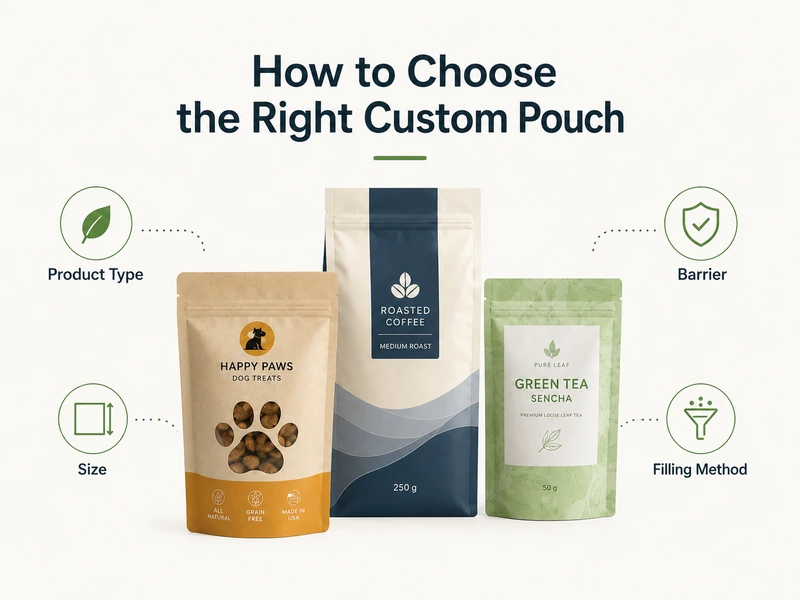
A useful packaging brief should begin with the product rather than the appearance of the bag.
1. Product Type and Physical Properties
Begin by identifying whether the product is a powder, liquid, dry food, oily food, hard piece, sharp product or temperature-sensitive item.
The supplier should also understand:
- Net weight per package
- Product density
- Particle size and shape
- Oil or moisture content
- Required shelf life
- Filling temperature
A lightweight snack and a dense powder may have the same net weight but require very different pouch dimensions.
2. Barrier Requirements
Barrier performance determines how effectively the package protects the product from external conditions.
The main factors include:
- Moisture barrier: Helps dry products remain crisp and prevents powders from clumping.
- Oxygen barrier: Helps slow oxidation and protect flavor, aroma and color.
- Light barrier: Protects light-sensitive products and ingredients.
- Aroma barrier: Helps retain coffee, tea, spice and pet food aromas.
- Puncture resistance: Protects the pouch from hard or irregular contents.
Requesting the thickest material is not always the best approach. The laminate structure should match the actual barrier and mechanical requirements of the product.
3. Bag Size and Filling Capacity
Pouch dimensions should be confirmed using the actual product whenever possible.
The usable filling area is smaller than the external bag dimensions because space is required for:
- Top and side seals
- Zipper placement
- Bottom or side gussets
- Product headspace
- Final heat sealing
A filling test with an unprinted sample is recommended before approving the final production size.
4. Filling and Sealing Method
The pouch must be compatible with the buyer’s packing process.
For manual filling, the opening should be wide enough for efficient loading without contaminating the sealing area.
Automatic or semi-automatic filling may require:
- Specific pouch width tolerances
- Registration marks
- Controlled zipper placement
- Consistent pouch opening performance
- Roll-film dimensions and core requirements
Providing the filling machine model or technical specification helps prevent compatibility problems.
5. Closure and Convenience Features
Features should support the way customers open, use, store and dispose of the product.
Common options include:
- Standard press-to-close zipper
- Slider zipper
- Child-resistant zipper
- Hook-and-loop closure
- Tear notch
- Spout and cap
- One-way degassing valve
- Hang hole
- Carry handle
- Transparent window
Too many features can increase cost and reduce printable space, so each feature should have a clear commercial or functional purpose.
6. Retail and Transportation Conditions
The packaging must perform beyond the production line.
Consider:
- Will the pouch be displayed upright, hung or placed in a carton?
- Will it be sold through retail stores, e-commerce or wholesale distribution?
- Will the product be stored in ambient, refrigerated or frozen conditions?
- Will the pouch experience air freight pressure changes?
- How many units will be packed into each shipping carton?
These details can affect pouch shape, seal strength, material stiffness and carton efficiency.
Common Material Structures
PET/PE
A transparent laminate suitable for general dry-product applications. It provides good printability and heat-sealing performance.
PET/VMPET/PE
A metallized structure that improves protection against oxygen, moisture and light. It is commonly used for snacks, coffee, powders and dried products.
PET/AL/PE
An aluminum foil laminate for applications requiring a very high barrier. It is suitable for sensitive ingredients, powders and longer shelf-life products.
PET/NY/PE
A nylon-reinforced structure used when additional puncture resistance or mechanical strength is required.
Kraft Paper Laminates
Kraft paper can provide a natural retail appearance while the inner film layers deliver the required sealing and barrier performance.
The paper appearance does not automatically make the package recyclable, so the complete material structure should be reviewed before making environmental claims.
Mono-Material PE or PP
Mono-material structures may support recycling goals where the destination market has an appropriate collection and recycling system.
Barrier requirements, filling temperature, drop performance and seal strength must be tested before replacing a conventional multi-layer laminate.
Custom Printing and Surface Finishes
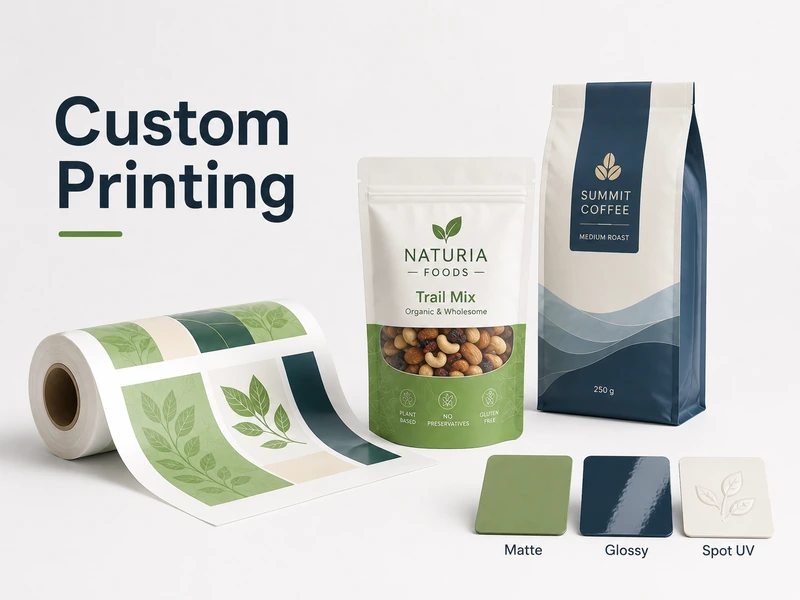
Printing should do more than make the pouch visually attractive. It must also remain consistent across production batches and provide enough space for regulatory and commercial information.
Digital Printing
Digital printing is suitable for smaller orders, multiple SKUs and projects that require faster artwork changes.
Because printing plates are not required, it can reduce setup requirements for short runs and market testing.
Rotogravure Printing
Rotogravure printing is commonly selected for medium and large repeat orders that require consistent color and a competitive unit cost.
Printing cylinders are required, so the setup cost and production quantity should be considered during quotation.
Surface Finish Options
Popular finishes include:
- Gloss finish
- Matte finish
- Soft-touch finish
- Spot UV
- Metallic effect
- Gold or silver stamping
- Holographic effect
The finish should support the brand position while remaining practical for filling, transport and retail handling.
Information Needed for an Accurate Quotation
A detailed request helps the manufacturer recommend the correct structure and prepare an accurate price.
| Required Information | Why It Matters |
|---|---|
| Product type and net weight | Determines capacity, barrier and strength requirements |
| Preferred pouch style | Determines structure, gusset and available printing panels |
| Bag dimensions | Required for material use and production pricing |
| Material or shelf-life requirement | Helps determine the appropriate barrier structure |
| Filling method | Ensures compatibility with manual or automated equipment |
| Required features | Affects pouch construction, price and usable area |
| Order quantity | Helps select the appropriate printing process |
| Artwork or number of designs | Required for printing setup and SKU planning |
| Delivery destination | Required for freight planning and export quotation |
Typical Custom Pouch Ordering Process
1. Submit Product Requirements
Provide the product, size, quantity, pouch style, required features and intended market.
2. Confirm the Packaging Structure
The supplier recommends a material, thickness, bag format and printing process according to the project requirements.
3. Test Samples
Use stock or unprinted samples to test product capacity, filling, sealing and shelf presentation.
4. Approve the Dieline and Artwork
Confirm dimensions, zipper location, window position, print area, colors, barcode and regulatory content.
5. Production and Quality Inspection
Production begins after the specification and artwork are approved. Finished pouches should be inspected for dimensions, printing, lamination, sealing and appearance.
6. Packing and Delivery
The finished packaging is packed into export cartons and shipped according to the confirmed delivery method.
Frequently Asked Questions
What is the minimum order quantity for custom pouches?
The minimum order quantity for many custom pouch projects starts from 1,000 pieces. The final MOQ depends on the dimensions, material, printing method and required features.
Can I order different designs in one project?
Yes. Multiple designs may be combined depending on the printing process, size, material and quantity allocated to each design.
Can you recommend a material structure?
Yes. Provide the product type, required shelf life, storage conditions and filling method so the packaging team can recommend a suitable structure.
Can I request samples before production?
Yes. Stock samples can be used to review material and workmanship. Unprinted size samples may also be prepared for filling and sealing tests.
Do I need finished artwork before requesting a quotation?
No. An initial quotation can usually be prepared using the pouch size, material, quantity, number of colors and required features. Final artwork is needed before printing production begins.
Can the pouch size be fully customized?
Yes. Width, height and gusset depth can be developed around product volume, filling equipment and shelf requirements.
Can you produce food-grade custom pouches?
Yes. Food-contact materials can be selected according to the product and destination-market requirements. Buyers should state any specific compliance or testing requirements during the quotation stage.
How long does custom pouch production take?
Production time depends on the material, printing process, quantity and features. The delivery schedule should be confirmed after the final specification and artwork are approved.
Final Recommendation
The best custom pouch is not necessarily the most complex or the thickest. It is the pouch that protects the product, works efficiently on the filling line, meets distribution requirements and presents the brand clearly.
Before placing a bulk order, confirm the product volume, material structure, bag dimensions, closure features and filling compatibility through samples or production testing.
Honghai Packaging provides custom sizes, materials, printing, finishes and pouch features for commercial packaging projects. Our packaging team can review your product requirements and recommend a practical solution based on your application and order quantity.
Start Your Custom Pouch Project
Send us your product type, filling weight, preferred pouch style, required features and estimated quantity. We will help you confirm a suitable size, material structure and printing option.