
How to Create Custom Mylar Bags: A Practical Guide for Brands & Wholesalers
Custom Mylar bags can do much more than display a logo. The right pouch protects the product, supports the filling process, fits the retail shelf, survives transportation, and gives buyers confidence in the brand.
That is why a successful custom bag project should not begin with colors or graphics. It should begin with the product, the supply chain, and the way the package will be used.
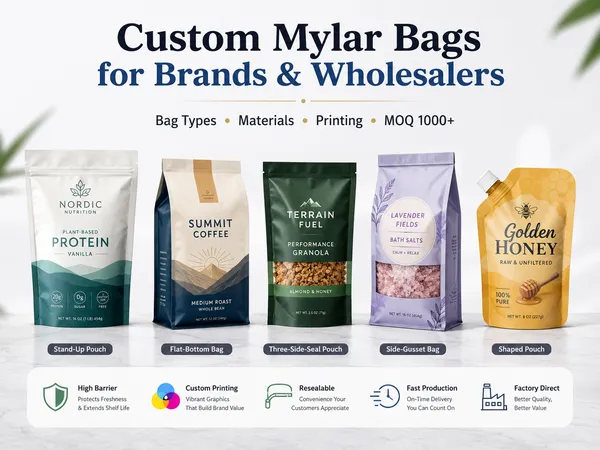
This guide explains how brands, wholesalers, importers, and private-label businesses can develop custom printed Mylar bags from the first packaging brief to mass production.
Contents
- What Are Custom Mylar Bags?
- Start With the Product Requirements
- Choose the Right Bag Style
- Confirm the Size and Capacity
- Select the Material and Barrier Level
- Choose Functional Features
- Select the Printing Method
- Prepare Artwork and Approve Samples
- Understand the Production Process
- Define Quality-Control Requirements
- Understand Cost, MOQ, and Lead Time
- Choose the Right Manufacturer
- Common Mistakes to Avoid
- Frequently Asked Questions
What Are Custom Mylar Bags?
In commercial packaging, the term “Mylar bag” is often used for a flexible, high-barrier pouch made from multiple laminated film layers. The exact material structure can vary depending on the product, shelf-life target, filling method, and regulatory requirements.
A well-designed pouch may combine:
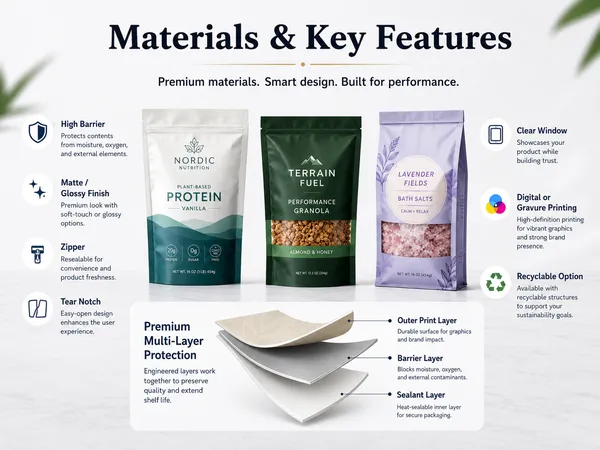
- An outer printable layer for graphics and surface protection.
- A barrier layer that helps reduce exposure to moisture, oxygen, light, or odors.
- An inner sealant layer that provides a secure heat seal.
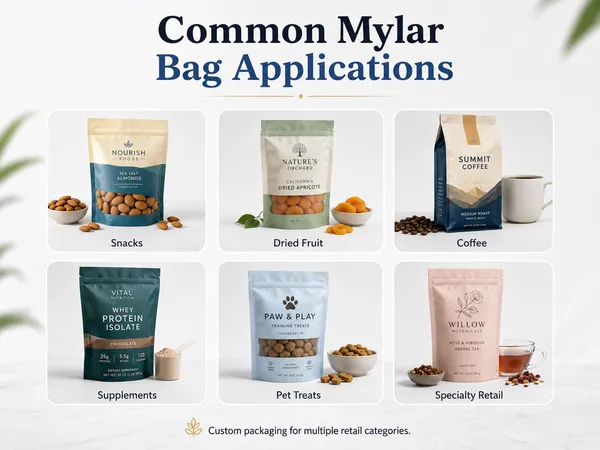
Custom Mylar bags are commonly used for snacks, dried fruit, coffee, tea, powders, supplements, pet treats, confectionery, and other specialty retail products.
1. Start With the Product Requirements
The fastest way to waste time on a packaging project is to discuss design before defining what the bag must actually do.
Before asking for a quotation, collect the basic product and supply-chain information. This allows the manufacturer to recommend a suitable bag structure instead of simply quoting the cheapest film.
| Information to Provide | Why It Matters | Example |
|---|---|---|
| Product type | Different products require different barrier, seal, and safety performance. | Coffee beans, dried mango, protein powder, pet treats |
| Fill weight or volume | The same weight can require different bag sizes because product density varies. | 100 g, 250 g, 500 g, 1 kg |
| Filling method | The opening width, seal area, bag stiffness, and tolerance must suit the filling line. | Manual filling, semi-automatic filling, automatic filling |
| Shelf-life target | Longer shelf-life targets may require stronger moisture, oxygen, odor, or light protection. | 6 months, 12 months, 18 months |
| Storage and transport | Temperature, humidity, stacking, and export shipping can affect material and seal requirements. | Warehouse storage, sea freight, e-commerce shipping |
| Target market | Labeling, testing, and packaging rules may differ by country and product category. | United States, Canada, United Kingdom, European Union, Australia |
Practical advice: Send the manufacturer a real product sample whenever possible. Dimensions alone do not always show how the product settles, expands, or moves inside the bag.
2. Choose the Right Bag Style
The bag style affects shelf presentation, filling efficiency, storage, carton utilization, and customer convenience. A visually attractive pouch can still be the wrong choice if it does not fit the production line or shipping method.
| Bag Style | Common Uses | B2B Buying Considerations |
|---|---|---|
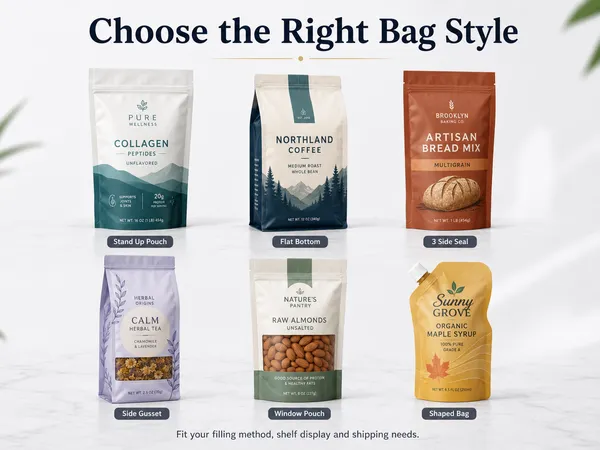
| Stand-up pouch | Snacks, dried fruit, powders, supplements, pet treats | Good shelf visibility, optional zipper and window, and efficient construction for many retail products |
| Flat-bottom bag | Coffee, premium snacks, specialty foods | Strong shelf presence and multiple printable panels, but typically uses more material |
| Three-side-seal pouch | Single-serve packs, flat products, samples, small retail packs | Compact, economical, and suitable for high-speed filling in many applications |
| Side-gusset bag | Coffee, tea, powders, bulk products | Provides extra capacity and a traditional package shape |
| Window pouch | Nuts, dried fruit, granola, pet treats | Shows the product, but the window area can reduce light-barrier performance |
| Shaped or spout pouch | Liquids, concentrates, specialty retail products | Distinctive appearance, but may require additional tooling and filling tests |
3. Confirm the Size and Capacity
Do not select a pouch only by looking at a competitor’s package or by copying a standard capacity chart. Product density, particle size, headspace, zipper position, sealing width, and filling method all affect the final dimensions.
A useful size-confirmation process is:
- Provide the target fill weight or volume.
- Provide the product density or send a physical sample.
- Confirm whether the bag will be filled manually or by machine.
- Allow enough headspace above the product for zipper use and heat sealing.
- Test the proposed size with an unprinted sample or mock-up before mass production.
For an existing package, send the flat dimensions in this format:
Width × Height × Bottom Gusset or Width × Height × Side Gusset, measured in millimeters or inches.
4. Select the Material and Barrier Level
Not every product needs the highest barrier, and a higher barrier does not automatically make a package better. The goal is to select a structure that protects the product without creating unnecessary cost, stiffness, or recycling challenges.
Common Performance Requirements
- Moisture barrier: Important for powders, crispy snacks, dried food, and moisture-sensitive products.
- Oxygen barrier: Important for products affected by oxidation, flavor loss, or rancidity.
- Light barrier: Useful for products that degrade or discolor under light exposure.
- Odor barrier: Helps retain aroma and reduce odor transfer.
- Puncture resistance: Important for sharp, dense, or irregular products.
- Seal performance: Must match the product, filling temperature, and production equipment.
Common Structure Directions
Depending on the application, the manufacturer may recommend transparent, metallized, foil-based, kraft-look, or recyclable mono-material structures. The final choice should be based on actual product tests, target shelf life, and local packaging requirements.
Do not approve a material based only on thickness. Two films with the same total thickness can have very different barrier, seal, and puncture performance.
5. Choose Functional Features
Features should solve a real packaging or user problem. Adding every available option can increase cost and complexity without improving the final result.
| Feature | Purpose | Important Check |
|---|---|---|
| Resealable zipper | Supports repeated opening and closing | Confirm zipper type, position, strength, and ease of use |
| Tear notch | Makes the package easier to open | Position it above the zipper and below the top seal |
| Clear window | Allows buyers to see the product | Review the trade-off between visibility and barrier performance |
| Hang hole | Supports peg display in retail stores | Confirm package weight and hole reinforcement |
| One-way valve | Allows gas release in suitable coffee applications | Confirm valve position and degassing requirements |
| Specialty closure | Supports regulated or category-specific packaging needs | Confirm the required standard and local legal requirements before production |
6. Select the Printing Method
The best printing method depends on order quantity, number of SKUs, design complexity, color requirements, and future repeat orders.
| Printing Method | Best For | Main Advantages | Points to Consider |
|---|---|---|---|
| Digital printing | Lower quantities, market testing, multiple SKUs, frequent design changes | No printing cylinders, flexible versioning, suitable for smaller custom runs | Confirm available materials, finishes, color range, and unit cost |
| Gravure printing | Larger repeat orders and long-term programs | Strong color consistency, sharp graphics, and lower unit cost at scale | Requires cylinder cost and is less flexible for frequent artwork changes |
Do not choose printing only by the lowest initial quotation. A method that looks cheaper for the first order may be more expensive across multiple SKUs, while a method with setup costs may become more economical for stable repeat orders.
7. Prepare Artwork and Approve Samples
Good artwork is not only attractive. It must also be technically ready for flexible packaging production.
Artwork Checklist
- Use the manufacturer’s final dieline instead of a self-created template.
- Provide editable AI, PDF, or other agreed production files.
- Convert or package fonts to prevent text changes.
- Use high-resolution images and suitable color settings.
- Keep important text, logos, barcodes, and regulatory information inside the safe area.
- Confirm the correct zipper, seal, gusset, and fold positions.
- Check barcode size, contrast, quiet zones, and scanning performance.
- Review every SKU separately before approval.
Sample Options
Different samples answer different questions:
- Stock sample: Helps evaluate bag style, zipper, film feel, and general workmanship.
- Unprinted size sample: Helps confirm capacity, dimensions, and filling suitability.
- Printed prototype: Helps review appearance, layout, and market presentation.
- Production sample: Confirms the actual material, printing, and bag-making result before the full order is completed.
A screen proof is useful, but it cannot fully represent metallic effects, transparency, matte finish, film stiffness, or the exact appearance of ink on the final material.
8. Understand the Production Process
A transparent process reduces misunderstandings and gives the buyer clear approval points before mass production.
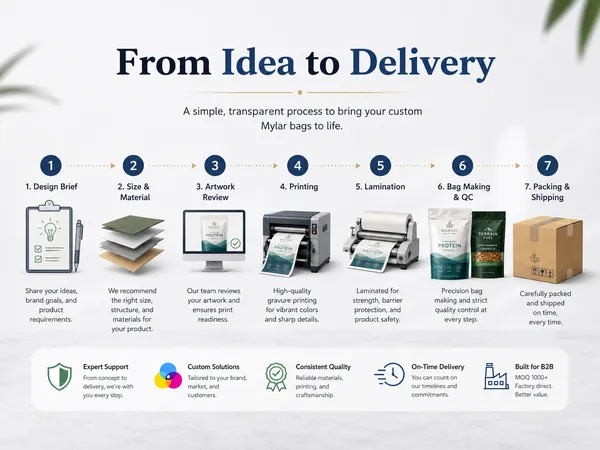
- Design brief: The buyer provides product, size, quantity, market, and design requirements.
- Size and material recommendation: The supplier proposes the pouch style, dimensions, film structure, and features.
- Artwork review: The dieline, layout, text, barcode, colors, and technical zones are checked.
- Printing: The approved design is printed using the selected method.
- Lamination and curing: Film layers are combined to create the required appearance and performance.
- Bag making and quality control: The laminated roll is converted into finished pouches and inspected.
- Packing and shipping: Finished bags are counted, packed, labeled, and prepared for delivery.
Buyers should confirm which step starts after final artwork approval because design changes made after printing begins can cause delays and additional cost.
9. Define Quality-Control Requirements
“Good quality” is too vague for a purchase order. The buyer and manufacturer should agree on measurable requirements before production.
Important Inspection Points
- Finished bag width, height, and gusset tolerance.
- Film structure and total thickness.
- Print registration and color consistency.
- Surface finish and appearance.
- Zipper position and opening performance.
- Seal width, seal strength, and leakage performance.
- Tear-notch, hang-hole, valve, or window position.
- Odor, contamination, scratches, wrinkles, and delamination.
- Quantity, packing method, carton label, and pallet requirements.
Product-specific testing may also be needed. For example, coffee bags may require valve checks, liquid pouches may require leakage tests, and heavy or sharp products may require puncture or drop testing.
10. Understand Cost, MOQ, and Lead Time
The lowest unit price does not always produce the lowest total cost. Packaging cost is affected by several connected decisions:
- Bag style and dimensions.
- Material structure and thickness.
- Printing method and number of colors.
- Number of artwork versions or SKUs.
- Zipper, window, valve, hang hole, and other features.
- Surface finish and special effects.
- Order quantity.
- Testing, packing, and shipping requirements.
Honghai Packaging supports custom Mylar bag projects with a minimum order quantity starting from 1,000 bags, depending on the bag specification and printing method.
For a more accurate quotation, review the available custom Mylar bag options and prepare the following information:
- Product name and application.
- Required bag style.
- Size or target filling weight.
- Material or shelf-life requirement.
- Printing design and number of SKUs.
- Required features.
- Order quantity.
- Delivery country or destination port.
Lead time should be confirmed after the material, artwork, printing method, quantity, and sample requirements are finalized. A supplier cannot give a reliable schedule from the product name alone.
11. Choose the Right Manufacturer
A packaging supplier should do more than accept artwork and provide a price. The right manufacturer helps identify problems before they reach production.
Questions Worth Asking
- Can the supplier recommend a material structure based on the actual product?
- Can the supplier provide size samples or prototypes before mass production?
- Does the prepress team check dielines, barcodes, fonts, and seal areas?
- Are digital and gravure printing options available for different order volumes?
- How are dimensions, printing, seals, zipper function, and appearance inspected?
- Can the supplier support multiple SKUs and repeat-order color consistency?
- Can the supplier provide the documents required for the target market or product category?
- Is communication clear when specifications change?
Do not evaluate factories only by the sample photo or the quoted unit price. A lower quote can become expensive if the bag size is wrong, the material is unsuitable, the artwork is not checked, or production needs to be repeated.
12. Common Mistakes to Avoid
Designing Before Confirming the Dieline
A design built on the wrong dimensions may need to be rebuilt. Confirm the bag structure, size, zipper, gusset, and seal areas first.
Choosing a Bag by Weight Alone
One kilogram of coffee, powder, granola, and dried fruit will not occupy the same volume. Use actual product-fill testing.
Using “High Barrier” as the Only Material Requirement
Specify the shelf-life target, product sensitivity, storage conditions, and required protection. Otherwise, different suppliers may quote completely different structures.
Ignoring the Filling and Sealing Process
A pouch can look correct but still fail on the production line because the opening, stiffness, zipper, or sealing layer is unsuitable.
Approving Artwork Without Checking the Physical Package
Folds, gussets, zippers, seals, and curves can change how a design appears. Review the artwork on the final dieline and, when possible, on a prototype.
Comparing Quotations Without Comparing Specifications
Compare the bag dimensions, film structure, thickness, printing method, accessories, quantity tolerance, packing method, and inspection requirements—not just the final price.
Frequently Asked Questions
What Is the Minimum Order Quantity for Custom Mylar Bags?
The minimum order quantity starts from 1,000 bags for suitable custom projects. The final MOQ depends on the bag style, dimensions, material, printing method, and number of SKUs.
Can I Customize the Size, Material, Printing, and Features?
Yes. The size, material structure, thickness, artwork, finish, zipper, tear notch, window, hang hole, valve, and other features can be developed according to the product and target market.
How Do I Choose the Correct Bag Size?
Provide the target fill weight, product density, existing package dimensions, and filling method. A physical product sample or fill test is the safest way to confirm capacity.
Should I Use Digital or Gravure Printing?
Digital printing is often suitable for lower quantities, multiple SKUs, and faster design changes. Gravure printing is generally better for larger repeat orders that need stable color and lower unit cost at scale.
Can I Request Samples Before Ordering?
Yes. Stock samples can help evaluate materials and workmanship, while unprinted or printed prototypes can help confirm size, appearance, and usability before mass production.
Are Recyclable Mylar Bag Options Available?
Recyclable flexible packaging structures may be available for suitable applications. The final recommendation depends on the required barrier, sealing performance, product protection, and local collection or recycling system.
What Files Are Needed for Custom Printing?
Editable AI or print-ready PDF files are preferred. Artwork should include the correct dieline, high-resolution images, outlined or packaged fonts, accurate barcodes, and all required label information.
What Information Is Needed for a Quotation?
Please provide the product, bag style, size or fill weight, material requirement, printing design, quantity, features, number of SKUs, and delivery destination.
Ready to Start a Custom Mylar Bag Project?
A strong package begins with a clear specification. Confirm the product, size, barrier, printing method, features, order quantity, and quality requirements before comparing prices.
Need help choosing the right pouch?
Explore our custom Mylar bags and send us your product, size, artwork, quantity, and target market. Our team can help you review the bag structure, material, printing, and production requirements before quotation.
Compliance note: Packaging and labeling requirements vary by product and market. Buyers should confirm all applicable local laws, testing requirements, warnings, and labeling rules before production.